External Sync

Lock Your LEDs to
Any External Source.

MIDI Time Code (MTC) synchronization in LSS4 lets you slave the show timeline to video playback, an external audio player, a lighting console, or any other device that sends MTC. When the external device plays, pauses, or scrubs, your LED show follows — frame by frame.

The professional standard for multi-device sync

MIDI Time Code is a widely supported synchronization protocol that expresses position as hours:minutes:seconds:frames. It's the standard way that video software, digital audio workstations, lighting consoles, and show control systems communicate timing to each other. When a video player sends MTC over a MIDI connection, every device that's slaved to it stays locked to the same frame position — even after scrubbing, pausing, and resuming.

LSS4 can receive MTC from any MTC-capable device. This makes it straightforward to integrate LED lighting into productions that already use MTC for video or audio synchronization. You don't need a specialized or proprietary interface — just a standard MIDI connection and an MTC source.

  • Receives MIDI MTC from any connected MIDI device or software
  • Show timeline slaves to the incoming timecode position
  • Stays locked after scrub, pause, and resume operations
  • Standard MIDI connection — no proprietary hardware required
  • Works alongside LSS4's internal clock and music sync modes
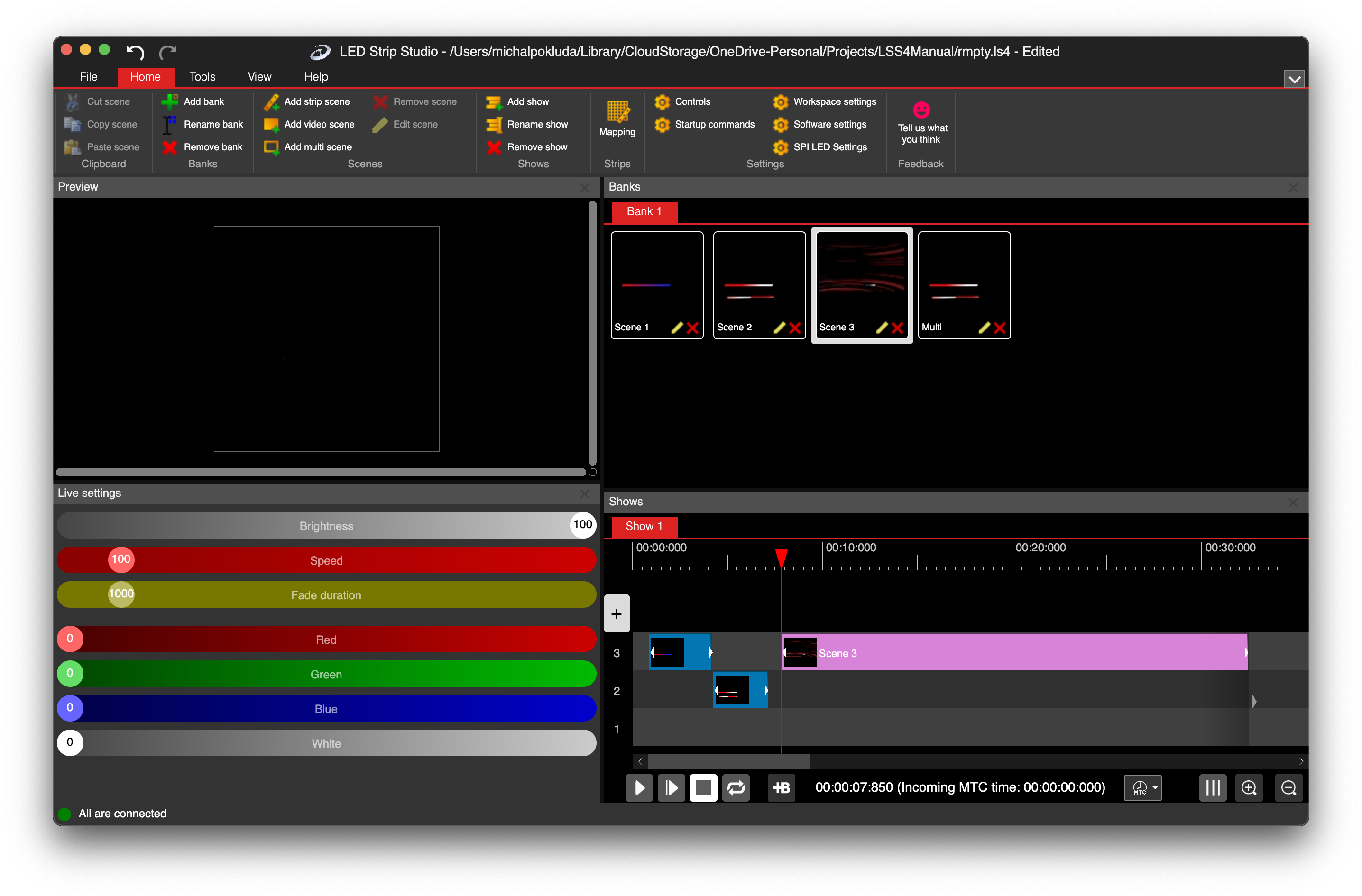
LSS4 show timeline synchronized to MIDI MTC from external device

Lock LEDs to video, audio, or your lighting console

The most common use case for MIDI MTC in LED productions is synchronization to video. When a broadcast event plays a pre-produced video segment, the LED installation needs to follow exactly. MTC from the video playback system drives LSS4, so the LED show moves in perfect step with the video — even if the video is paused mid-show or rewound for a second take.

MTC sync also appears in live concert productions where a central timecode source — typically a DAW running the backing track or click track — drives multiple departments simultaneously: audio, video, lighting, and LED. LSS4 slots into this workflow without requiring changes to the existing timecode infrastructure.

  • Sync LED show to video playback systems (QLab, VLC, broadcast playout)
  • Lock to DAW timecode in live concert productions
  • Receive MTC from Ableton Live, Pro Tools, Logic, or any MTC-sending DAW
  • Integrate with lighting consoles that output MTC
  • Broadcast and TV production sync via video playback server
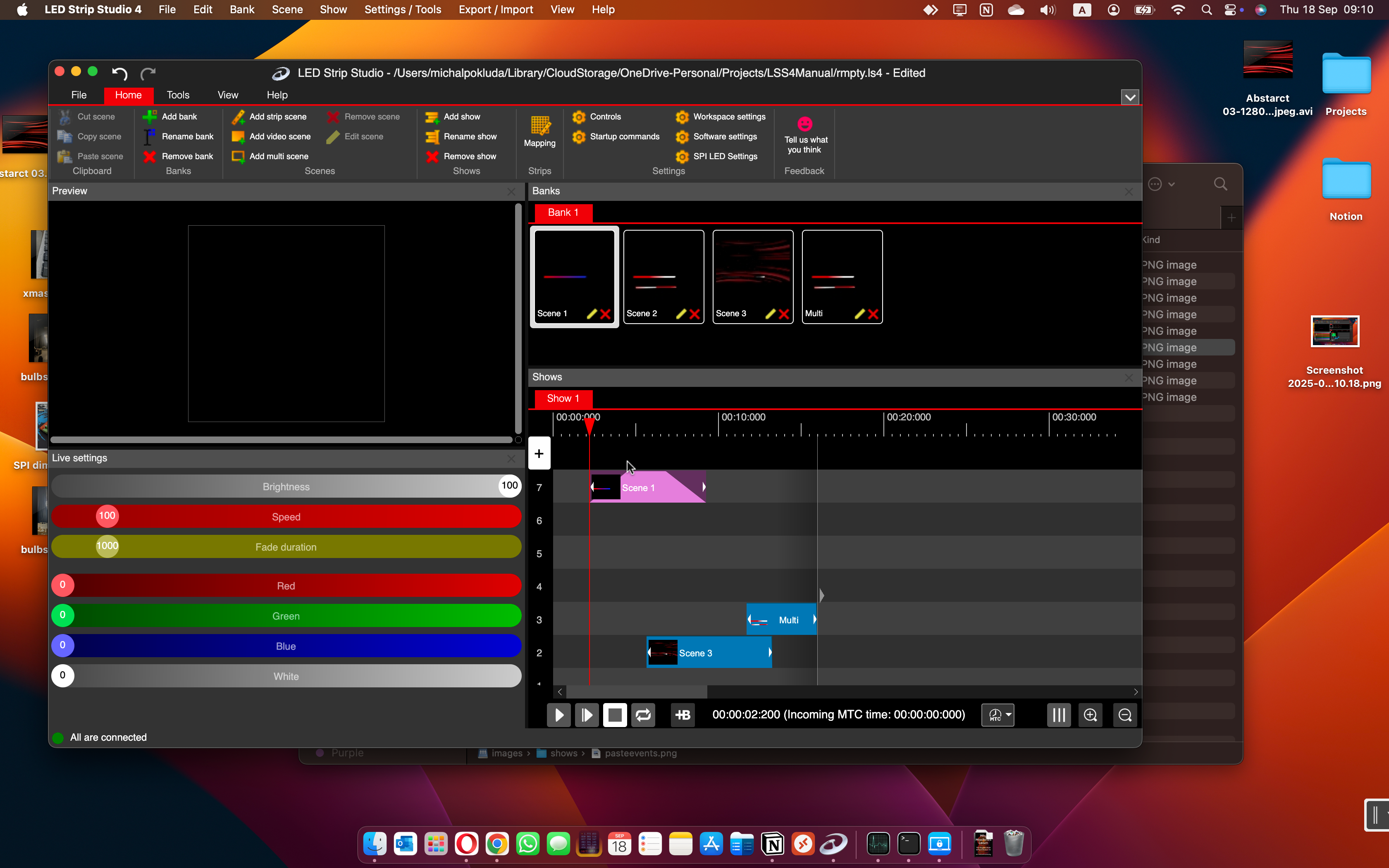
LSS4 MIDI MTC synchronization configuration for external video sync

Three ways to drive the show timeline

🕐

Internal Clock

The show runs on LSS4's internal clock. Use when LSS4 is the master timing source and no external synchronization is needed.

🎵

Music Sync

Import an audio file and the timeline is driven by its playback position. LSS4 controls playback — start, pause, stop — and the show follows.

🎛️

MIDI MTC

An external device sends MIDI Time Code. LSS4 slaves to it — the show position follows the incoming timecode, including scrubs and position jumps.

MIDI MTC questions

How do I sync my LED show to video playback with MIDI MTC?

Connect the MTC output from your video playback system to the computer running LSS4 via a MIDI interface. In LSS4, select the MIDI MTC sync mode for the show timeline and choose the MIDI input device. When the video playback system plays, it sends MTC and LSS4 follows automatically. The show will stay locked to the video position, including pauses, scrubs, and position jumps.

Which software can send MIDI MTC to LSS4?

Any software or hardware that outputs MIDI Time Code can be used as a master for LSS4. Common sources include QLab (frequently used for theater and event show control), Ableton Live, Pro Tools, Logic Pro, Reaper, video playback servers, and dedicated show control systems. If your existing production software can send MTC, it can drive LSS4.

What hardware do I need to receive MIDI MTC in LSS4?

You need a MIDI interface connected to the computer running LSS4. This can be a physical MIDI-to-USB interface (for hardware MIDI connections) or a virtual MIDI port (if both the MTC source and LSS4 run on the same computer). Many audio interfaces include MIDI ports that work directly. Some show control networks also support MIDI over network, which can be bridged to a virtual MIDI port on the LSS4 machine.

Contact & Support

Real people, real answers. Choose the channel that works best for you.

📧

Email

Send us your questions, project details, or feature requests. We reply with thorough answers.

[email protected]
💬

WhatsApp

Quick questions, photos of your installation, or a live voice call — WhatsApp works for all of it.

+421 948 280 393
📹

Zoom Consultation

Book a screen-share session with the team. Walk through your project, get hands-on guidance.

Book a Call
🎧

Talk to Support

Use the contact form to describe your issue or question in detail. We follow up promptly.

Contact Us
✈️

On-Site Support

For large-scale installations — stadiums, studios, architecture — we travel worldwide to assist on-site.

[email protected]
⬇️

Download Free Trial

Try LSS4 with full features. No credit card required. Windows and macOS.

Download Now

Your LED show, locked to anything

MIDI MTC means your LEDs stay in sync with video, audio, or console timecode — no matter what the rest of the production is doing. Download LSS4 and integrate it into your workflow.