Installations
How Do You Plan Addressable LED for Shows and Public Events?
A festival stage, a town celebration and a congress gala ask the same thing of a lighting system: look different every night, without being rebuilt. Addressable LED for shows and public events answers that with pixels. Every LED carries its own colour value and is driven from software instead of from a dimmer. This article collects the numbers behind three real builds: a touring mobile stage, a mountain stage at 2000 metres and a permanent installation in a multi-purpose venue.
It is written for integrators, stage builders, event technicians and rental companies who specify pixel systems for shows, public events and celebrations. You will leave with pixel and universe limits, a temporary-versus-permanent decision table, a planning sequence and the mistakes that cost a day on site. It is the guide behind the Events & Stages category on our Solutions page.
What Is Addressable LED for Shows and Public Events?
Addressable LED for shows and public events is a lighting system in which every LED, or every small group of LEDs, holds its own colour and brightness value. The surface therefore behaves as a low-resolution screen built into the structure, not as a luminaire that only dims. One physical installation can run a calm warm wash at a village celebration and a fast reactive show at a festival, with no hardware change at all.
That flexibility is the entire commercial argument. Event structures are used by different clients every weekend, and each one wants a different look from the same steel.
A decorative LED strip repeats one state along its whole length. An addressable strip receives per-pixel data and can display movement, gradients, logos or video across the structure.
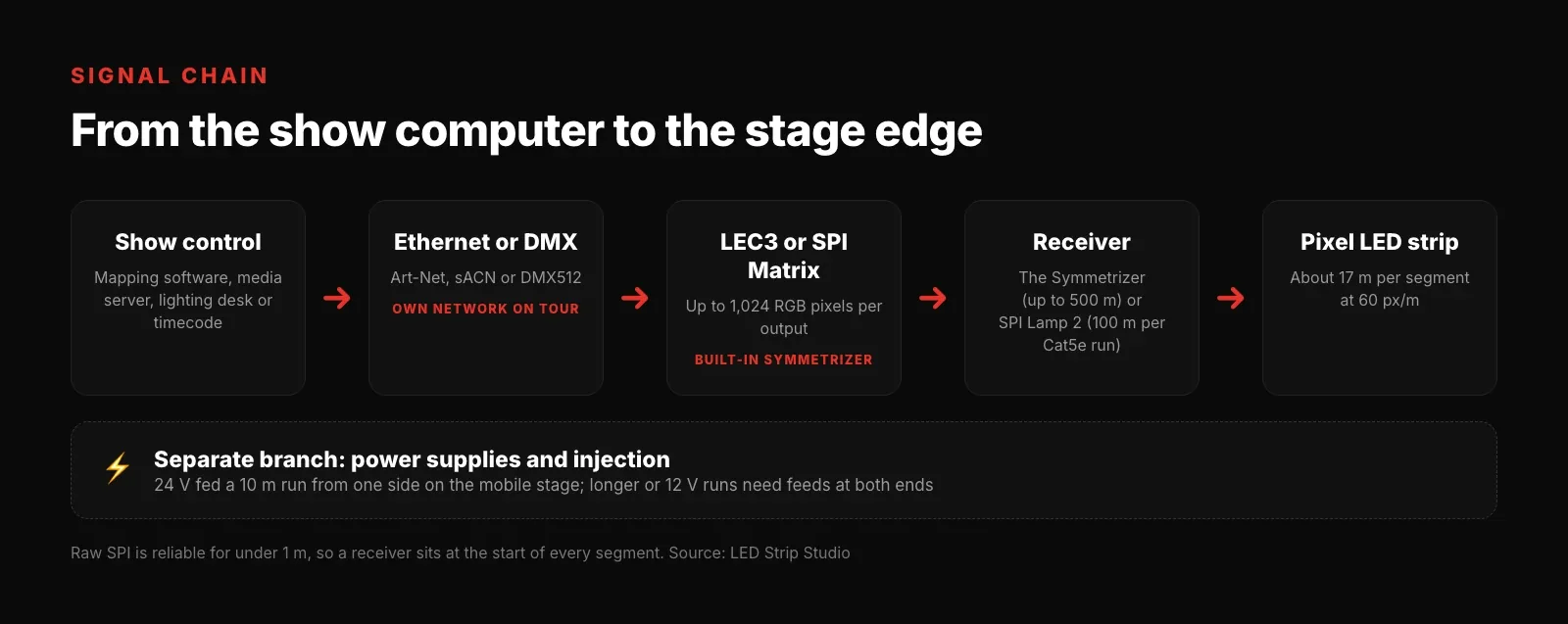
The difference shows up in the control chain, not in the strip. Between the computer and the LEDs sit mapping software, a pixel LED controller, power supplies and a large number of hand-made connections.
Shows, public events and celebrations split into three build types. Touring and rental rigs travel and are rebuilt constantly, permanent outdoor stages stay outside all year, and permanent venue installations live inside architecture and serve whoever hires the hall. Each type changes the specification more than the effect does, and the comparison table further down sets the three side by side.
Which Numbers Decide the Whole Design?
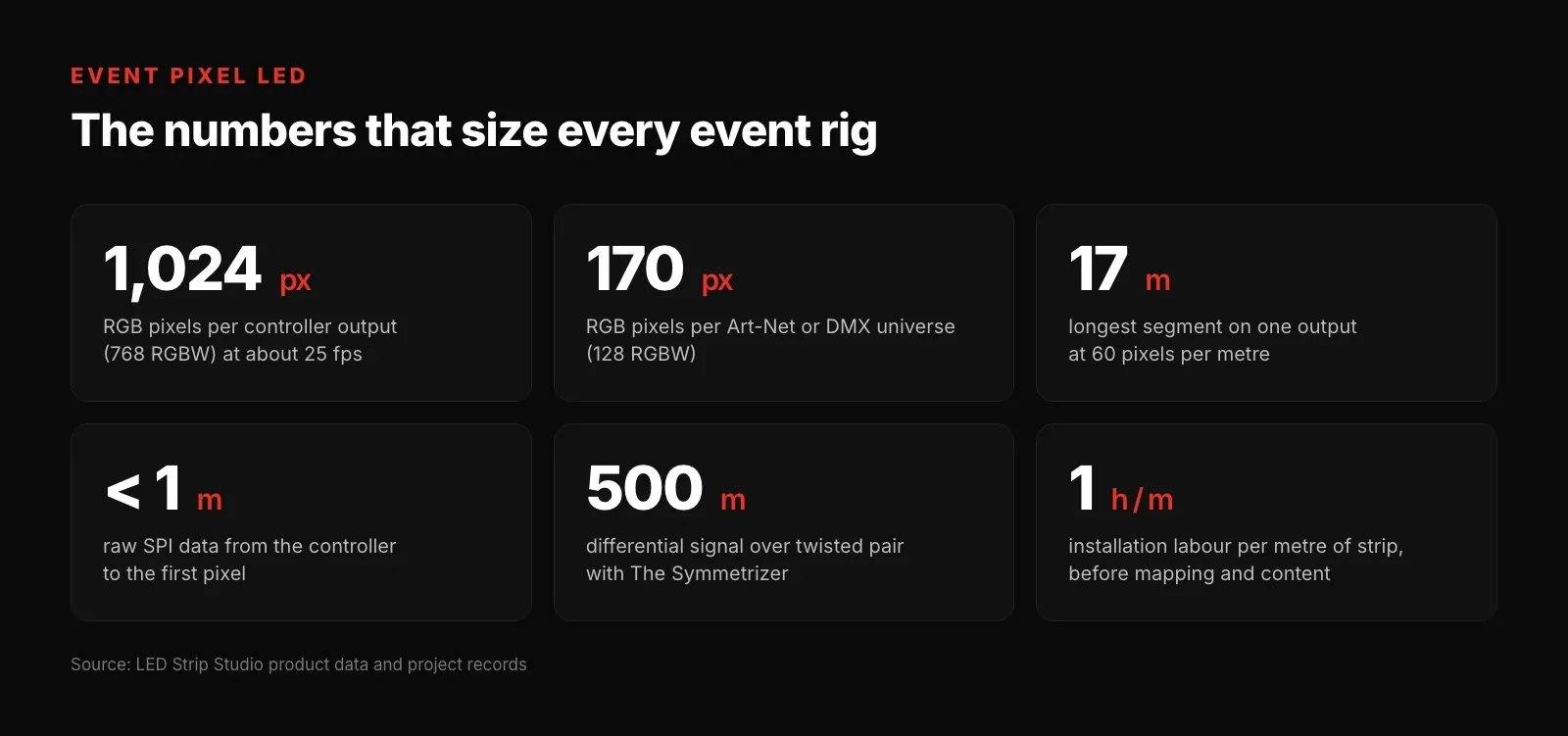
Four figures constrain almost every event pixel project: pixels per output, pixels per universe, metres per segment and hours per metre. Get these wrong at quotation stage and the build cannot be fixed on site.
 Source: LED Strip Studio
How Many Pixels Fit on One Output and One Universe?
One output of an LEC3 or an SPI Matrix Art-Net to SPI decoder drives up to 1,024 RGB or 768 RGBW pixels. At that load the output still holds about 25 frames per second. One Art-Net or DMX universe is a separate limit: 512 channels, which is 170 RGB pixels or 128 RGBW pixels.
The two limits are not interchangeable. The output limit decides how the cable is split; the universe limit decides the licence and the patch.
| Limit | RGB pixels | RGBW pixels |
|---|---|---|
| Pixels per DMX / Art-Net universe | 170 | 128 |
| Pixels per controller output | 1,024 | 768 |
| Pixels carried by 6 universes | 1,020 | 768 |
| Max segment at 30 px/m | 34.1 m | 25.6 m |
| Max segment at 60 px/m | 17.0 m | 12.8 m |
| Max segment at 144 px/m | 7.1 m | 5.3 m |
Over Art-Net, plan a full RGB output at 1,020 pixels, because six universes hold four pixels fewer than the output limit.
Count pixels, not LEDs. Many 12 V strips drive three LEDs with one IC, so a “60 LED/m” strip may carry only 20 pixels per metre. Our Art-Net universe calculator does the rounding per output, which is where most licence mistakes happen.
How Far Can the Signal Travel on an Event Site?
A raw SPI data line is reliable for under 1 m from controller to first pixel. On an event site that is nothing, because the controller usually sits in a rack and the first pixel sits on the structure.
Converting the data to a differential signal solves it. The Symmetrizer carries the signal up to 500 m over twisted pair, and SPI Lamp 2 carries it 100 m per standard Cat5e run. Both LEC3 and SPI Matrix already contain the transmitting side, so only a receiver is needed at each segment start. The full calculation is in our guide to sending an SPI signal over long distance.
How Much Labour Does One Metre of Strip Really Cost?
Our working rule of thumb is one hour of work per one metre of installed strip. That covers placing, cutting, soldering and powering, and it excludes mapping and content entirely.
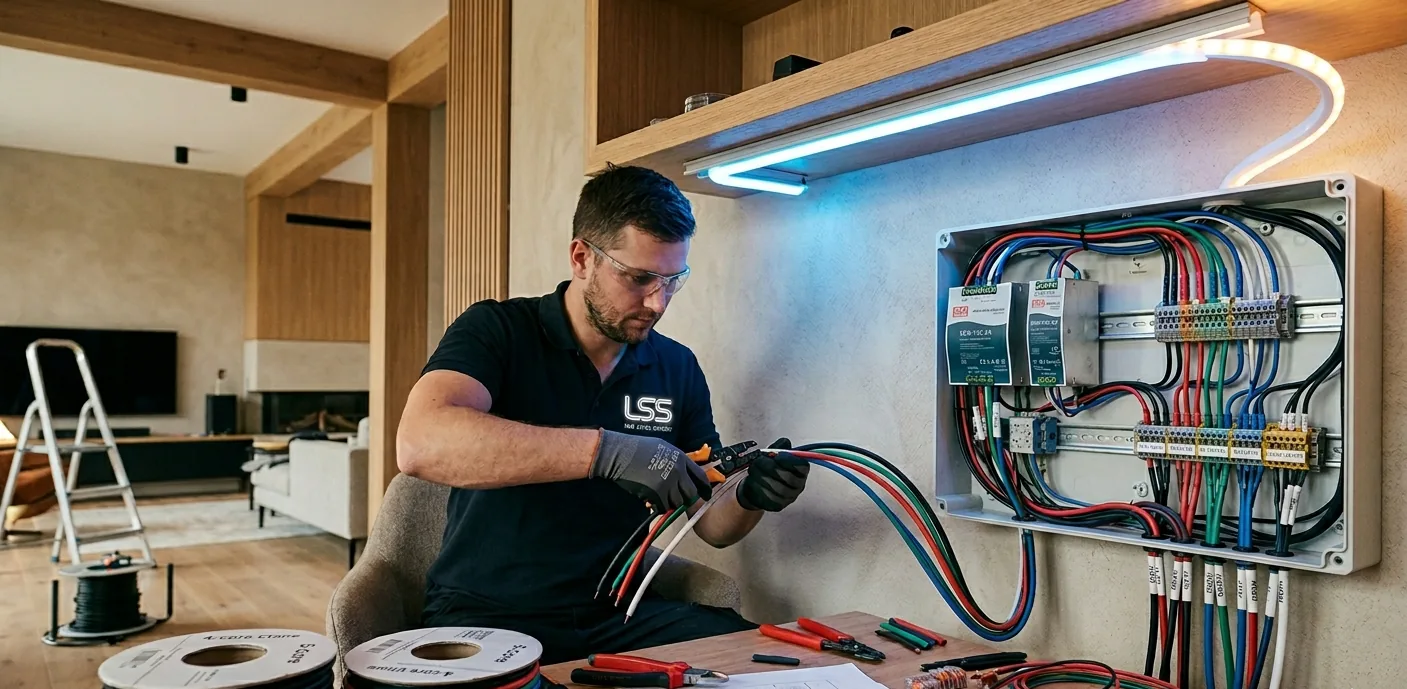
Two details drive that hour. Strips are cut into segments of roughly two metres and every cut is soldered by hand, because the current is too high for quick connectors. Long runs also need power injection at both ends, or the far end reads visibly dimmer. The full cost breakdown is in our article on what a pixel LED installation really costs.
 Source: LED Strip Studio
Which Hardware Does an Event Pixel System Need?
Every event rig is built from four layers: the light source, the mechanical carrier, the controller and the control interface. The controller is the layer that defines everything else. Refresh rate, colour depth and pixels per output are properties of the controller, not of the strip.
 Source: LED Strip Studio
What Does an Art-Net to SPI Controller Do?
It translates network data into the serial SPI protocol that addressable strip understands. A lighting desk, media server or mapping computer sends Art-Net or DMX over Ethernet; the controller converts it and clocks the pixels.
Controller tiers are sold by pixel and universe capacity, which is how a rig is sized in practice.
| Tier | Pixels (RGB) | Art-Net universes | LEC3 | SPI Matrix |
|---|---|---|---|---|
| LITE | 1,024 | 6 | 650 € | 300 € |
| STANDARD | 2,048 | 12 | 950 € | 450 € |
| PRO | 4,096 | 24 | 1,250 € | 600 € |
Prices are those listed on the product pages in September 2026; check them again before quoting.
Why Does Voltage Change the Whole Cabling Plan?
On the mobile stage described below, 24 V allowed up to 10 metres to be fed from a single side. At 12 V the same run would show voltage drop: dimmer ends and a colour shift toward warm on white scenes.
Feeding one side per run removed injection cabling and any structural modification to the stage frame. The exact limit depends on current draw per metre and conductor cross-section, so it must be recalculated for every strip type.
Why Do Aluminium Profiles Matter on a Structure That Travels?
An aluminium profile is the mechanical carrier, and on a transported structure it is also the protection. Depth is the variable worth arguing about: a deeper profile adds weight, catches on covers and is visible from the audience.
COB strip combined with a milky diffuser removes the roughly 3 cm depth normally needed to blend individual LED dots. That is what lets a touring rig use an ultra-thin profile and still show a continuous line of light. For rental work that should skip soldering altogether, ProfiLED packs waterproof pixel bars and a controller into one plug-and-play kit.
Case Studies: Three Events, Three Very Different Builds
The three projects below show addressable LED for shows and public events at three very different scales. They use the same technology and almost none of the same decisions. Comparable builds are collected on our Our Work page.
| Mobile stage | Alpine outdoor stage | Congress hall | |
|---|---|---|---|
| Use | Different venue every weekend | Permanent, summer shows | Multi-purpose venue, hired out |
| Strip | 30 m COB, 20 px/m, 24 V | 250 m, 60 px/m, 12 V | Two windows, 31.7 × 1.25 m |
| Pixels | 600 | approx. 15,000 | 38,000 |
| Controllers | 1 × SPI Matrix | 5 × LEC3, 4096 version | 20 × SPI Matrix |
| Control | LSS Remote over own Wi-Fi | MIDI Timecode, Front of House | DMX from third-party software |
| Installation | 1 day on site | Summer 2024, on-site time not recorded | 6 weeks, 3 people |
How Was a Touring Mobile Stage Lit With 600 Pixels?
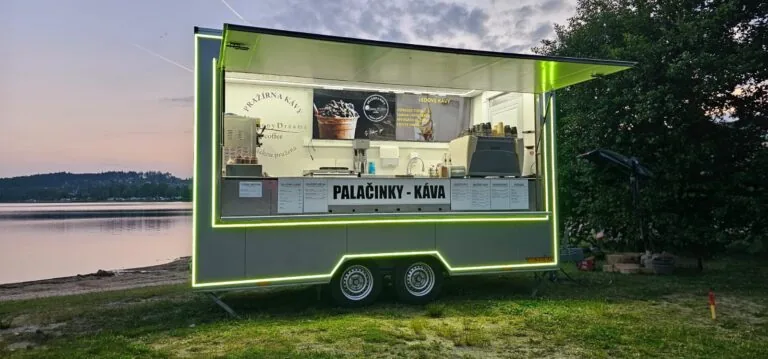
A towable stage plays a drum and bass festival on Friday and a village dance on Saturday. It carries 30 metres of COB strip at 20 pixels per metre, which gives 600 addressable pixels on a single SPI Matrix. The strip sits in an ultra-thin profile with a milky diffuser.
The brief was to attract attention without reading as a cheap disco: no strobes, no flashing. Preparation took several months; the physical installation took one day. That ratio is normal, and it is why the rig arrives pre-wired and pre-mapped. The full build is described in our article on mobile LED lighting for events.
 Source: LED Strip Studio
What Changes on an Outdoor Stage at 2000 Metres?
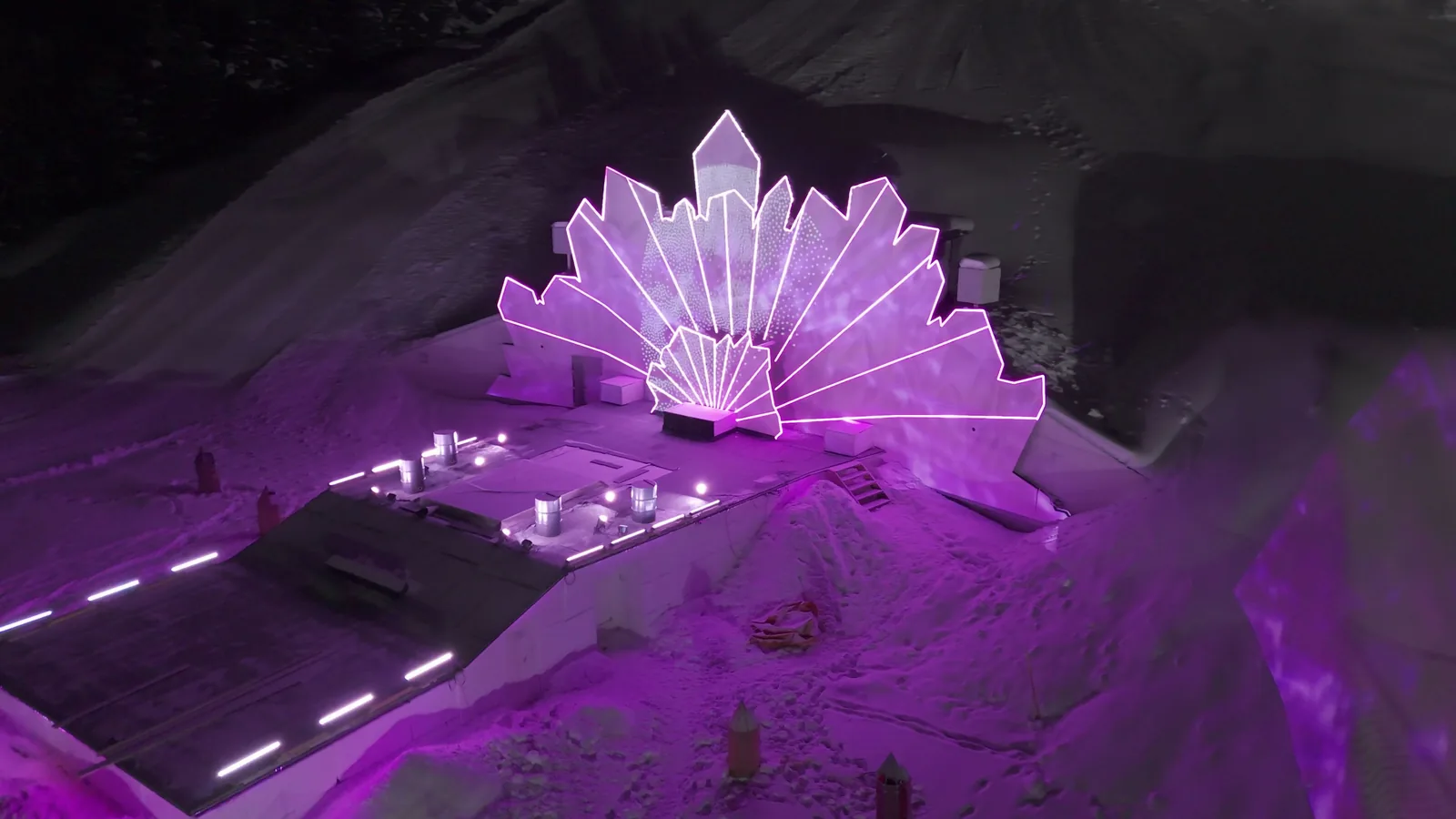
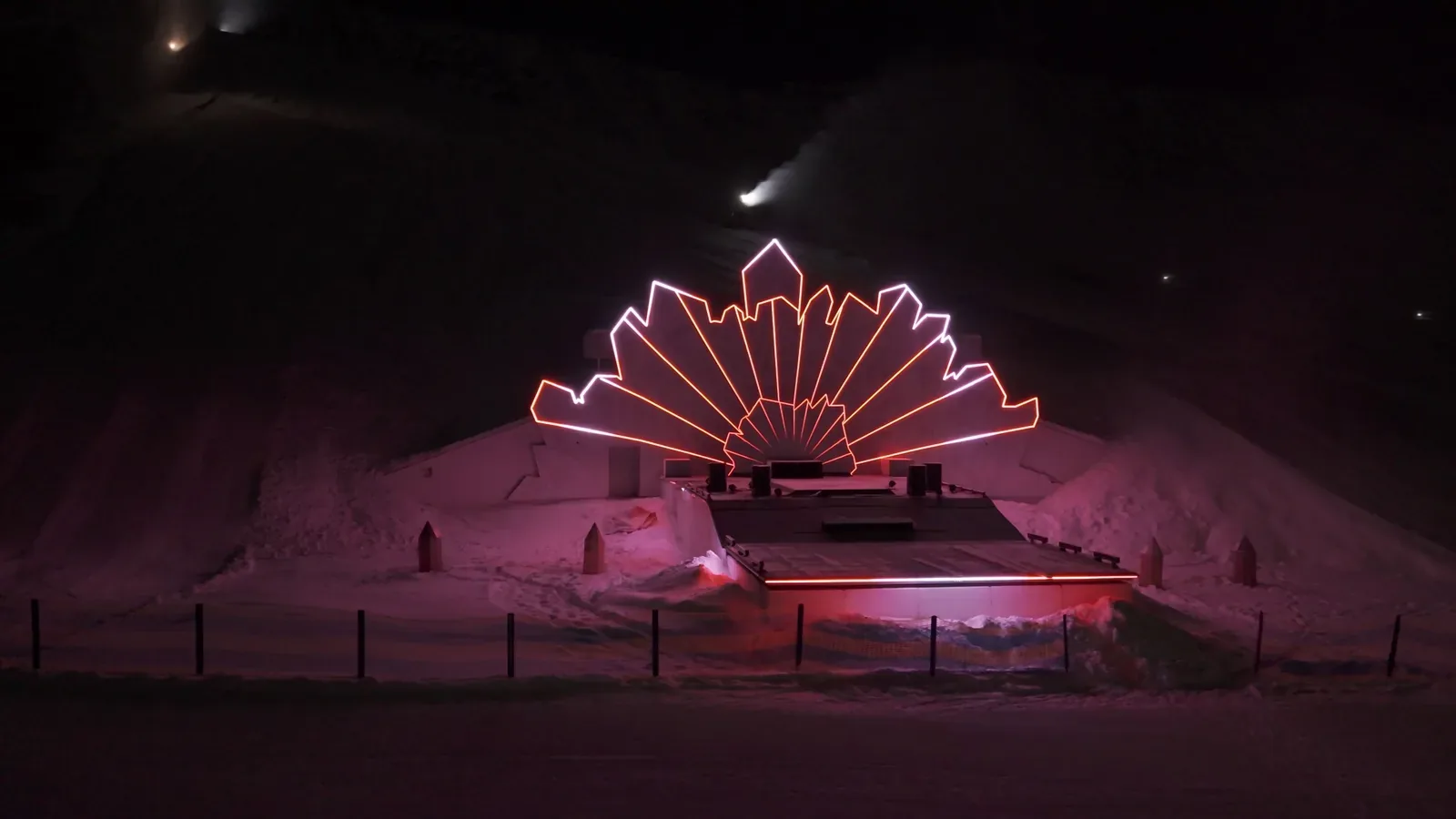
A stage in the Serfaus-Fiss-Ladis ski resort in Austria runs a nightly summer show and then sits in a snowfield all winter. It uses 250 metres of 12 V strip at 60 pixels per metre, roughly 15,000 pixels, across five LED Ethernet Controller 3 units in the 4096-pixel version.
Cold was handled mechanically, not optically. Strips arrived sealed in plastic tubes and were hidden inside aluminium profiles. Controllers and power supplies went into IP-rated enclosures with sub-zero-rated components.
Five controllers give a ceiling of 20,480 pixels, so the system was specified with about 25 % headroom. That margin matters on a mountain, because adding a sixth unit later means a lift and a weather window. See building an outdoor pixel LED stage in freezing cold.
 Source: LED Strip Studio
How Do 38,000 Pixels Work in a Multi-Purpose Venue?
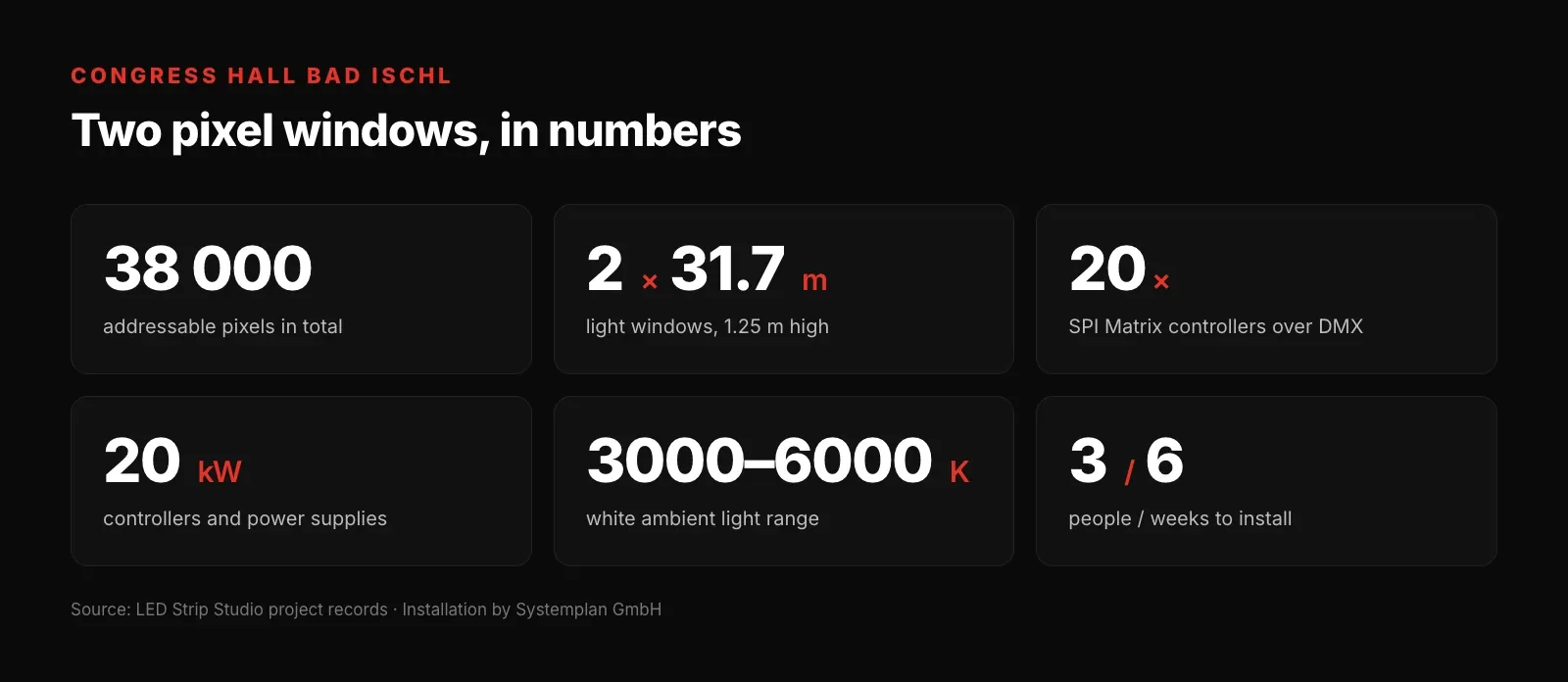
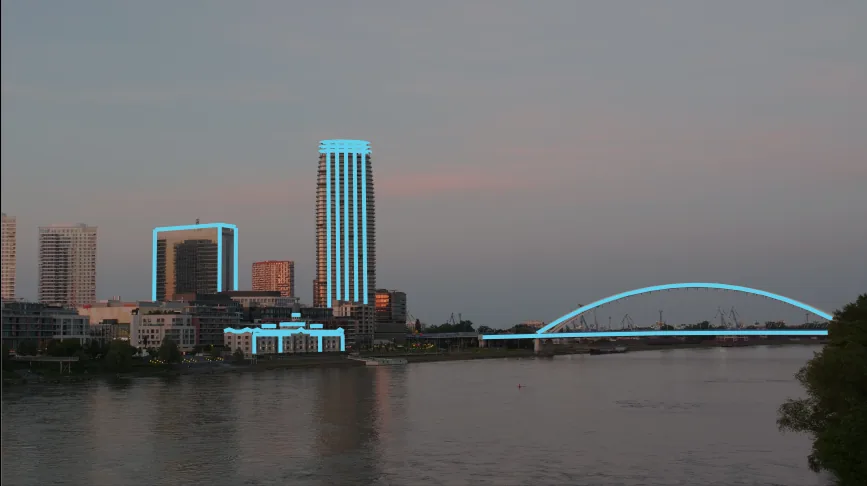
The rebuilt congress hall in Bad Ischl, Austria, holds two illuminated windows of 31.7 × 1.25 metres. They carry 38,000 pixels in total, driven by 20 SPI Matrix controllers over DMX. All controllers and power supplies together draw 20 kW.
The venue argument is the interesting one. Every mode is controllable over DMX, so a visiting production can drive the windows from its own media server or desk without learning a new system. The same surface also produces white ambient light from 3000 K to 6000 K for conferences and receptions. Three people needed six weeks to build it, as described in the Bad Ischl congress hall case study.
 Source: LED Strip Studio
Temporary or Permanent: Which Build Type Fits Your Event?
Addressable LED for shows and public events is built in three ways, and the decision is made by how often the structure moves and who operates it. Audience size has almost nothing to do with it.
| Criterion | Touring / rental rig | Permanent outdoor stage | Permanent venue installation |
|---|---|---|---|
| Priority | Set-up speed, repeatability | Weather and cold survival | Integration with architecture |
| Network | Its own Wi-Fi access point | Cabled Ethernet to Front of House | DMX open to visiting desks |
| Typical operator | Non-technical crew on site | Automated show, no operator | In-house team plus visiting productions |
| Control interface | Mobile app, saved scenes | Timecode-triggered show | DMX from any third-party desk |
| Protection | Transport vibration, handling | IP enclosures, sub-zero components | Hidden strips, service access |
| Spare capacity | Low, because it can be re-rigged | High, because access is expensive | Medium, because the cavity closes after fit-out |
| Biggest risk | Depending on venue Wi-Fi | Water at every cable entry | Power and heat treated as a detail |
A touring rig should also carry its own network. A rig that depends on the venue’s Wi-Fi will fail at the venue that has none, and that venue always appears eventually.
The mobile stage above carries a small Wi-Fi router configured as a standalone access point. Operators open LSS Remote on a phone and recall saved scenes, with no venue Wi-Fi, no SIM card and no laptop.
How Do You Plan an Event Pixel System Step by Step?
The sequence below is the one we follow when we specify addressable LED for shows and public events. Each step exists because skipping it costs a day on site.
- Define the scenes first. Decide what the structure should look like for each event type before choosing any product.
- Measure the carrier. Profile runs are cut to the structure, so frame dimensions drive the strip layout.
- Choose voltage and run length together. 24 V with a 10 m one-sided feed is a design decision, not a detail.
- Count pixels, then universes. Round up per output, not per project, or the licence turns out too small.
- Size the controller with headroom. On structures that are hard to reach, plan roughly 25 % spare capacity.
- Plan the signal distance. Anything beyond 1 m of raw SPI needs a buffer, a symmetrizer or SPI Lamp 2.
- Build the pixel map. Place every segment in LED Strip Studio mapping software where it physically sits.
- Programme and name the scenes. Operators recall scenes; they should never build them at an event.
- Test the rig fully assembled, including the access point or the timecode source.
 Source: LED Strip Studio
Why Does Mapping Take Longer Than Expected?
Because the software has no idea where the strips physically are. After installation, every segment must be placed in the map exactly where it sits on the structure, or the picture will not land on the build.
The work resembles drawing in a vector editor. A rectangle is trivial to map; a truss arch, a set of crystals or a curved stage edge is not.
How Do You Trigger and Synchronise a Show?
Three control models cover almost every event: live playback from software, timecode-triggered playback, and stand-alone playback from the controller’s SD card. The choice depends on who is present on the night. When several controllers must play as one show, they synchronise over Ethernet or DMX, as explained in our multi-device synchronization guide.
What Does MIDI Timecode Do on an Event Stage?
It gives every element of the show one shared clock. On the Serfaus stage, LED cues are triggered automatically against that clock. The stage, the dancers, the performers in LED suits and the drone show all land on the same beat.
The practical consequence is repeatability. The lighting show runs identically every night, with no operator chasing it.
When Should DMX Trigger Stored Effects Instead?
When a lighting desk already runs every other fixture in the venue. Since firmware 3.54, a DMX signal can trigger effects stored on the controller’s SD card instead of streaming pixel data in real time.
The desk sends a cue and the controller does the rendering, so the line carries only a handful of control channels. Firmware 3.55 added explicit roles: one device in the chain is the Master and receives the trigger on its DMX IN, and the rest follow as Slaves. Our guide to triggering LED effects with DMX covers the setup.
Who Operates the Rig on the Night?
Usually someone who is not a lighting technician. That is the argument for an LED controller mobile app: it recalls effects already stored on the SD card and changes effect, speed and brightness.
It is a recall interface, not a design tool. Whatever is not on the card cannot be selected on the phone, which is exactly why scene programming belongs to the design phase.
Why Does Content Decide How the Show Actually Looks?
Because the hardware only plays what someone made. In addressable LED for shows and public events, content is the item most often left out of the budget, and its absence is visible from the first row.
We have an 80 m² curved installation in Slovakia that has been running the same single video for eight years, because no budget was allocated to a content designer. The equivalent on a stage is a pixel rig driven with one flat colour on every segment. A simple fade travelling along the stage edge would already look better.
An event rig needs fewer scenes than people expect, but they have to be named ones. Three complete shows were pre-programmed for the Serfaus stage before handover, together with a library of additional effects the venue can pull from later.
For a rental rig, one scene per event type is a realistic starting point: warm wash, colour show, brand colours, and a static look for speeches. Add to the card between seasons, not on the night.
Which Mistakes Ruin Addressable LED at Public Events?
When addressable LED for shows and public events disappoints, the cause is rarely a hardware fault. It is almost always a decision made before the first metre of profile was cut.
- Budgeting the strip and not the hours. Labour dominates, at roughly one hour per metre of installed strip.
- Buying hardware before defining scenes. The component list should be an output of the design, never its starting point.
- Ignoring the universe limit. 170 RGB pixels fill one universe, and rounding happens per output.
- Running raw SPI data across the structure. Beyond 1 m, convert to a differential signal.
- Feeding a long 12 V run from one end. Voltage drop appears as dim ends and a colour shift, usually only once assembled. Long 12 V runs such as the Serfaus stage work because power is injected along them.
- Depending on venue Wi-Fi. A touring rig needs to carry its own network.
- Specifying zero headroom. On a mountain or in a closed cavity, expansion costs a lift or a rebuild.
- Leaving content out of the scope. Nobody is contracted to produce the video, so the rig runs one clip forever.
Planning pixel lighting for a stage, a festival or a public celebration? Book a free consultation and we will size the control chain around your structure.
Sources & references
- LED Strip Studio — Mobile LED lighting for events: 30 m COB, 600 pixels, 24 V, own access point
- LED Strip Studio — Outdoor pixel LED stage in freezing cold: Serfaus-Fiss-Ladis, summer 2024, 2000 m a.s.l.
- LED Strip Studio — Congress hall LED lighting: Bad Ischl, 38,000 pixels, 20 × SPI Matrix
- Systemplan GmbH, Germany — project partner in Bad Ischl, installation time (3 people, 6 weeks)
- LED Strip Studio — LEC3 and SPI Matrix product pages: tiers, universes, 1,024 RGB / 768 RGBW pixels per output
- LED Strip Studio — The Symmetrizer and SPI Lamp 2 product pages: differential signal, 500 m and 100 m
- LED Strip Studio — DMX trigger in firmware 3.54 and 3.55: SD card effects, Master and Slave roles
- Lighting Controls Podcast — interview with the founder of LED Strip Studio: labour rule of thumb, content budgets
- ESTA — ANSI E1.11 DMX512-A: 512 channels per universe
- Artistic Licence — Art-Net 4 specification
Summary
Addressable LED for shows and public events gives every pixel its own colour value, so one structure covers every event type without rewiring. Four numbers size the project: 1,024 RGB pixels per controller output, 170 RGB pixels per universe, about 17 m per segment at 60 px/m, and roughly one hour of labour per metre of strip. Touring rigs need their own network and fast set-up, permanent outdoor stages need cold and water protection plus spare capacity, and venue installations need DMX access for visiting productions. Three real builds show the range: 600 pixels on a mobile stage, about 15,000 pixels at 2000 m in Austria and 38,000 pixels in the Bad Ischl congress hall. Content is the line item most often forgotten, and a rig with no scenes runs one clip forever.