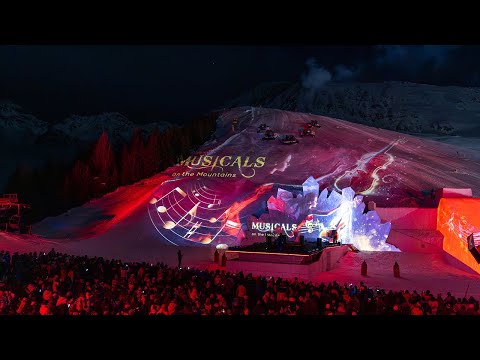
Installations
How Do You Build an Outdoor Pixel LED Stage in Freezing Cold?
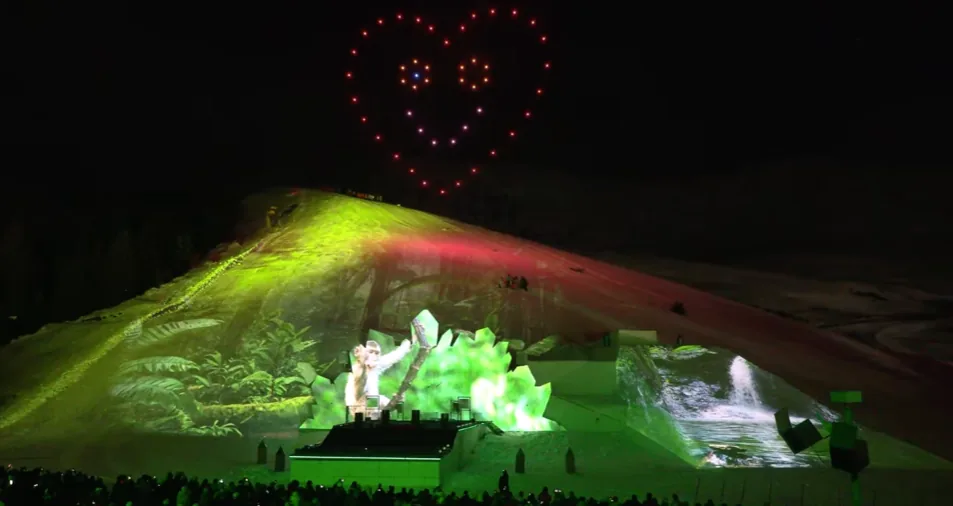
An outdoor pixel LED stage at 2000 metres has to survive two very different jobs. In summer it runs a nightly show for a paying audience. In winter it sits in a snowfield at temperatures far below freezing, with nobody on site. This article uses one such installation — a mountain stage in the Serfaus-Fiss-Ladis ski resort in Austria — to explain what changes when addressable LED leaves a heated venue.
It is written for event technicians, stage builders and integrators who are quoting a permanent outdoor pixel installation and need to know where the real risks sit.
What Is an Outdoor Pixel LED Stage?
An outdoor pixel LED stage is a permanent addressable LED installation built into stage architecture and left outside all year. Every component must therefore tolerate weather, UV and wide temperature swings while staying individually controllable. The word permanent is what separates it from touring rigs. Nothing gets packed away after the show, and nothing gets inspected between seasons.
In a pixel system each LED, or each small group of LEDs, carries its own colour and brightness value. That is why a stage outline can act as a slow ambient edge on one cue and a fast chase on the next, with no change to the hardware.
The second defining trait is remote operation. Mountain stages are rarely staffed outside event nights, so control, triggering and diagnostics all have to reach the structure over a network rather than by hand.
Which Hardware Does a 2000 m Alpine Stage Need?
The Serfaus build used five LED Ethernet Controller 3 units in the 4096-pixel version, all feeding into a network switch that runs back to Front of House. That single decision — Ethernet rather than local SPI runs — is what makes a structure this size operable from a control position hundreds of metres away.
- 5× LED Ethernet Controller 3, 4096-pixel version
- 250 m of addressable LED strip, 12V, 60 pixels per metre
- 200 m on the two vertical crystals, approximately 50 m on the stage section
- Aluminium profiles over strips already sealed in plastic tubes
- IP-rated electrical enclosures for all controllers and power supplies
How Many Pixels Did Five Controllers Drive?
At 60 pixels per metre, 250 metres of strip is 15,000 addressable pixels — roughly 12,000 across the two crystals and 3,000 on the stage section. Five controllers at 4096 pixels each give a ceiling of 20,480 pixels, so the system was specified with about 25% headroom. On a mountain that headroom matters more than on a ground-level venue, because adding a sixth controller later means a lift, a weather window and a crew.
Why 12V and 60 Pixels per Metre?
The 60 pixels per metre density was chosen for practical installation and to keep power injection points down. A denser strip draws more current per metre and needs feeds more often. Fewer injection points means fewer cable entries, and every cable entry on an outdoor structure is a place where water can get in.
Case Study: Serfaus-Fiss-Ladis at 2000 Metres
 Source: LED Strip Studio
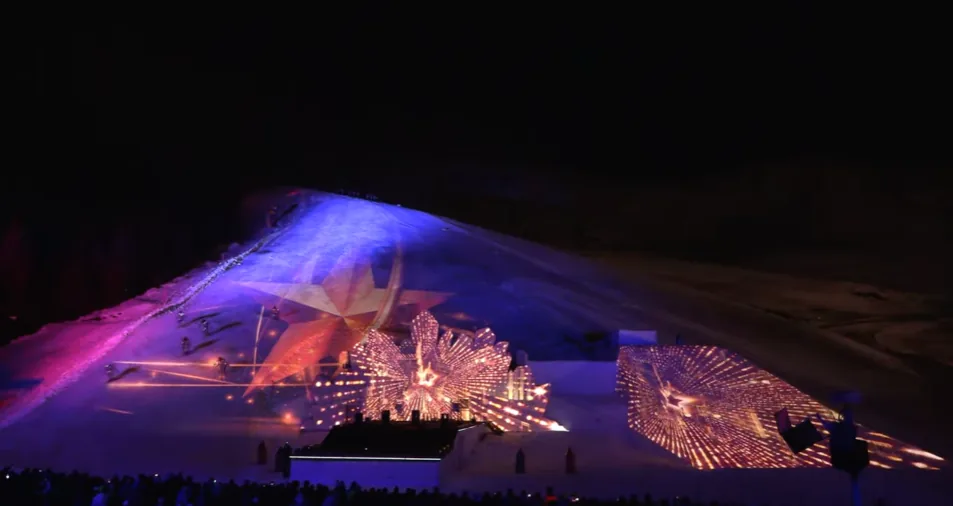
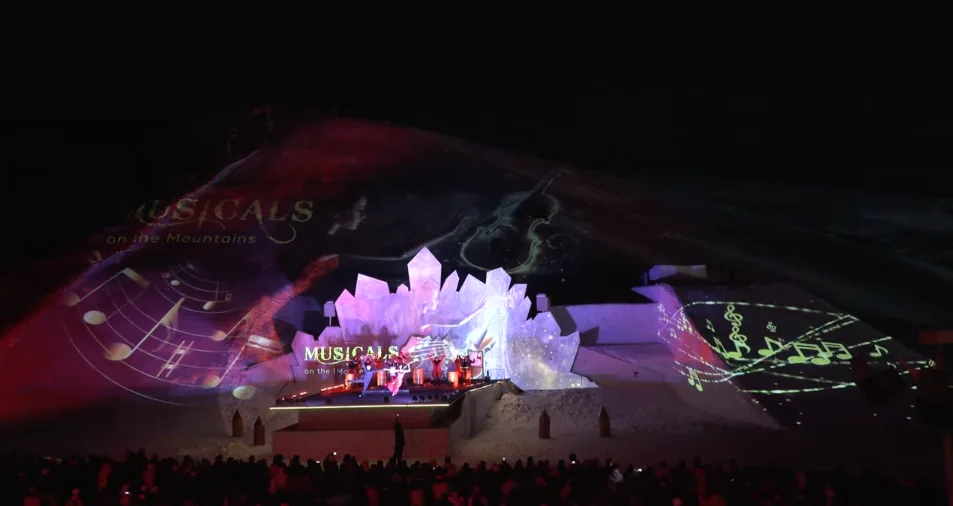
The work was carried out during summer 2024, on a stage at 2000 metres above sea level in Serfaus, part of the Serfaus-Fiss-Ladis ski resort in Austria. The stage was not new. Two vertical crystals had already been installed for projection mapping. The brief was to outline them with pixel LED, so they read as objects in their own right rather than only as projection surfaces.
The third element was the stage floor itself, which sits on hydraulic mechanisms that raise and lower it during a performance. Lighting a moving surface changes the wiring problem completely, because every cable crossing that joint has to survive repeated travel rather than a single install. Bridges and building joints raise the same problem, as described in our guide to pixel LED facade lighting.
The finished installation is used for Adventure Night – Musicals on the Mountains, where the LED stage runs alongside dancers, performers in LED suits and a drone show. How it compares with touring rigs and venue installations is covered in our guide to addressable LED for shows and public events. Comparable installations are collected in our project portfolio.
 Source: LED Strip Studio
How Do You Protect Pixel LEDs from Sub-Zero Cold?
Cold at 2000 metres was the single biggest concern on this project, and it was addressed mechanically rather than by choosing a different LED. Strips arrived already sealed in plastic tubes, and those tubes were then hidden inside aluminium profiles. Controllers and power supplies went into IP-rated electrical enclosures fitted with components rated for sub-zero operation.
| Design point | Typical indoor pixel install | Alpine outdoor stage (this build) |
|---|---|---|
| Strip protection | Bare strip or diffuser only | Strip in plastic tube, inside aluminium profile |
| Controller housing | Rack or open mounting | IP-rated electrical enclosure |
| Component rating | Room temperature | Rated for sub-zero operation |
| Winter behaviour | Powered off between events | Kept powered through freezing nights |
| Cable entries | Convenience-driven | Minimised; every entry is a water risk |
| Service access | Any time | Weather-window dependent |
Why Should You Keep LEDs Powered in Winter?
Our recommendation to the client was to keep the pixels energised through winter nights, when temperatures drop well below freezing. A powered strip dissipates a small amount of heat continuously, which keeps the assembly above ambient. Whether that margin is enough depends on the exact strip and enclosure, so treat it as an operational recommendation rather than a rated specification. The same protection applies to parks and other permanent outdoor sites, as covered in our guide to pixel LED lighting for public spaces.
How Do You Programme and Synchronise an Outdoor LED Show?
Three complete shows were pre-programmed in LED Strip Studio software before handover, together with a library of additional effects the venue can pull from later. Programming ahead of time is not a convenience on a mountain stage. It is the only realistic option, because nobody is going to build cues on site in bad weather.
What Does MIDI Timecode Actually Do Here?
MIDI Timecode gives every element of the show one shared clock. The LED cues are triggered automatically against that clock. The stage, the dancers, the LED suits and the drone show all land on the same beat, with no operator chasing them. The practical consequence is that the lighting show runs identically every night.
Which Mistakes Ruin an Outdoor Pixel LED Stage?
Most failures on permanent outdoor installations are specification decisions, not component defects. These are the ones worth checking before anything is ordered.
- Treating IP rating as the whole answer. Sealing keeps water out; it does nothing about components that are not rated for sub-zero operation.
- Specifying zero pixel headroom. Expanding a mountain installation later costs a lift and a weather window, not an afternoon.
- Running fixed cable across a moving joint. Hydraulic stage sections travel every performance, and the wiring has to be designed for that travel.
- Maximising pixel density by default. Higher density means more current per metre, more injection points and more cable entries to seal.
- Leaving programming until the site visit. Shows should be built and tested before anyone drives up the mountain.
Planning a permanent outdoor or high-altitude installation? Book a free consultation and we will specify the protection and controller layout around your structure.
Sources & References
- LED Strip Studio — original project report: Stage design for SKI resort in Austrian Alps
- LED Strip Studio — LED Ethernet Controller 3 technical specifications
- LED Strip Studio — LED Strip Studio 4 software
- Internal project records: Serfaus-Fiss-Ladis stage installation, summer 2024, 2000 m a.s.l.
Summary
An outdoor pixel LED stage stays outside all year, so cold and water protection drive the specification more than optics do. The Serfaus build at 2000 m used five LED Ethernet Controller 3 units (4096-pixel version) and 250 m of 12V strip at 60 pixels per metre — about 15,000 pixels. Strips sit in plastic tubes inside aluminium profiles; controllers sit in IP-rated enclosures with sub-zero-rated components. We recommend keeping the pixels powered through winter nights so the assembly stays above ambient temperature. Three complete shows were pre-programmed and are triggered automatically over MIDI Timecode, in sync with dancers, LED suits and a drone show.
See the Alpine Stage in Action