Installations
How Was Congress Hall LED Lighting Built With 38,000 Pixels?
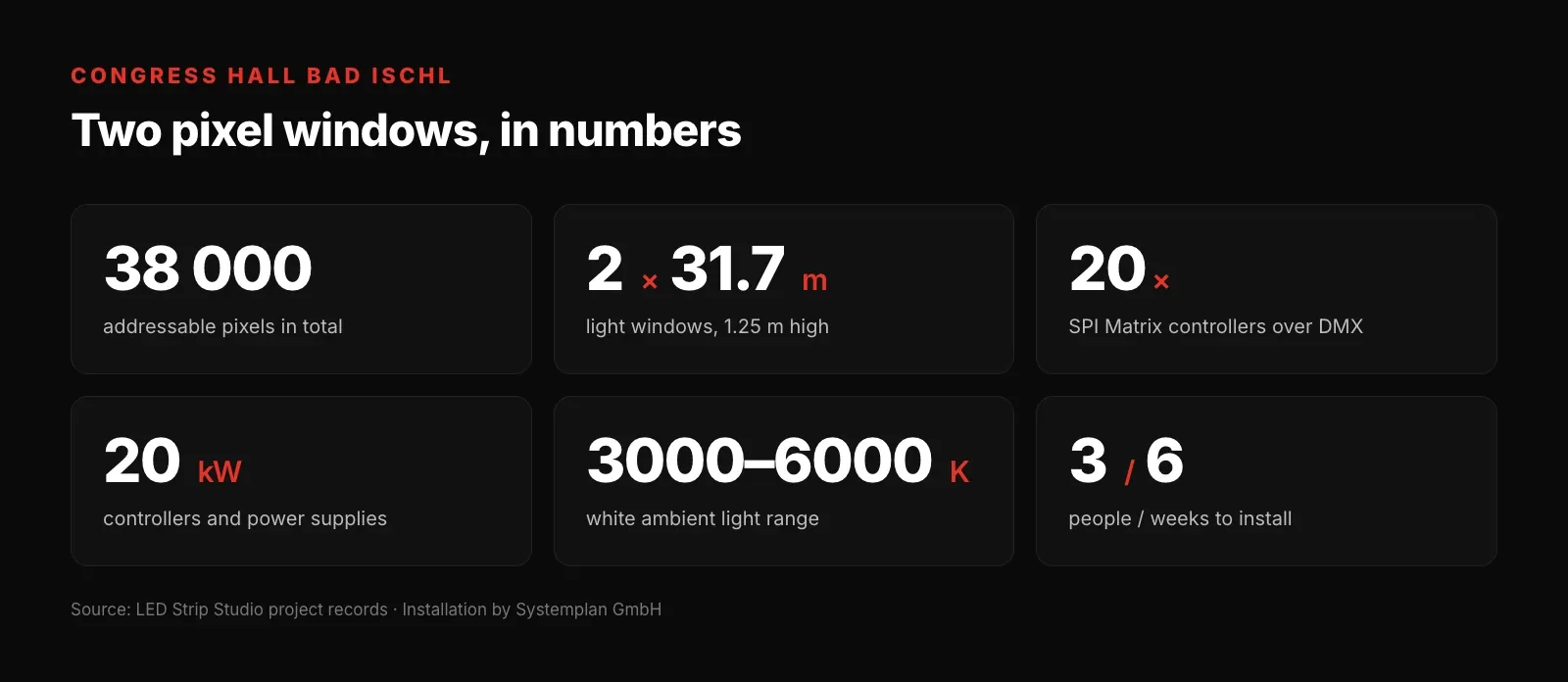
A congress hall hosts a conference in the morning, a concert in the evening and a gala at the weekend. Its lighting has to change character just as often. This case study shows how congress hall LED lighting was built into two 31.7-metre pixel windows in Bad Ischl, Austria, with 38,000 addressable pixels and 20 controllers.
It is written for integrators, venue technicians and architects who plan large pixel installations in public buildings and want real numbers for control, power and installation time.
What Is Pixel LED Lighting in a Congress Hall?
Pixel LED lighting in a congress hall is an installation in which every LED point is addressed individually, so a lit surface can show colour, text or moving images. A conventional architectural luminaire only dims or changes one colour. A pixel surface behaves like a low-resolution screen that is part of the building.
For a multi-purpose venue that difference is practical, not decorative. The same surface can carry a sponsor’s name during a conference, video during a festival programme and calm white light during a reception. Nothing is rewired between events; only the content changes.
The design challenge is to keep the technology out of sight. Visitors should notice the light, not the strips, cables and pixel LED controllers that produce it.
What Are the Key Parameters of the Bad Ischl Windows?
The installation consists of two large illuminated “windows”. Each measures 31.7 × 1.25 metres, and together they hold 38,000 pixels. The figures below come from our project records; values marked as calculated are derived by us from those records.
| Parameter | Value |
|---|---|
| Location | Congress hall, Bad Ischl, Austria |
| Context | Rebuild within the European Capital of Culture project (Bad Ischl Salzkammergut 2024) |
| Number of light windows | 2 |
| Size per window | 31.7 × 1.25 m |
| Lit area in total | 79.25 m² (calculated) |
| Pixels in total | 38,000 |
| Average pixel density | approx. 480 px/m² (calculated) |
| Controllers | 20 × SPI Matrix |
| Control protocol | DMX |
| Power consumption, controllers and power supplies | 20 kW |
| Content | Text, video, ambient colour effects |
| Ambient white range | 3000 K – 6000 K |
| Installation team | 3 people, 6 weeks |
At an average of about 480 pixels per square metre, the pitch works out to roughly 46 mm if the pixels form an even grid. That gives around 27 pixel rows across the 1.25-metre height — enough for one clear line of text.
How Much Power Do 38,000 Pixels Need?
All controllers and power supplies together draw 20 kW. Divided across 38,000 pixels, that is about 0.53 W per pixel, or roughly 250 W per square metre of lit surface. We use the same figure as a first power estimate in our guide to pixel LED facade lighting.
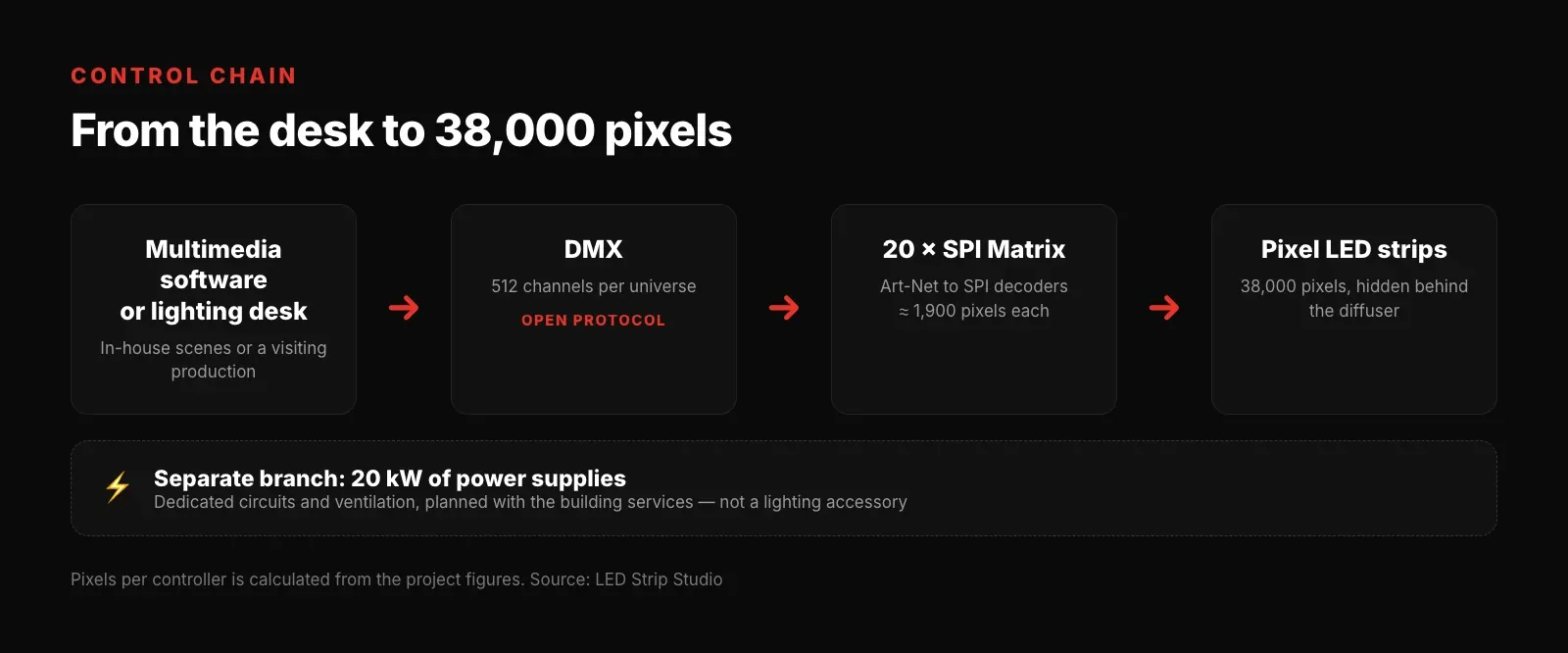
For the electrical designer, 20 kW is a building-services item, not a lighting accessory. It needs dedicated circuits, distribution planned alongside the rest of the rebuild, and ventilation for power supplies installed in an enclosed cavity.
Case Study: How Was the Congress Hall in Bad Ischl Built?
Bad Ischl and the Salzkammergut region held the title of European Capital of Culture in 2024. As part of that programme, the town rebuilt its congress hall, and the two pixel windows became one of the most visible elements of the renovated building.
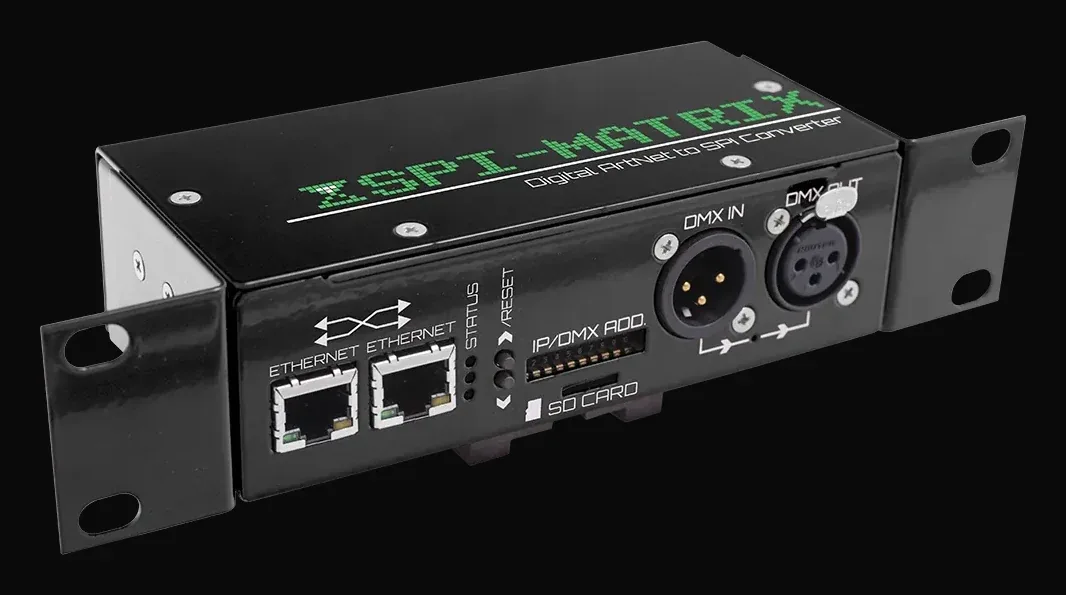
The project partner was Systemplan GmbH from Germany. LED Strip Studio supplied the control side: 20 SPI Matrix Art-Net to SPI decoders that receive DMX data and drive the pixel strips.
The windows render text, video and ambient colour effects. They also produce white ambient light anywhere between 3000 K and 6000 K, from warm evening tones to cool daylight. Every mode is controllable via DMX, so third-party multimedia software can drive the windows directly. How a venue installation differs from touring and outdoor stages is covered in our guide to addressable LED for shows and public events. More venue builds are in our project portfolio.
Why Are the LED Strips Hidden From View?
The design brief put the effect in front of the technology. The strips sit where visitors do not see them at first glance, so the windows read as glowing architecture rather than as an LED screen fixed to a wall.
That matters more in a historic spa-town venue than in a nightclub. The light should look as if it has always belonged to the building. Hiding the strips does cost planning effort: diffusion depth, service access and cable routes must be fixed before the finishing works close the cavity. Galleries, museums and cinemas face the same brief, as described in our guide to pixel LED lighting for public spaces.
How Long Did the Installation Take?
Systemplan told us that three people worked for six weeks to build the installation. That is 18 person-weeks for 38,000 pixels, or roughly 2,100 pixels per person-week.
The figure is a useful benchmark for anyone quoting a comparable job. Our article on what a pixel LED installation really costs explains why labour, not the LED strip, usually dominates the budget.
How Do You Size the Control for 38,000 Pixels?
With 20 SPI Matrix units, each controller handles on average 1,900 pixels. How many DMX universes that represents depends on the number of colour channels per pixel. One DMX universe carries 512 channels, which is 170 RGB pixels or 128 RGBW pixels.
 Source: LED Strip Studio
| Calculation | RGB pixels (3 channels) | RGBW pixels (4 channels) |
|---|---|---|
| Pixels per DMX universe | 170 | 128 |
| Channels for 38,000 pixels | 114,000 | 152,000 |
| Universes for 38,000 pixels | 224 | 297 |
| Pixels per SPI Matrix (38,000 / 20) | 1,900 | 1,900 |
| Universes per SPI Matrix | 12 | 15 |
All values in this table are calculated, and the two columns bracket the answer: RGB strips give the lower number, RGBW the higher.
Either way, the result is several hundred universes. That is far beyond one DMX line or one small controller, and it explains why the load was split across 20 units. Our guide to controlling LED strips over DMX covers universe limits and start addresses in detail.
 Source: LED Strip Studio
Why Does DMX Integration With Third-Party Software Matter?
A congress hall rarely has one operator. Event companies arrive with their own media servers and lighting desks, while the in-house team runs everyday scenes. DMX is the common language all of them already speak.
Because the windows accept DMX, a visiting production can drive them as part of its own show without learning a new system. For in-house content, pixel scenes can be prepared in LED Strip Studio pixel mapping software and recalled whenever the hall is not hired out.
Which Mistakes Should Venue LED Projects Avoid?
Large pixel projects in public buildings fail for predictable reasons, most of them decided long before commissioning.
- Treating 20 kW as a lighting detail. Power distribution and heat need their own design, coordinated with the building services engineer.
- Choosing a controller before counting universes. Several hundred universes need a distributed control chain, not one large box.
- Leaving the strips visible. In a representative venue, exposed hardware undermines the architecture it was meant to highlight.
- Locking the system to one software. Without DMX access, every visiting production depends on the in-house operator.
- Underestimating installation time. Three people needed six weeks here, so book the slot in the construction schedule early.
Planning pixel lighting for a venue or public building? Book a free consultation and we will size the control chain with you.
Summary
The rebuilt congress hall in Bad Ischl carries two illuminated windows of 31.7 × 1.25 metres holding 38,000 addressable pixels between them. Twenty SPI Matrix controllers drive the installation over DMX, roughly 1,900 pixels each, and all controllers and power supplies together draw 20 kW — about 0.53 W per pixel. The windows render text, video and ambient colour, plus white light anywhere from 3000 K to 6000 K, with the strips hidden from view so the surfaces read as architecture rather than as a screen. Because every mode is reachable over DMX, a visiting production can drive the hall from its own desk. Three people from Systemplan GmbH built it in six weeks.