Installations
How Do You Plan Pixel LED Lighting for Public Spaces?
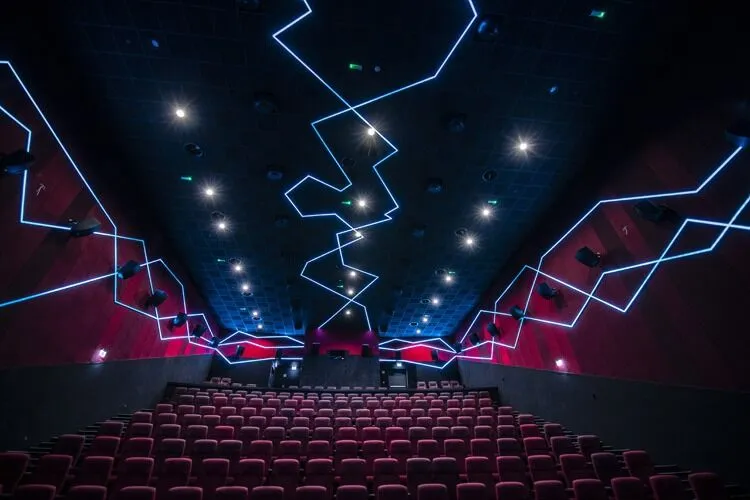
A gallery, a cinema, a museum and a park share one lighting problem. The light has to work for people who did not come to look at the light. Pixel LED lighting for public spaces answers that, because it turns illumination into programmable content instead of a fixed fitting.
This article is written for facility managers, municipalities and architects deciding whether an addressable system belongs in a public building or a park. It covers what such a system needs in control, protection and daily operation, not what it looks like in a render.
What Is Pixel LED Lighting for Public Spaces?
Pixel LED lighting for public spaces is architectural lighting in which every LED, or every small group of LEDs, has its own address. The light can therefore carry colour, gradients and slow motion as content, where a conventional luminaire can only be dimmed or switched to one colour.
For a building that serves the public, that means one installation with many jobs. A quiet weekday, a school visit, a temporary exhibition and a municipal celebration all use the same fixtures; only the scene is different.
Public buildings also have an audience that returns. Light that feels novel on the first visit becomes noise on the tenth, so restraint is part of the specification. On a showroom facade we lit for a numismatic auction house, transitions were kept deliberately subtle so the building reads as ambience rather than as a display.
Typical places for a pixel layer in a public building or park:
- Facades and entrances, the part of the building visible after closing time
- Foyers, staircases and circulation areas, where people wait
- Exhibition niches, plinths and showcase edges, as accent light within conservation limits
- Auditoria and aisles, as orientation light that must disappear on cue
- Paths, water features and structures in parks and public gardens
Which Parameters Change Between a Gallery, a Cinema and a Park?
The technology is the same in a gallery, a cinema and a park. What changes is the constraint that decides the specification, and it is rarely the one the client mentions first.
| Requirement | Gallery / museum | Cinema | Park / public outdoor |
|---|---|---|---|
| Primary constraint | Conservation limits on exhibits | No stray light on the screen | Weather, vandalism, remote access |
| Typical position | Coves, niches, showcase edges | Foyer, aisles, ceiling coves | Paths, trees, water, structures |
| Protection | Indoor, no ingress rating needed | Indoor, no ingress rating needed | Sealed strip in a tube inside an aluminium profile |
| Control trigger | Opening hours, curator scene | Projection automation cue over DMX | Schedule or external time switch |
| Day-to-day operator | Gallery staff with a phone or tablet | Projectionist or automation system | Municipal maintenance, remotely |
| Scene changes | Per exhibition | Per programme block | Per season or event |
| Service access | Any time outside opening hours | Between screenings | Weather and lift dependent |
Why Do Museums and Galleries Limit Light on Exhibits?
Light damages sensitive material cumulatively, and the damage cannot be reversed. Conservation practice therefore caps both illuminance and annual exposure. CIE 157:2004 recommends at most 50 lux for light-sensitive materials such as textiles, watercolours and photographs, and 200 lux for low-sensitivity materials such as oil paintings.
In these buildings, addressable pixel strip usually provides architectural and wayfinding light, not light on the artefact itself. Keep the pixel layer on the architecture and leave the object to dedicated museum optics. Where a pixel line does sit near an exhibit, agree the limit with the conservator and measure it at the object surface.
What Changes When the Installation Moves Outdoors?
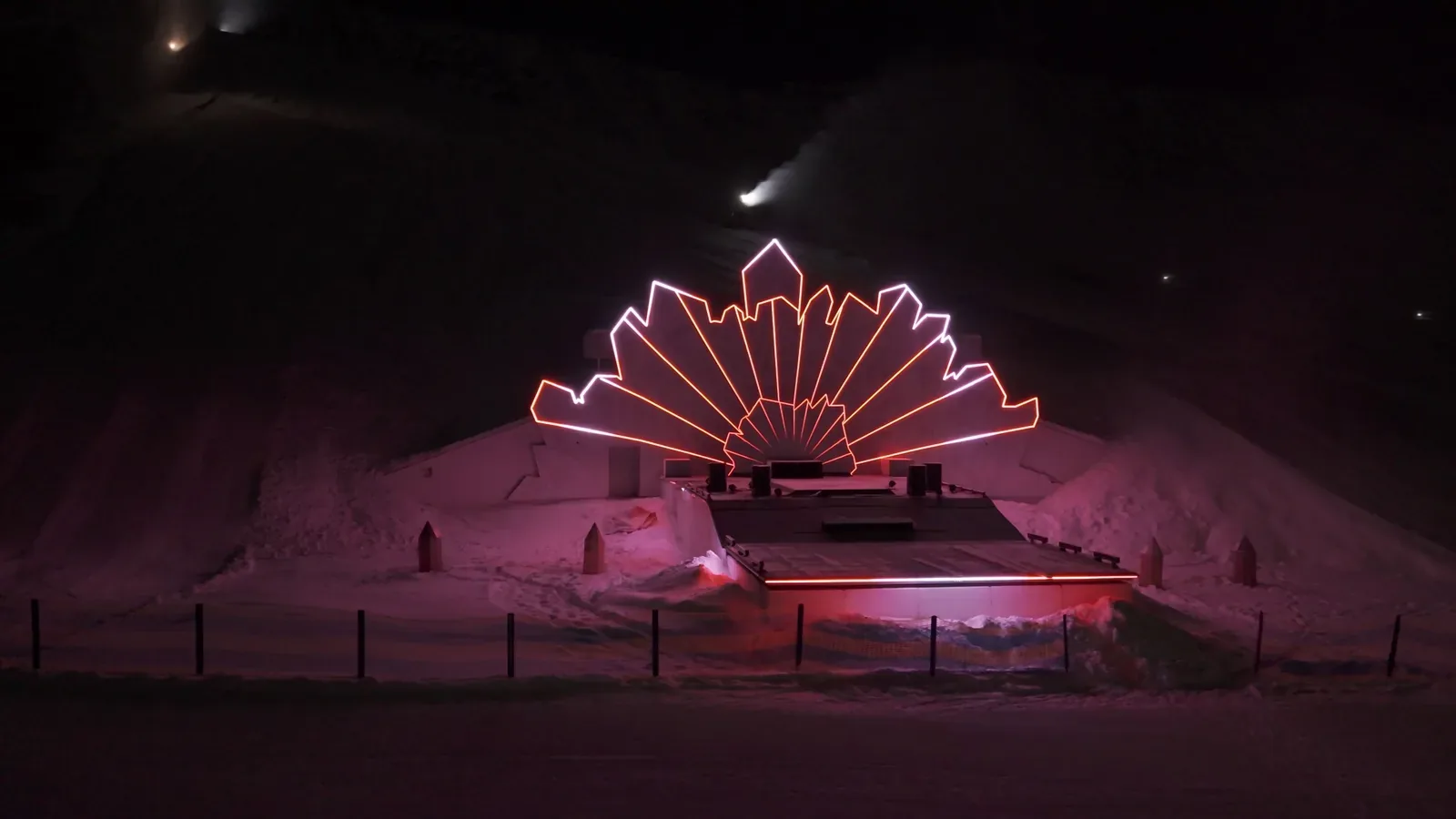
Three things change: water, cold and reach. Strips go into sealed tubes inside aluminium profiles. Controllers and power supplies go into rated enclosures with components specified for the local temperature range.
Reach is the part that budgets usually miss. A park installation has no technician standing next to it, so control, triggering and diagnostics must arrive over the network. We recommend keeping outdoor pixels powered through freezing nights, as on our outdoor pixel LED stage at 2000 metres. The small amount of heat a live strip dissipates keeps the assembly above ambient. Facades, monuments and bridges add fixing and access constraints, covered in our guide to pixel LED facade lighting.
 Source: LED Strip Studio
Planning Example: How Is a Museum Foyer and Exhibition Hall Lit?
The following is a planning example, not a specific client project. Its figures are sizing arithmetic, so replace them with surveyed values before quoting. The exterior of a building is a separate job, covered in our guide to pixel LED facade lighting.
A mid-sized museum lights the ceiling cove of its foyer and the wall niches of one exhibition hall. About 36 metres in the foyer and 48 metres in the hall, at 60 pixels per metre, give roughly 5,000 pixels. The hall runs stay on the architecture, away from the exhibits, so the conservation limits above are not touched.
Each cove and niche is mapped as its own Digital strip in LED Strip Studio pixel mapping software. The foyer and the hall can then carry different scenes while sharing the same controllers. Scenes are prepared once during commissioning: opening hours, an exhibition opening, a national holiday and a night mode for the closed building.
 Source: LED Strip Studio
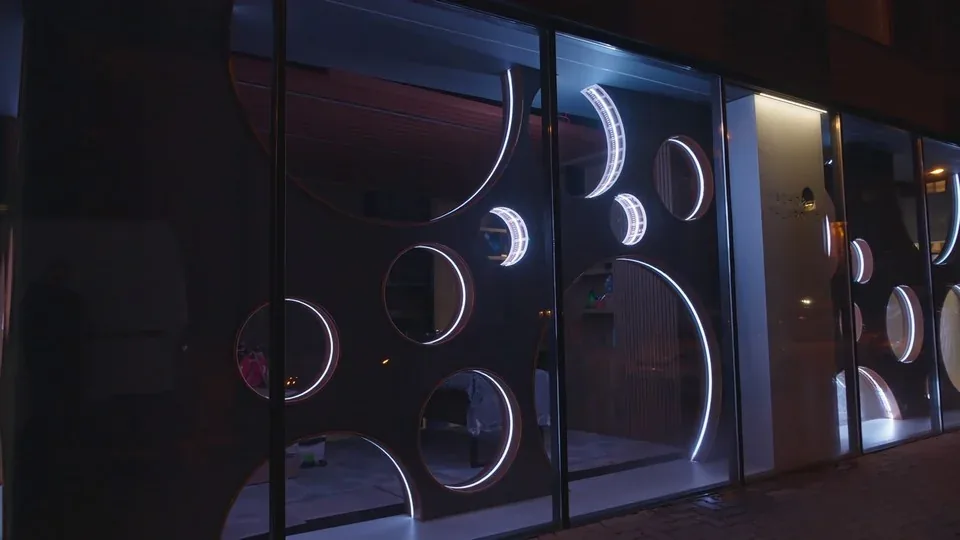
The same mapping decision runs in a real building: in our pixel LED showroom lighting case study, every coin-shaped opening is its own Digital strip, so a single object can carry its own effect years later. The largest public venue we have documented with numbers is the congress hall in Bad Ischl, where two pixel windows hold 38,000 pixels on 20 controllers. Further builds sit on our Our Work page.
Who Operates the System Day to Day?
Not an integrator, and that is the point. Front-of-house staff recall saved scenes from the LSS Remote app over the in-house network, and the building runs its default schedule without anyone touching it.
Budget one training session and a written scene list at handover. A public building has staff turnover, and an operator who cannot recall a scene will leave one look running for years.
How Do You Size the Control for a Public Space?
Sizing starts with the pixel count and the number of colour channels per pixel, not with the fixture catalogue. One DMX universe carries 512 channels, which is 170 RGB pixels or 128 RGBW pixels.
| Calculation (example, 5,000 pixels) | RGB pixels (3 channels) | RGBW pixels (4 channels) |
|---|---|---|
| Pixels per DMX universe | 170 | 128 |
| Channels required | 15,000 | 20,000 |
| Universes, project-wide | 30 | 40 |
| Universes, 625 pixels on each of 8 outputs | 32 | 40 |
| LEC3 controllers (4,096 RGB / 3,072 RGBW each) | 2 | 2 |
| Outputs used of 8 | 5 | 7 |
All values in the table are calculated from the example pixel count; power is sized from the strip’s own W/m figure, which the datasheet gives and this example does not. The two controllers leave three RGB outputs free. Keep them free on purpose, because adding a controller to a finished ceiling cove later costs access, not hardware.
 Source: LED Strip Studio
Which Control Input Should a Public Building Keep Open?
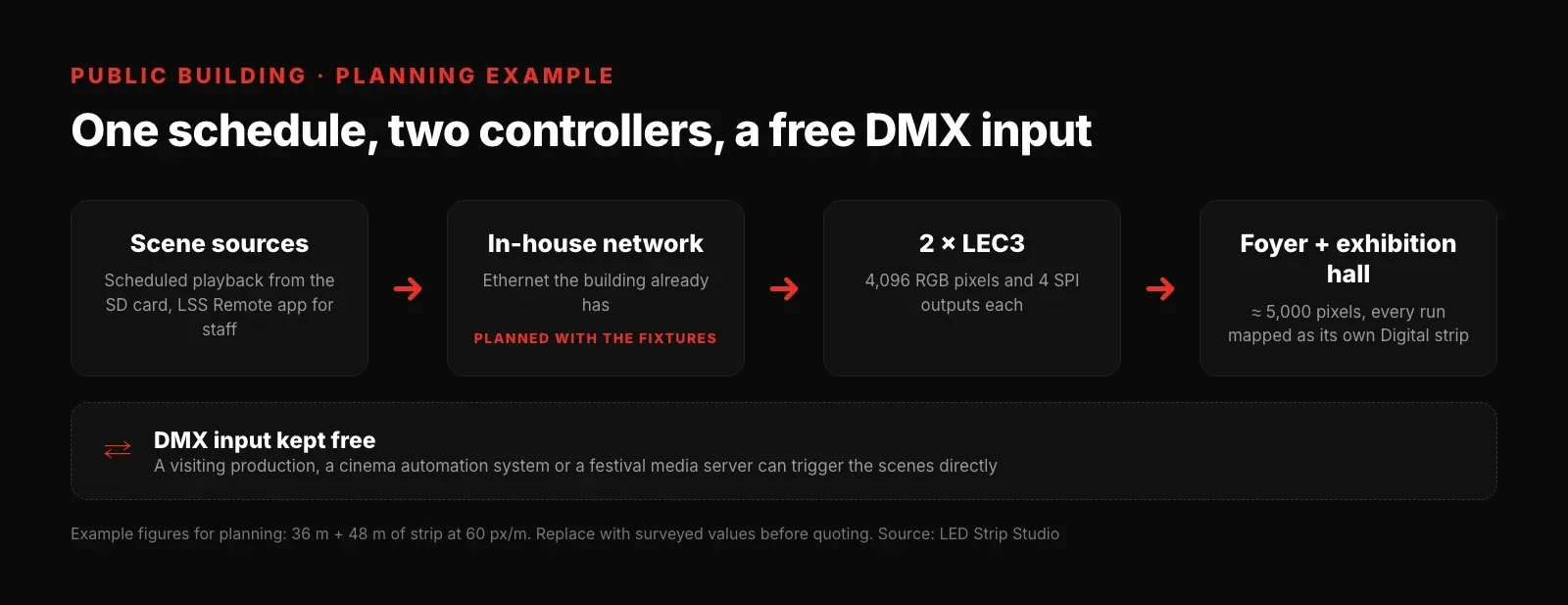
Everyday control runs over the building’s own Ethernet: scenes play from the SD card on a schedule, and staff pick exceptions in the app. The lighting desk of a visiting production is the case to plan for. A festival crew, a cinema automation system or a media server already speaks DMX, so an SPI Matrix or LEC3 with its DMX input wired to a socket at the stage position lets them trigger the installation without learning your system.
The universe arithmetic behind the table, and when DMX, Art-Net or our own protocol is the right carrier, is explained in our guide to controlling LED strips over DMX and Art-Net.
Which Mistakes Ruin LED Lighting in Public Spaces?
Most failures in pixel LED lighting for public spaces are decided long before commissioning.
- Programming a nightclub into a museum. Fast saturated effects undermine the institution the light was meant to dignify.
- Ignoring conservation limits. Illuminance near sensitive exhibits is measured and documented, never estimated.
- Locking the system to one app. Without a DMX or Art-Net input, every visiting production depends on in-house staff.
- Treating the network as somebody else’s scope. Remote control of a park is only as reliable as the link behind it.
- Planning controller positions after the finishes. Cable routes in public buildings close early and reopen expensively.
Planning lighting for a gallery, cinema, museum or park? Book a free consultation and we will size the control chain around your building.
Sources & references
- LED Strip Studio — Congress hall LED lighting in Bad Ischl: 38,000 pixels, 20 SPI Matrix controllers, 20 kW
- LED Strip Studio — Outdoor pixel LED stage at Serfaus-Fiss-Ladis: outdoor protection, powering through winter
- LED Strip Studio — Pixel LED showroom lighting: Digital strips, Groups, LSS Remote over the in-house network
- LED Strip Studio — LEC3 and SPI Matrix product pages: pixels per output, SD card playback with scheduling, DMX input
- ESTA — ANSI E1.11 DMX512-A: 512 channels per universe
- CIE 157:2004 — Control of Damage to Museum Objects by Optical Radiation
Summary
Pixel LED lighting for public spaces turns light into programmable content, so one build serves everyday operation, exhibitions and events without rewiring. The deciding constraint differs per space: conservation limits in museums and galleries, stray light on the screen in cinemas, and weather and remote access in parks. Size the control from the pixel count, because one DMX universe carries 170 RGB or 128 RGBW pixels, and specify headroom before the finishes close. Keep a DMX input next to the app, so visiting productions and automation systems can trigger scenes directly. Staff recall saved scenes, so budget training and a written scene list at handover.