Installations
How Do You Plan Pixel LED Facade Lighting for Buildings?
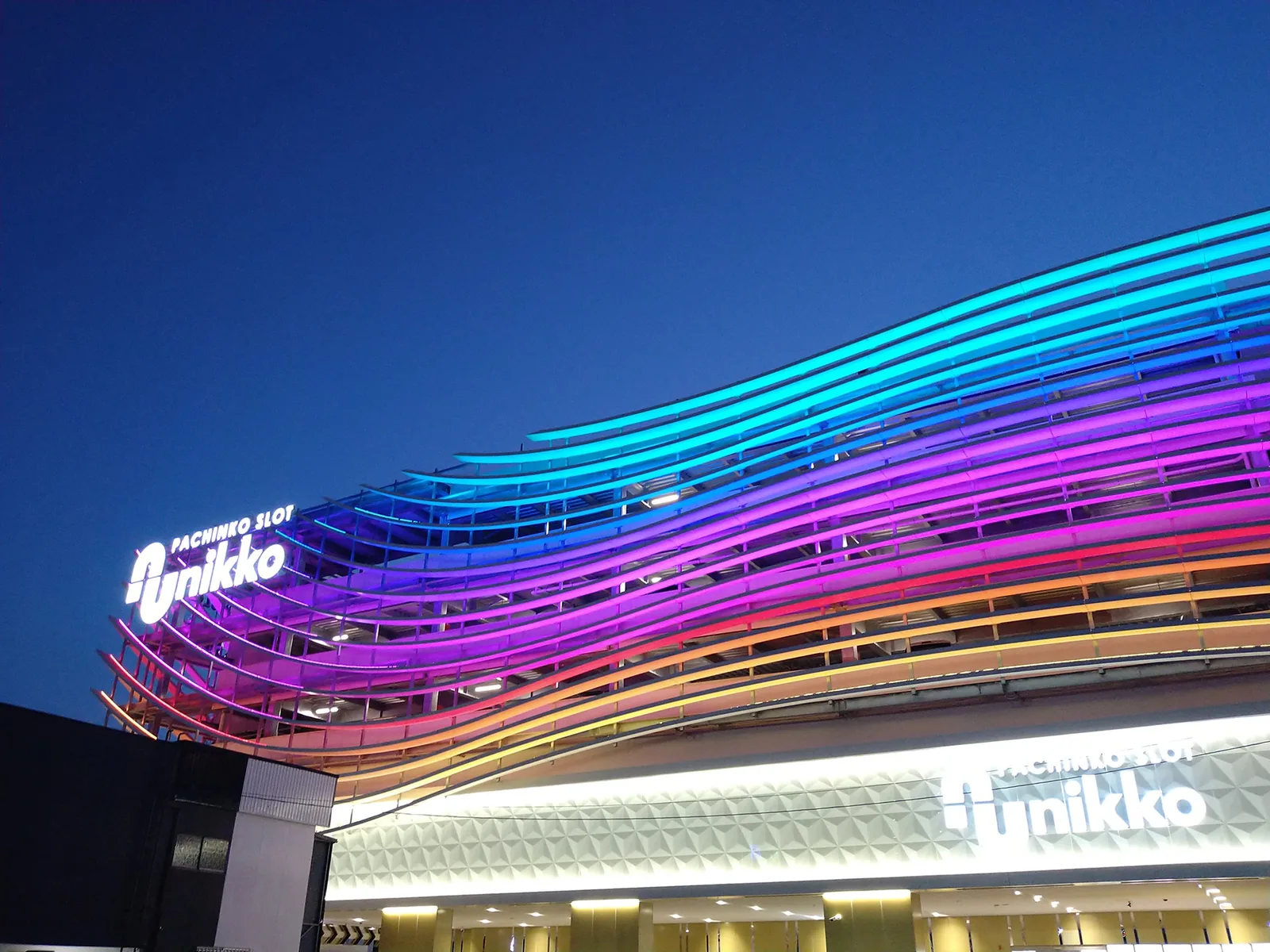
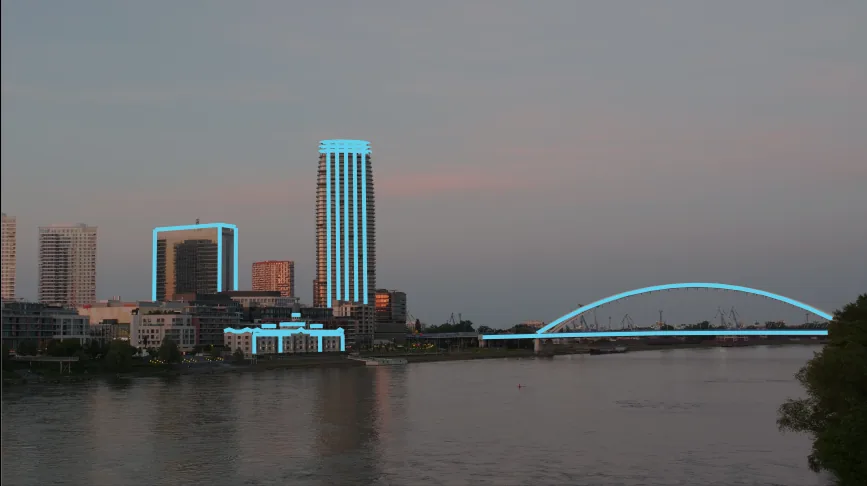
A facade, a listed monument and a bridge look like three versions of the same job. They are not. The surface is outdoors in all three cases, but the fixing method, the signal distance and the permission you need are different every time.
This article is written for integrators, architects and construction project managers specifying pixel LED facade lighting on a building, a heritage object or a bridge. It covers the decisions made before the strip is ordered, because those are the ones that cost money later.
What Is Pixel LED Facade Lighting?
Pixel LED facade lighting is an exterior installation in which every LED, or every small group of LEDs, is addressed individually. The building line then carries colour, gradients and motion as content rather than as a fixed setting. A conventional floodlight can only dim or change one colour across a whole surface.
That difference is what makes the installation worth its price on a building. One physical build serves an everyday evening scene, a national holiday, a corporate event and a city festival. Nothing is rewired between them, because only the scene changes.
The second defining trait is that nobody is standing next to it. A facade at the fourth floor, a monument behind a fence and a bridge over water all need control, triggering and diagnostics to arrive over the network. We treat remote operation as part of the specification, not as an upgrade.
Typical lines for a pixel layer on a structure:
- Cornices, reveals and vertical ribs, the lines that describe the building’s geometry
- Entrances and canopies, the part people stand under and inspect closely
- Monument outlines and architectural detail, as accent light under heritage constraints
- Bridge arches, cables, railings and soffits, long runs with structural movement
- Towers, chimneys and industrial landmarks, high-level runs with hard service access
Which Parameters Change Between a Facade, a Monument and a Bridge?
The hardware is the same across all three. What changes is the constraint that decides the design, and it is rarely the one the client raises first. The comparison is our design assessment, not a survey of regulations.
| Requirement | Building facade | Listed monument | Bridge |
|---|---|---|---|
| Primary constraint | Cable routes through the building | Approval and reversible fixing | Structural movement and access |
| Fixing method | Profiles on a substructure or in reveals | Clamps, existing joints or a separate frame | Profiles on steel or concrete, designed for vibration |
| Controller to first segment | Tens of metres from a plant room | Often no indoor room at all | Hundreds of metres along the deck |
| Protection | Sealed strip in a tube inside an aluminium profile | Same, plus concealed by day | Same, plus spray, salt and vibration |
| Service access | Lift or rope access | Scaffold, often supervised | Lane or channel closure |
| Typical trigger | Schedule or external time switch | Schedule with curfew limits | Schedule plus remote override |
| Permission needed | Building owner, sometimes planning | Heritage authority, rules vary by country | Structure owner plus road or waterway authority |
Why Do Monuments Need a Reversible Installation?
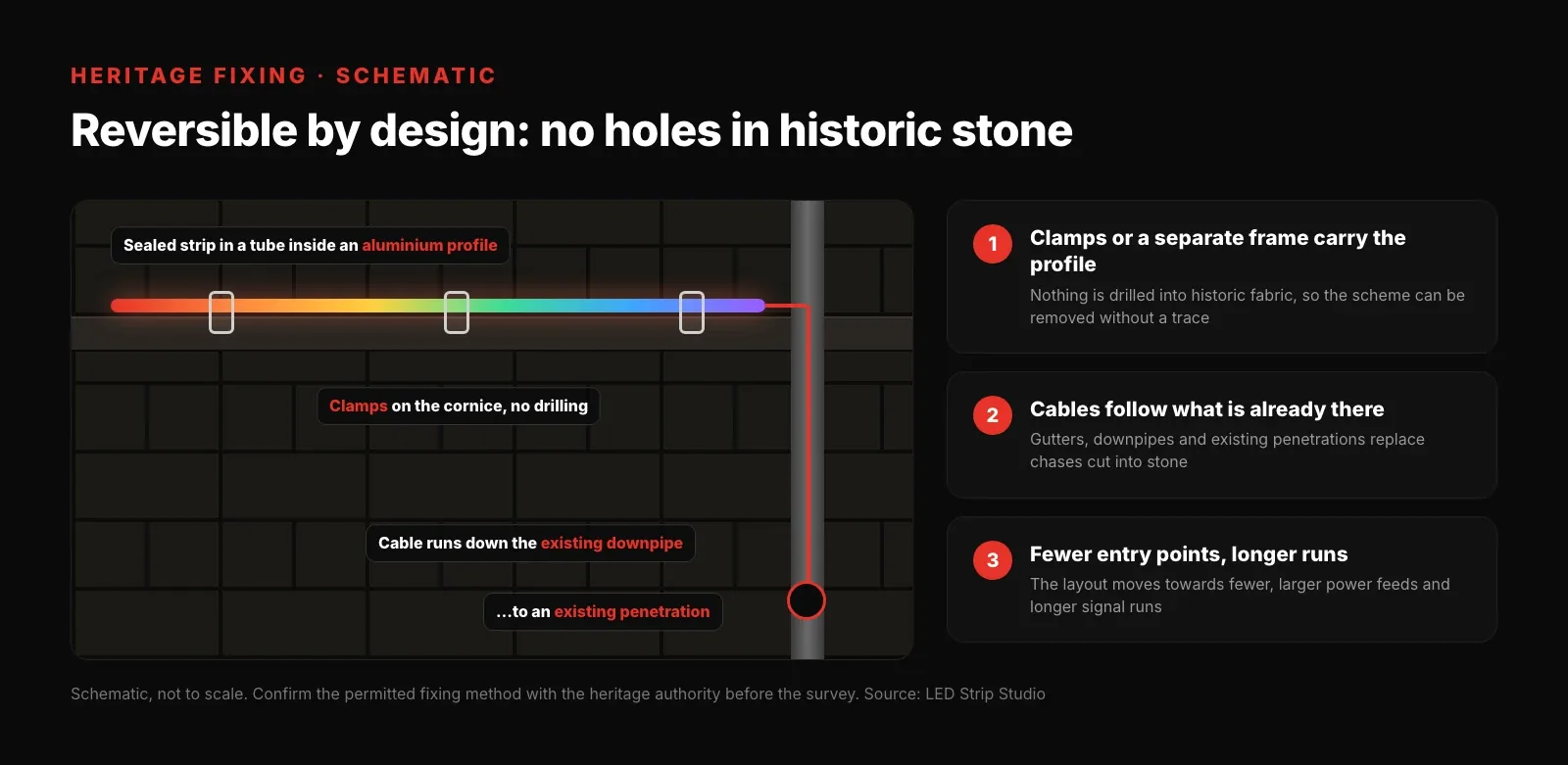
Because the object has to survive the lighting. On heritage structures the usual working assumption is that nothing may be drilled into historic fabric, so profiles are carried on clamps, existing joints or a separate frame. Confirm the exact rule with the responsible authority before the survey, since it varies by country and by protection level.
Reversibility also changes the cable plan. Without chases cut into stone, feeds have to follow gutters, downpipes and existing penetrations. That usually means fewer entry points than a designer wants, which pushes the layout towards longer runs and fewer, larger power feeds.
 Source: LED Strip Studio
What Makes Bridges the Hardest of the Three?
Movement and distance together. A bridge has expansion joints that travel with temperature and traffic, so every cable crossing one must be designed for repeated travel rather than a single install. We met the same problem on our outdoor pixel LED stage at 2000 metres, where the stage floor sits on hydraulics and moves during every show.
Distance is the second half. A 200-metre span puts the far end of the run far beyond any direct SPI cable, so the signal architecture has to be planned before the fixing detail. Access is the third: inspecting a bridge soffit takes a lane closure or a boat, not a ladder.
Planning Example: How Is a 60-Metre Facade Run Wired?
The following is a planning example, not a specific client project. Replace the figures with surveyed values before you quote.
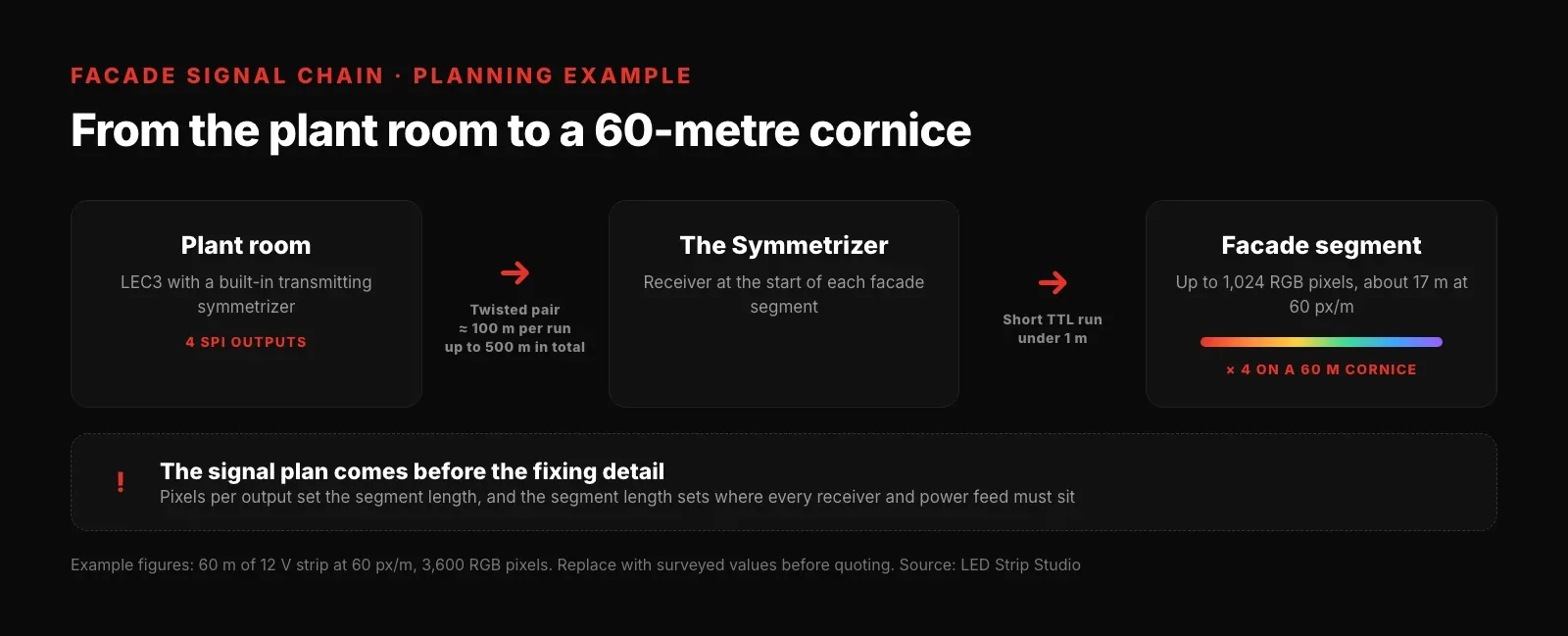
A building outlines 60 metres of cornice with 12 V addressable strip at 60 pixels per metre. That is 3,600 RGB pixels. One output of an LEC3 pixel controller carries 1,024 RGB pixels, or about 17 metres at that density. The run therefore splits into four segments: three of 17 metres and one of 9.
Four segments fit the four outputs of a single LEC3, but 3,600 of 4,096 pixels is 88 % of its capacity. On a facade we would specify two controllers instead, because adding the second one later means a lift, a weather window and a crew.
Each architectural line is mapped as its own Digital strip in LED Strip Studio pixel mapping software. Scenes are prepared once at commissioning: default evening, late-night low level, holiday and a dark mode for local curfews.
 Source: LED Strip Studio
Which Distances Break the Signal on a Facade?
The SPI data line is the weak point, not the strip. We recommend keeping the direct TTL run from controller to first pixel under one metre. Beyond that the edges of each bit round off, and pixels start reading a 0 as a 1.
On a facade the controller almost never sits within a metre of the strip, so convert the data to a differential signal. The Symmetrizer carries it about 100 metres per twisted-pair run and up to 500 metres in total. The transmitting side is already built into LEC3 and SPI Matrix, and our guide to sending an SPI signal over long distance has the segment tables.
 Source: LED Strip Studio
How Do You Size Power and Control for a Facade?
Sizing starts from the pixel count and the channels per pixel, not from the fixture catalogue. One DMX universe carries 512 channels, which is 170 RGB pixels or 128 RGBW pixels.
| Calculation (example, 3,600 pixels) | RGB pixels (3 channels) | RGBW pixels (4 channels) |
|---|---|---|
| Pixels per DMX universe | 170 | 128 |
| Channels required | 10,800 | 14,400 |
| Universes required | 22 | 29 |
| Max pixels per controller output | 1,024 | 768 |
| Segments at 60 px/m | 4 | 5 |
| LEC3 controllers (4,096 RGB / 3,072 RGBW each) | 1, two recommended | 2, required |
| Power at 0.53 W per pixel, the Bad Ischl reference | ≈ 1.9 kW | ≈ 1.9 kW |
All values in the table are calculated from the example pixel count. The power row uses a figure from a completed build: at the Bad Ischl congress hall, 38,000 pixels and their power supplies draw 20 kW. Treat it as a sanity check, never as a substitute for the strip’s own W/m figure.
Art-Net or DMX for a Building Facade?
Art-Net carries DMX data over standard Ethernet, so 22 or 29 universes travel on structured cabling instead of daisy-chained DMX lines. Our guide to controlling LED strips over DMX and Art-Net covers universe limits and start addresses. Much larger schemes are a different matter: above about 10,000 LEDs we switch to our own LED Strip Studio protocol, which needs roughly a fifth of the bandwidth.
Keep a DMX input available even when everyday control is a schedule. A city festival, a projection-mapping crew or a media server already speaks DMX. An SPI Matrix Art-Net to SPI decoder or LEC3 lets a visiting production drive the facade without learning your system.
Which Mistakes Ruin Pixel LED Facade Lighting?
Most failures in pixel LED facade lighting are decided during design, not during commissioning.
- Fixing the profile detail before the signal plan. Segment length is set by pixels per output, so it dictates where feed points must sit.
- Assuming an IP rating covers cold. Sealing keeps water out; it says nothing about components rated for sub-zero operation.
- Specifying zero controller headroom. On a facade, expansion later costs access equipment rather than hardware.
- Running fixed cable across an expansion joint. Bridge and facade joints move, and the wiring has to move with them.
- Leaving heritage approval to the end. A monument scheme that cannot be fixed reversibly has to be redesigned, not adjusted.
Planning a facade, monument or bridge scheme? Book a free consultation and we will size the signal and power chain around your structure.
Sources & references
- LED Strip Studio — Outdoor pixel LED stage at Serfaus-Fiss-Ladis: outdoor protection, powering through winter, cabling across a moving joint, controller headroom
- LED Strip Studio — Congress hall in Bad Ischl: 38,000 pixels, 20 SPI Matrix controllers, 20 kW
- LED Strip Studio — CNN Prima NEWS studio: LED Strip Studio protocol instead of Art-Net above 10,000 LEDs
- LED Strip Studio — LEC3 product page: 4,096 pixels, 4 outputs, 1,024 RGB / 768 RGBW per output, built-in transmitting symmetrizer
- LED Strip Studio — The Symmetrizer product page and datasheet: differential signal over twisted pair, about 100 m per run, up to 500 m in total
- LED Strip Studio — Pixel LED showroom lighting: Digital strips and Groups in LED Strip Studio
- ESTA — ANSI E1.11 DMX512-A: 512 channels per universe
Summary
Pixel LED facade lighting turns the lines of a building into programmable content, so one build serves everyday evenings, holidays and events without rewiring. The deciding constraint differs by structure: cable routes on a facade, reversible fixing on a monument, and movement and access on a bridge. Segment length comes from pixels per output, about 17 m at 60 px/m for 1,024 RGB pixels, so the signal plan must come before the fixing detail. Keep the direct TTL run under one metre and go differential for anything longer: The Symmetrizer carries about 100 m per twisted-pair run and up to 500 m in total. Specify controller headroom deliberately, because expanding a facade installation later costs access equipment, not hardware.