Installations
How Do You Plan Residential Pixel LED Lighting at Home?
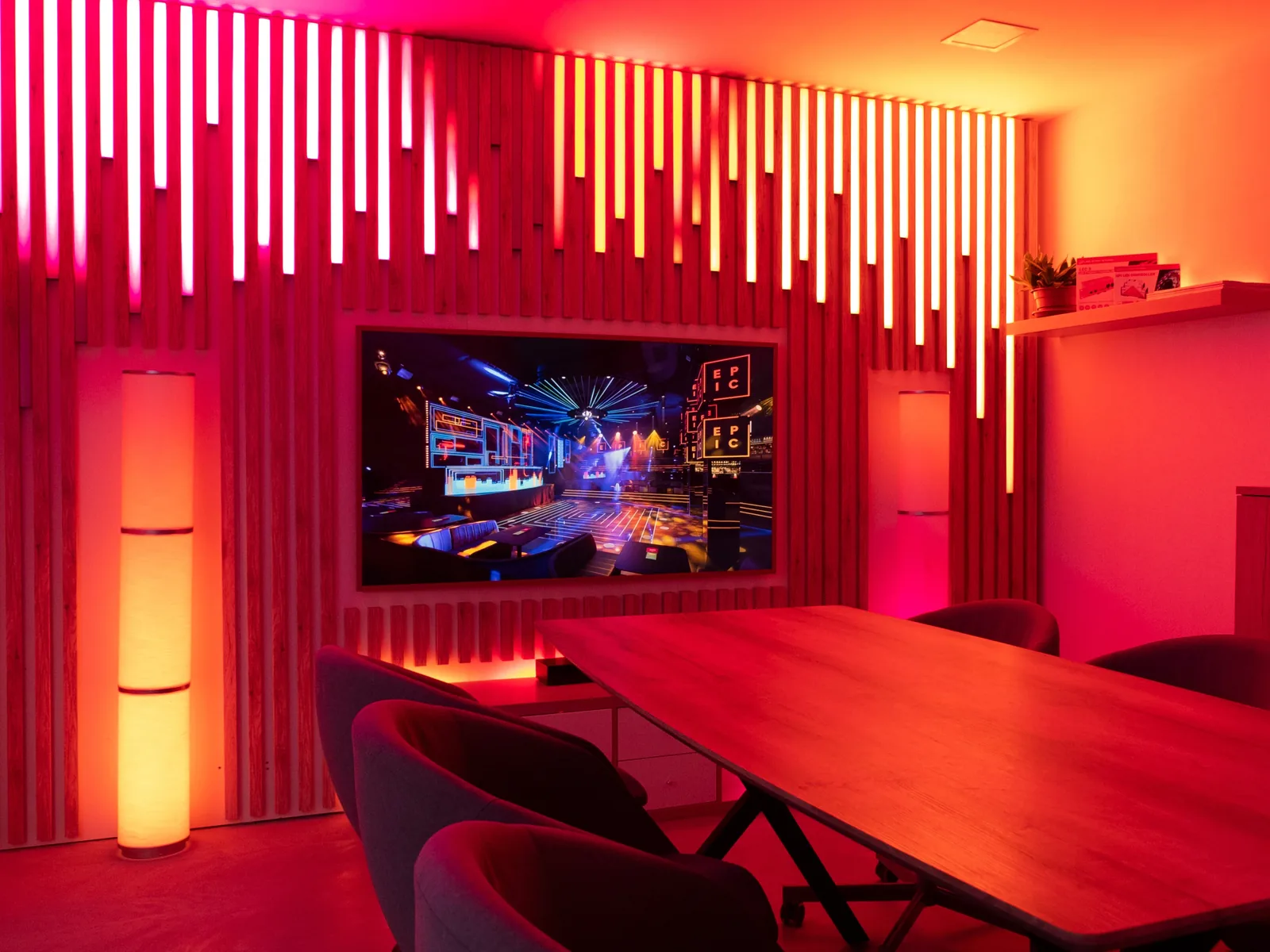
A spa ceiling, a garden path, a garage workbench and a living-room cove are four different lighting jobs inside one house. The hardware behind them can be identical. What differs is humidity, distance and who operates the result on a Tuesday evening.
This article is written for homeowners, architects and installers specifying residential pixel LED lighting in private property. It covers the decisions made before anything is ordered, because those decide whether the system is still in daily use two years later.
What Is Residential Pixel LED Lighting?
Residential pixel LED lighting is a private installation in which every LED, or every small group of LEDs, is addressed individually. A room can then carry gradients, motion and colour as content. A conventional dimmable strip only goes brighter or darker across its whole length.
That difference is what pays for the extra hardware in a house. One physical build serves an everyday evening, a birthday, Christmas and a film night, and only the scene changes between them.
The second defining trait is specific to homes. In a venue there is a technician; at home the operator is whoever is in the room. We therefore treat recall, two taps on a phone, as part of the specification.
Typical zones for a pixel layer in a house:
- Spa, sauna and pool rooms, with heat, humidity and reflective wet surfaces
- Gardens, terraces and driveways, with long runs, freezing nights and no cabinet nearby
- Garages and workshops, with working light by day and display light in the evening
- Living rooms and home cinemas, with indirect coves and screen-driven ambient light
- Staircases, corridors and cellars, with sensor-triggered, directional light
What Changes Between a Spa, a Garden and a Garage?
The controller and the strip can be the same in all four zones. What changes is the constraint that decides the design, and it is rarely the one mentioned first.
| Requirement | Spa & pool | Garden & terrace | Garage & workshop | Living room |
|---|---|---|---|---|
| Primary constraint | Humidity and heat | Distance from the house | Dust, impact, working light | Invisible fixtures |
| Fixing method | Sealed strip in a tube inside a profile | Profiles on walls, edges, decking | Profiles on shelving and beams | Coves, reveals, furniture rebates |
| Controller location | Dry room outside the wet zone | Indoor cabinet, never in the garden | Wall cabinet in the garage | Media cabinet or utility room |
| Typical trigger | Wall switch or scene button | Schedule or external time switch | Motion sensor | Phone app or scene button |
| Colour requirement | Slow, low-level, glare-free | Warm and neighbour-friendly | Neutral white for work | Tunable, matched to the screen |
| Who operates it | The family | Nobody, most nights | The family | The family |
Why Is a Spa the Hardest Room in the House?
Because water, heat and electronics share one ceiling. The strip itself is protected the same way as an outdoor run: sealed in a tube inside an aluminium profile, with every joint made outside the wet area. The controller and the power supply stay in a dry room, and only low-voltage cable enters the spa.
A sauna cabin is a separate question. Cabin temperatures sit far above what addressable LED strips are rated for. Light the cabin surround and the changing area rather than the hot zone, and check the strip datasheet before any of it goes near a heater. Wiring rules for zones around baths and pools vary by country and must be confirmed before the layout is fixed.
How Far Is the Garden From the Controller?
Further than the data line tolerates. A raw SPI data line is only reliable for about a metre, and in a garden the controller sits indoors, tens of metres away. The data therefore has to travel as a differential signal.
The Symmetrizer carries it about 100 metres per twisted-pair run and up to 500 metres in total, with the transmitting side already built into LEC3. Our guide to sending an SPI signal over long distance has the segment tables.
Winter is the other garden question. We recommend keeping outdoor pixels powered through freezing nights, as on our permanent outdoor stage in the Alps. A live strip dissipates a little heat continuously and stays above ambient temperature.
Planning Example: How Is a Four-Zone Home Wired?
The following is a planning example, not a client project. Replace the figures with surveyed values before you quote.
| Zone | Length | Density | RGB pixels | Controller outputs | Universes |
|---|---|---|---|---|---|
| Spa ceiling | 12 m | 60 px/m | 720 | 1 | 5 |
| Garden and terrace | 40 m | 30 px/m | 1,200 | 2 | 8 |
| Garage | 16 m | 60 px/m | 960 | 1 | 6 |
| Living-room cove | 18 m | 60 px/m | 1,080 | 2 | 7 |
| Total | 86 m | 3,960 | 6 | 26 |
Outputs run out before pixels do. One output of an LEC3 pixel controller carries 1,024 RGB pixels, and the controller holds 4,096 in total. The example needs only 3,960 pixels but six outputs, so one controller cannot do it: zones in separate parts of a house cannot share a data chain.
Two controllers are the honest answer, and we would specify them from the start. Each zone is mapped as its own Digital strip in LED Strip Studio pixel mapping software. Scenes are prepared once at commissioning: everyday evening, late-night low level, party and away mode.
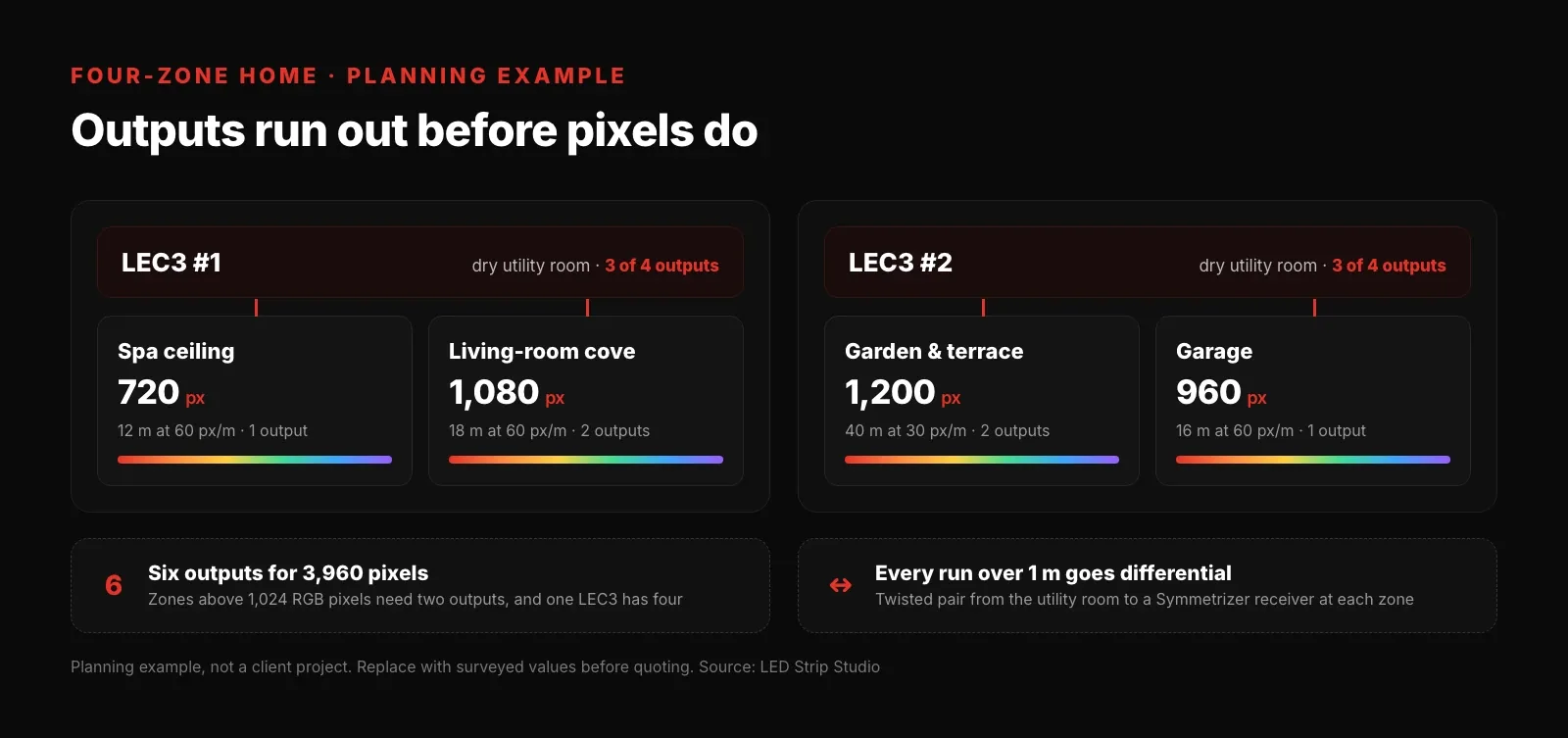 Source: LED Strip Studio
Which Distances Break the Signal in a House?
Any run over one metre of direct TTL, which in practice means all of them. Even a living-room cove sits more than a metre from the media cabinet once the cable follows the wall.
Two solutions cover a whole house. A differential signal over twisted pair handles the long runs to a garden or a garage. SPI Lamp 2 puts the receiver next to the strip and lets the runs between rooms use ordinary Cat5e, up to 100 metres per hop.
How Do Our Own Four Zones Run?
Our building is not a family home, but it has the same problem: several rooms, each with its own device and SD card. A gaming corner runs on a Reactivo, with effects on the card and screen grabbing when the light should follow the monitor. A digital horizon used as a video background runs on one LEC3. The office ceiling plays a music-synchronised show from another LEC3, started by a Shelly switch and a custom sound board.
The staircase is the honest entry in that list. It is still unfinished. The plan is to move it to a controller with a sensor input, so the steps light up in the direction of travel and dim down by time of day. Each zone appears in the app under its room name, which is why one device per zone is the rule we follow at home as well.
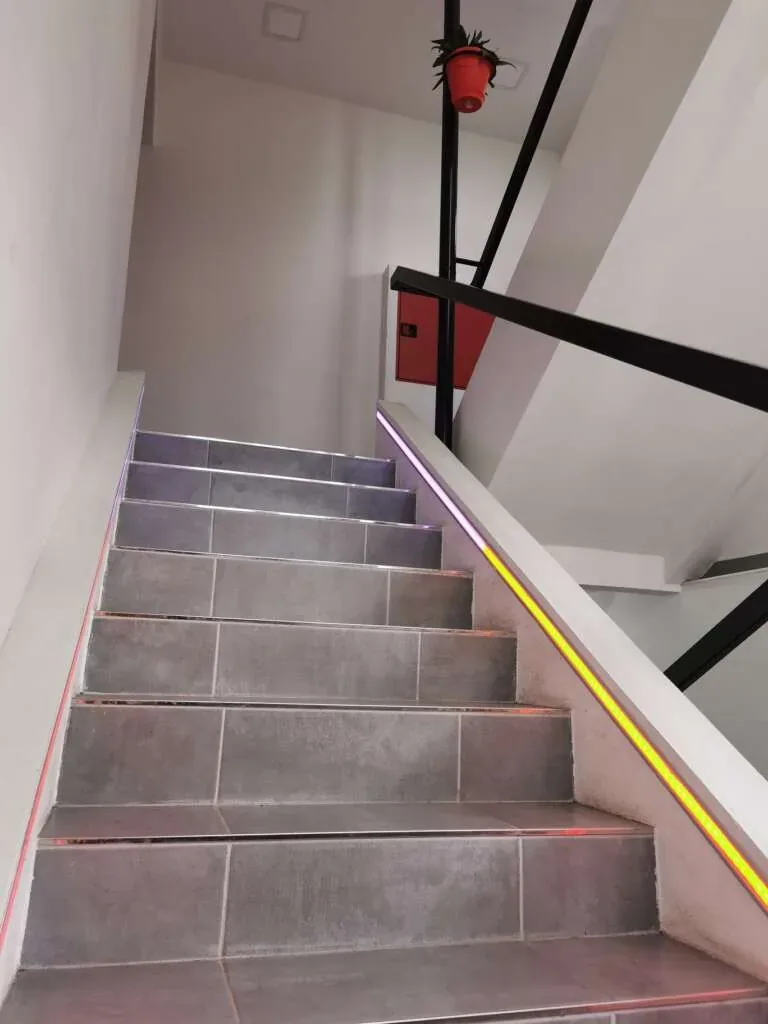 Source: LED Strip Studio
How Do You Size Power and Control for a Home?
Sizing starts from the pixel count and the channels per pixel. One DMX universe carries 512 channels, which is 170 RGB pixels or 128 RGBW pixels, and the example above needs 26 universes when each zone is rounded on its own.
Power is sized from the strip’s own W/m figure in its datasheet, never from an average. Put a power supply near each zone rather than one large supply in a central cabinet. Low-voltage runs lose voltage over distance, and a garden fed from the utility room shows it first as dim, warm-shifted ends.
Who Operates the System After Handover?
The family, from a phone. Scenes are written to the controller’s SD card, so the installation plays them standalone and the app only picks which one runs. The LSS Remote app changes effect, animation speed and brightness on LEC3 and SPI Matrix; our article on the LED controller mobile app covers its limits.
Where a scene should start by itself, use a controller with inputs. Reactivo 2 accepts buttons, motion sensors and contacts, which is what a garage, a staircase and a cellar actually need. The same controller drives screen-synced light at a desk, as in our gaming LED setup.
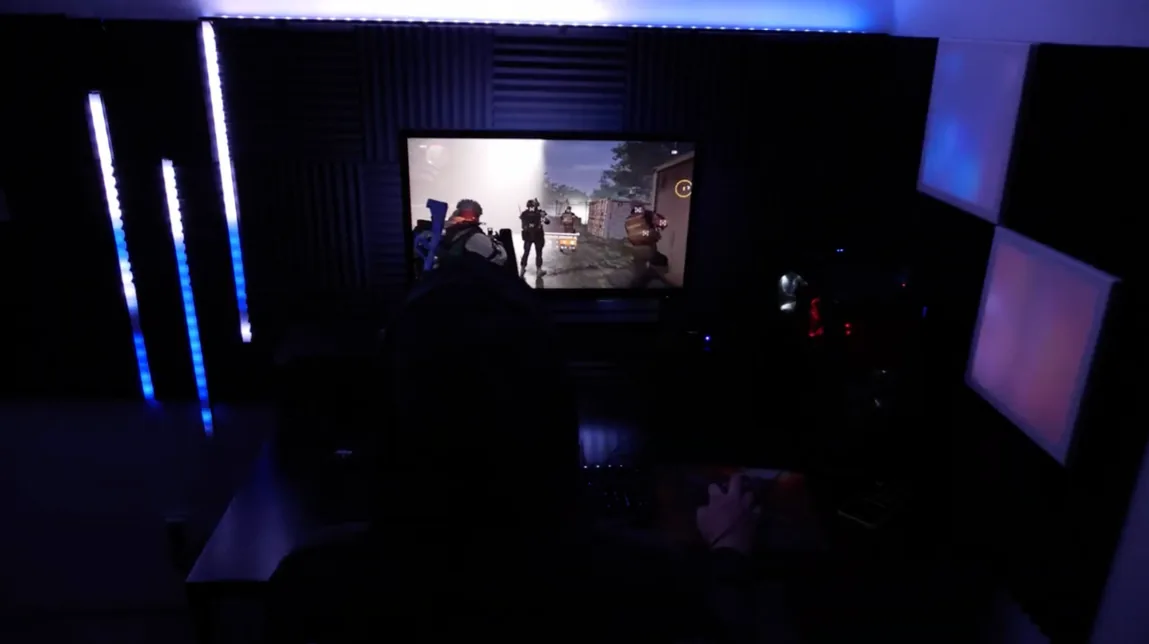 Source: LED Strip Studio
Which Mistakes Ruin Residential Pixel LED Lighting?
Most failures in residential pixel LED lighting are decided during design, not during commissioning.
- Putting the controller in the wet room. Electronics belong in a dry space; only low-voltage cable should enter a spa.
- Counting pixels but not outputs. A house runs out of controller outputs long before it runs out of pixel capacity.
- Feeding the garden with a direct TTL line. Anything over a metre needs a differential signal or an SPI Lamp at the far end.
- Leaving the scenes on a laptop. If the content is not on the SD card, the system stops being used the week the laptop moves.
- Switching outdoor pixels off for the winter. Keeping them powered holds the assembly above ambient temperature.
Planning a spa, garden, garage or living-room scheme? Book a free consultation and we will size the signal and power chain around your house.
Sources & references
- LED Strip Studio — LEC3 product page: 4,096 pixels, 4 outputs, 1,024 RGB / 768 RGBW per output, built-in transmitting symmetrizer
- LED Strip Studio — The Symmetrizer product page and datasheet: differential signal over twisted pair, about 100 m per run, up to 500 m in total
- LED Strip Studio — SPI Lamp 2 product page: up to 100 m of Cat5e per hop
- LED Strip Studio — Outdoor pixel LED stage at Serfaus-Fiss-Ladis: outdoor protection, powering through winter
- LED Strip Studio — LED controller mobile app: four zones in our own building, effect / speed / brightness on LEC3 and SPI Matrix
- LED Strip Studio — Reactivo 2 product page: buttons, sensors and triggers; gaming LED setup with screen grabbing
- ESTA — ANSI E1.11 DMX512-A: 512 channels per universe
Summary
Residential pixel LED lighting makes a room's light programmable content, so one build covers everyday evenings, parties and film nights without rewiring. The deciding constraint differs by zone: humidity in a spa, distance in a garden, dust and working light in a garage, invisible fixtures in a living room. Controller outputs, not pixel capacity, decide how many controllers a house needs, because 1,024 RGB pixels fit on one output and one LEC3 has four. Keep the direct TTL run under one metre and go differential for anything longer, which in a house means almost every run. Put the scenes on the SD card and hand over a phone app, because at home the operator is whoever is in the room.