Installations
How Do You Plan Pixel LED Lighting for Commercial Spaces?
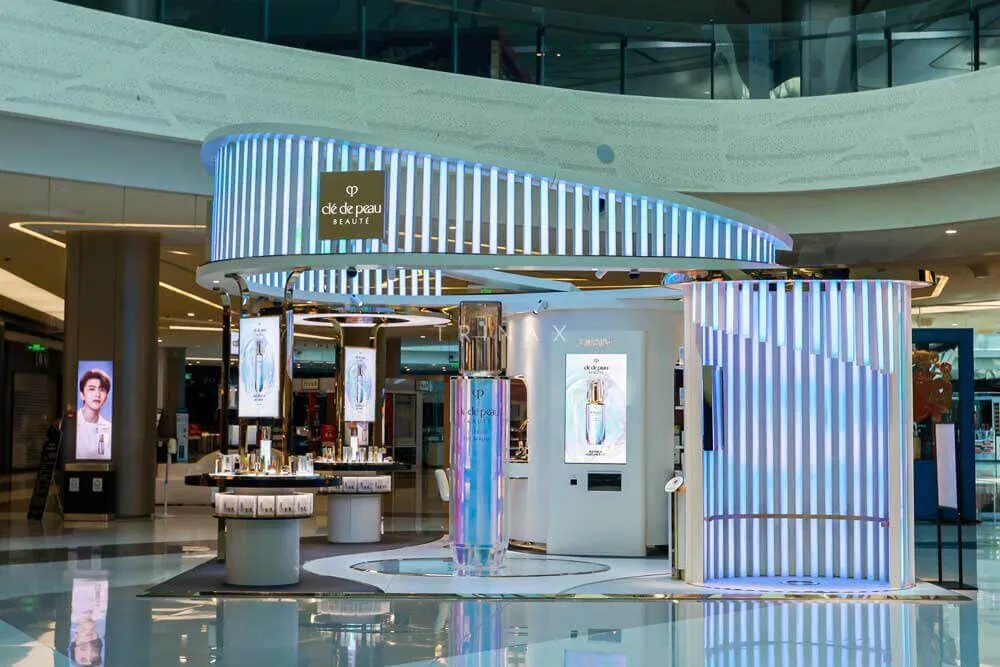
A shop window, a showroom facade and a trade show stand all have to sell something before anyone speaks. Pixel LED lighting for commercial spaces does that job with light that moves. Every LED carries its own colour value and is driven from software instead of from a dimmer. This article collects the decisions behind commercial builds: the hardware limits, what a real showroom installation used, and what changes in an exhibition hall.
It is written for shop and showroom owners, marketing managers, integrators, shopfitters and exhibition stand builders. You will leave with the pixel and signal limits that size the project, a decision table for the three environments, and the mistakes that are expensive to fix after fit-out.
What Is Pixel LED Lighting for Commercial Spaces?
Pixel LED lighting for commercial spaces is an installation in which every LED, or every small group of LEDs, holds its own colour and brightness value. The light then changes as content, not as a dimmer setting. One physical build therefore delivers many different looks without any rewiring.
That property is the whole commercial argument. A retailer changes the scene for a season, a campaign or a product launch, and the fixtures stay exactly where the shopfitter left them.
The technical difference sits in the control chain, not in the strip. Between the computer and the LEDs sit mapping software, a pixel LED controller, power supplies and a large number of hand-made connections.
The risk is equally obvious. Addressable pixels are easy to overdrive, and a shop that flashes like a nightclub loses the credibility it was trying to buy. In the showroom case study below, the brief was ambience first and effect second.
Which Commercial Spaces Does This Cover?
Shops, showrooms and trade show stands split into three build types that behave differently in almost every respect. Opening hours, who operates the system and how often the structure is dismantled change the specification far more than the visual effect does.
A retail interior runs daily, all year, and is operated by staff who are not technicians. A stand is built, used for a few days of the show and taken apart again.
Which Numbers Decide a Commercial Build?
Three figures decide most commercial projects before any design work starts: how much strip one controller output can drive, how far the data signal can travel through the interior, and how many hours the physical build needs before the fit-out closes.
How Much Strip Fits on One Controller Output?
One output of an LEC3 or SPI Matrix drives up to 1,024 RGB pixels, which at 60 pixels per metre is about 17 metres of strip; denser strip shortens the run. A shop window rarely gets near that limit, but a long counter front or a shopfront line does, and the segment then has to be split before the joinery is drawn. Check pixels per metre in the datasheet rather than LEDs per metre, because many 12 V strips share one IC between three LEDs. The segment tables for every density and pixel type are in our guide to sending an SPI signal over long distance.
How Many Hours Does a Shop Fit-Out Need?
Our rule of thumb for the physical build is one hour of work per metre of installed strip, before mapping and content. In a shop that hour has a deadline attached: the fit-out closes on a fixed date, and every cut, solder joint and power feed must be finished before the joinery covers it. Plan the pixel work into the shopfitter’s schedule rather than after it. The full cost breakdown sits in our article on what a pixel LED installation really costs.
How Far Can the Signal Travel in a Finished Interior?
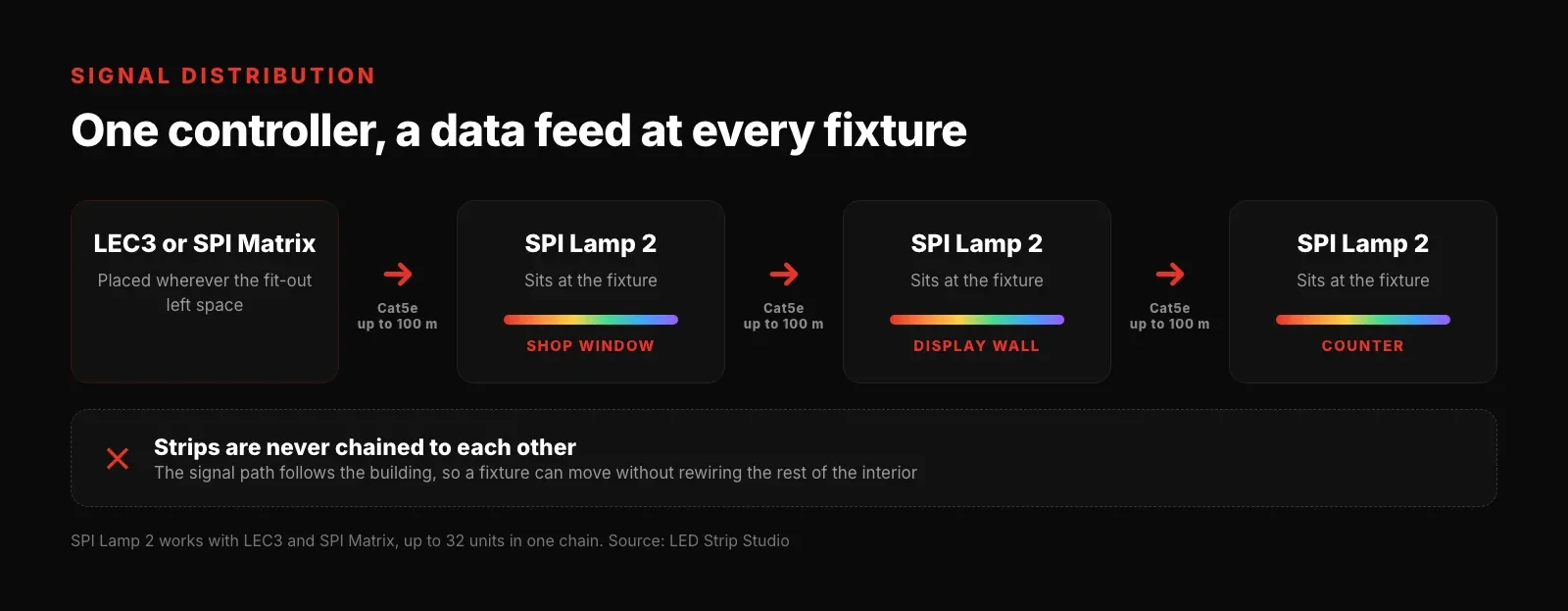
A raw SPI data line is reliable for under 1 m from the controller to the first pixel. In a finished shop or showroom that is nothing, because the controller ends up wherever the fit-out left space.
Converting the data to a differential signal solves it. SPI Lamp 2 receives the signal over standard Cat5e cable, with up to 100 m per hop and up to 32 units in one chain. Each lamp sits at the fixture, so strips are never chained to one another and the signal path follows the building rather than the decoration.
 Source: LED Strip Studio
Case Study: How Was a Showroom Facade Lit?
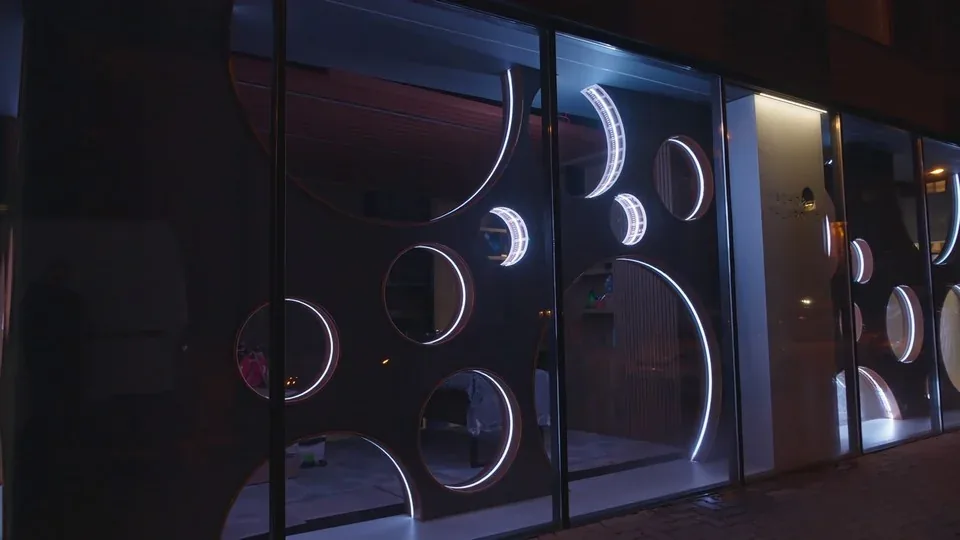
The inner facade of a numismatic showroom and auction centre carries circular openings, each one a stylised coin. Every opening holds a WS2815 addressable strip at 60 pixels per metre, running at 12 V. An SPI Lamp at each ring receives data over standard CAT6 cable.
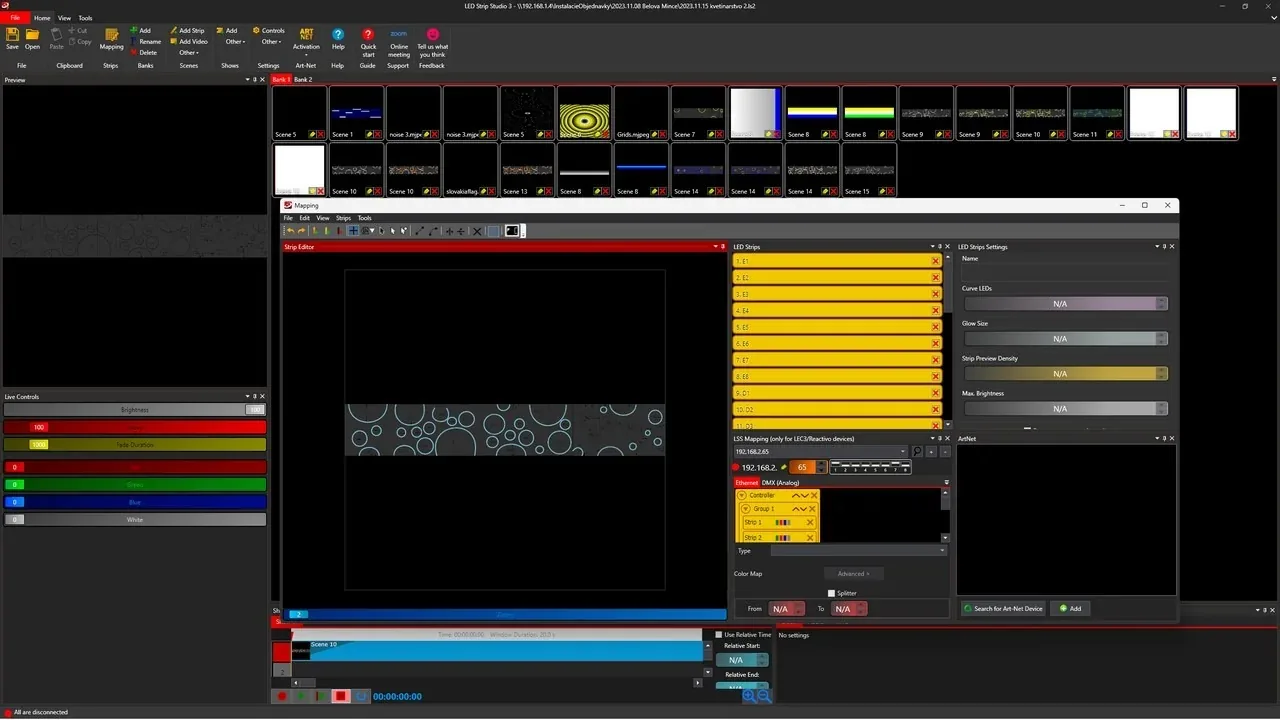
Each coin is defined in the software as its own Digital strip inside a Group, not as a segment of one long line. That single decision is what allows an effect to be assigned to an individual coin for the rest of the installation’s life. The full build is described in our article on pixel LED showroom lighting.
Programming in LED Strip Studio mapping software was deliberately restrained, so the facade reads as ambience rather than as a display. The client now recalls scenes 24/7 from a phone over the in-house network, which works because that network was already solid.
 Source: LED Strip Studio
What Does a Trade Show Stand Need That a Shop Does Not?
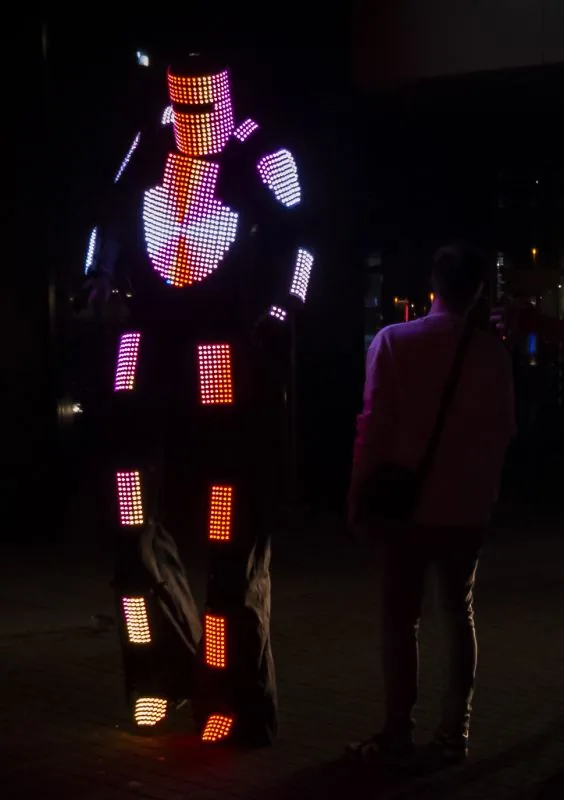
Independence from the venue. Our own event agency TRON built a walking pixel LED robot 2.5 m tall, with almost 2,000 pixels driven by one LEC3. It shows logos, text and video, and at exhibitions it is the act people queue to photograph.
The robot uses two wireless links: Wi-Fi to build and test the show, and wireless DMX for show sync during the performance. A stand is less extreme but follows the same rule: pre-wire the modules, bring your own network, and never assume the hall will provide one. The build is on our Our Work page.
The second difference is content. A stand is hired by a different brand at every show, so scenes have to be swapped without touching the pixel map. Vehicles and costumes push the same idea further, as our guide to pixel LED advertising explains. Builds for other space types are collected on our Solutions page.
 Source: LED Strip Studio
Shop, Showroom or Trade Show Stand: What Changes?
The environment, not the audience size, decides the specification. The table below sets the three commercial build types side by side.
| Criterion | Shop / retail interior | Showroom, representative premises | Trade show stand |
|---|---|---|---|
| Primary goal | Stop passers-by, hold brand colours | Credibility, ambience, product focus | Visibility across a crowded hall |
| Typical run time | Opening hours, daily, all year | Opening hours plus evening facade | A few show days, then dismantled |
| Who operates it | Store staff, non-technical | In-house team or owner | Stand crew, on the first morning |
| Control interface | Saved scenes recalled from a phone | Saved scenes over the in-house network | Own access point or wireless DMX |
| Content refresh | Per season and per campaign | Per occasion, such as a private viewing | Per client and per show |
| Signal distribution | Planned with the cable routes | An SPI Lamp at each fixture over Ethernet cable | Pre-wired modules, plugged together |
| Spare capacity | Medium, because the cavity closes after fit-out | High, because fixtures are hard to reach later | Low, because the structure is rebuilt anyway |
| Biggest risk | Effects too fast for the brand | Controller position decided too late | Depending on the hall’s network |
One line in that table is worth reading twice. Retail and showroom fixtures become inaccessible the moment the fit-out closes, so signal distribution and spare capacity belong in the same conversation as the joinery.
Which Mistakes Ruin Commercial Pixel LED?
Most failures in pixel LED lighting for commercial spaces repeat with striking consistency. None of them is a hardware fault.
- Programming a nightclub in a shop. Fast, saturated effects undercut the credibility of a premium brand.
- Building everything as one Digital strip. Individual objects can then never carry individual effects.
- Deciding controller positions after the interior is finished. Signal distribution should be planned while cable routes are still open.
- Depending on somebody else’s network. Remote control is only as reliable as the Wi-Fi behind it, and exhibition halls are the worst case.
- Leaving content out of the scope. Nobody is contracted to produce the scenes, so the installation runs one look forever.
- Handing over without training. A client who cannot recall a scene will keep the opening-day look for years.
 Source: LED Strip Studio
Planning lighting for a shop, a showroom or an exhibition stand? Book a free consultation and we will size the control chain around your space.
Sources & references
- LED Strip Studio — Pixel LED showroom lighting case study: Macho & Chlapovic numismatic showroom (WS2815 rings, SPI Lamp over CAT6, Digital strips per coin)
- LED Strip Studio — TRON pixel LED robot, Our Work page: 2.5 m, almost 2,000 pixels, LEC3, Wi-Fi and wireless DMX
- LED Strip Studio — LEC3 and SPI Matrix product pages: 1,024 RGB / 768 RGBW pixels per output, approx. 25 fps
- LED Strip Studio — SPI Lamp 2 product page: up to 100 m per Cat5e hop, up to 32 units, LEC3 and SPI Matrix only
- LED Strip Studio — Art-Net universe calculator: 512 channels, 170 RGB / 128 RGBW pixels per universe
- Lighting Controls Podcast — interview with the founder of LED Strip Studio: one hour of labour per metre, content budgets
- ESTA — ANSI E1.11 DMX512-A: 512 channels per universe
- Artistic Licence — Art-Net 4 specification
Summary
Pixel LED lighting for commercial spaces gives every pixel its own colour value, so one build covers seasons, campaigns and events without rewiring. Three numbers size the project: about 17 m of strip per controller output at 60 px/m, 100 m of Cat5e per SPI Lamp 2 hop, and roughly one hour of labour per metre before the fit-out closes. Shops need simple daily operation by staff, showrooms need signal distribution planned before the fit-out closes, and trade show stands need to be independent of the hall. In the showroom case study, each coin-shaped fixture is a separate Digital strip inside a Group, which allows per-object effects later. Restraint is the commercial brief: ambience first, effect second, and content budgeted from the start.