Installations
How Did We Power and Control a 341-Tube LED Tree in Kigali?
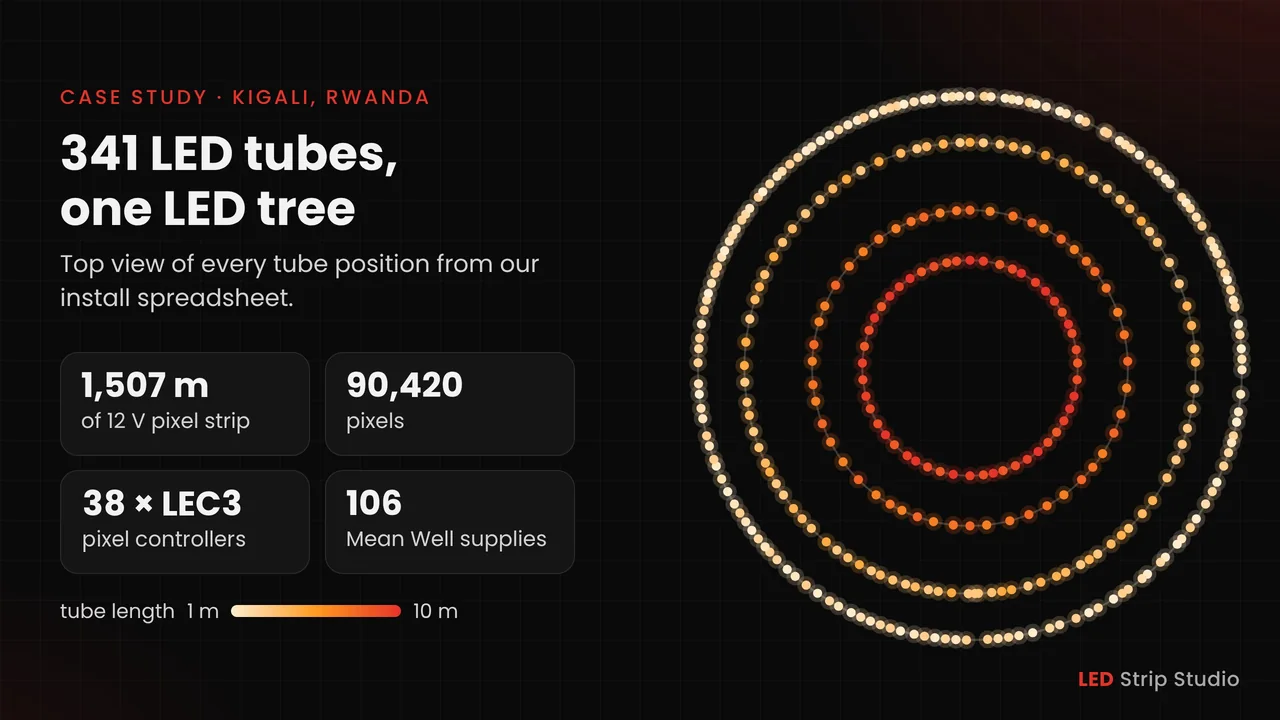
In April 2024, a public commemoration event at BK Arena in Kigali, Rwanda, had a giant pixel LED tree at its center. The tree hung 341 vertical LED tubes on four rings, short on the outside and up to 10 m long in the middle. We designed the whole pixel system from the client’s lighting plan, built and tested it in our warehouse, installed it on site and created the pixel mapping and effects. During the event itself, an external technician ran the effects.
The data side ran on 38 networked LEC3 pixel controllers and 290 SPI Lamp 2 units. Power came from 106 Mean Well supplies. This case study shows how those numbers came together. It’s written for integrators and lighting designers who plan large pixel structures, especially temporary ones that have to go up fast, and it puts our guide on how to calculate LED strip power supply requirements into practice.
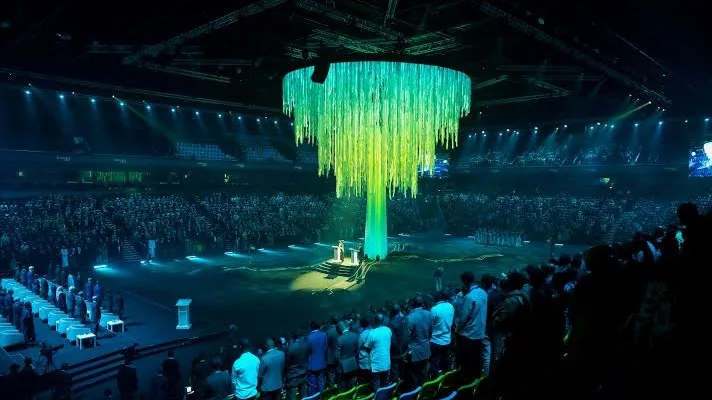 The LED tree during the commemoration event at BK Arena, Kigali, April 2024.
What Was the LED Tree at BK Arena?
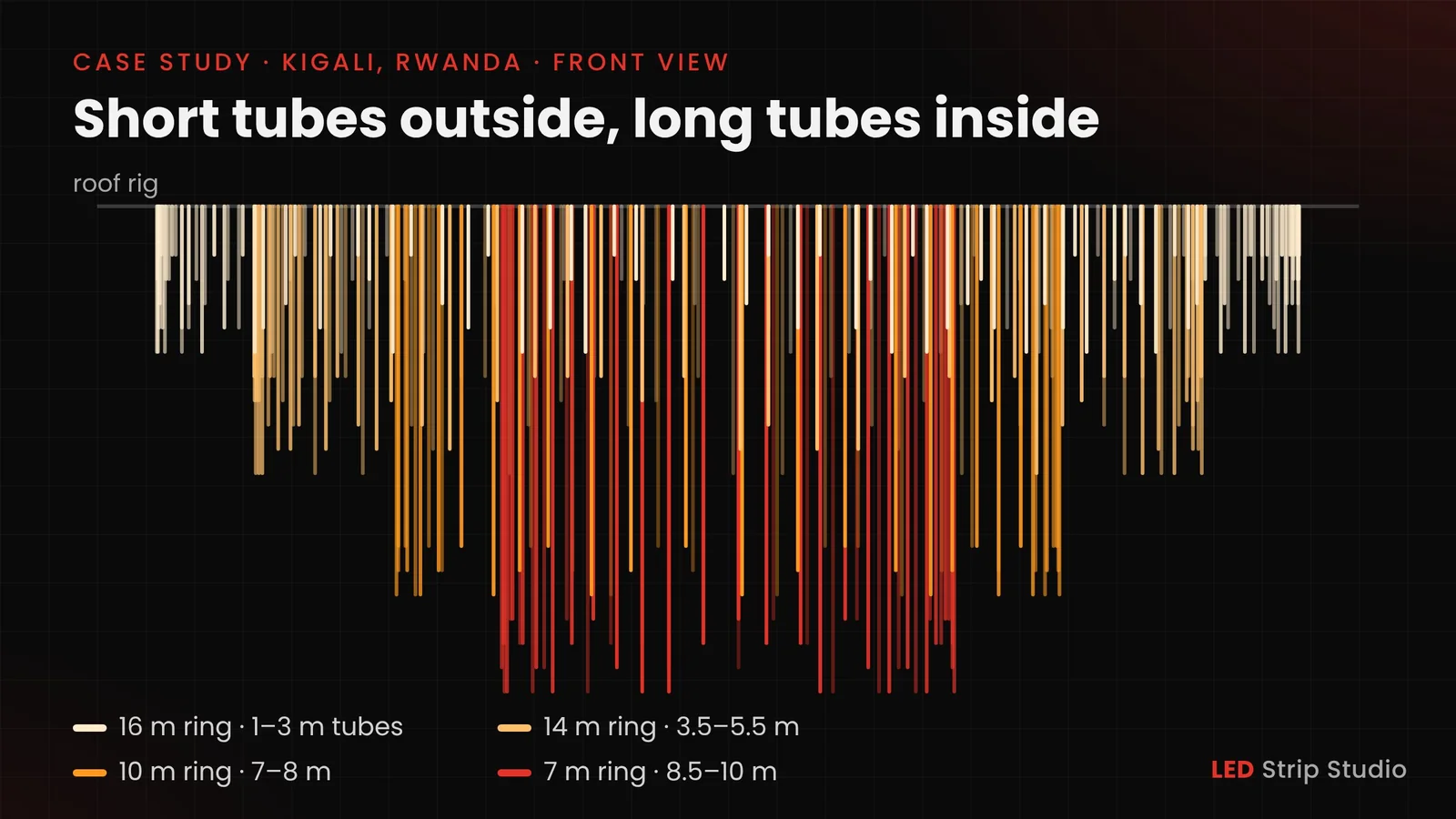
The tree is essentially a ring chandelier stretched into a cone. Four concentric rings hang from the roof rig, labeled 16, 14, 10 and 7 m in the lighting plan, and the tubes get longer towards the center. The shape and the tube lengths came from the client’s plan, with lighting design by Enjoy Lights and production by Comeanddo. The electrical and data design was ours.
Every tube is 12 V WS2815 pixel strip with 60 pixels per meter. WS2815 has a backup data line, so a single failed pixel doesn’t take the rest of a tube dark, which matters when the tube hangs out of reach. Along each ring, neighboring tubes sit 10 to 80 cm apart, and that uneven spacing gives the tree its loose, organic outline.
| Ring | Tube lengths | Tubes | Strip | Pixels | Supplies |
|---|---|---|---|---|---|
| 16 m | 1–3 m | 153 | 294.5 m | 17,670 | 26 × RSP-200-12 |
| 14 m | 3.5–5.5 m | 89 | 385 m | 23,100 | 30 × RSP-200-12 |
| 10 m | 7–8 m | 50 | 373 m | 22,380 | 25 × RSP-200-12 |
| 7 m | 8.5–10 m | 49 | 454.5 m | 27,270 | 25 × RSP-320-12 |
| Total | 1–10 m | 341 | 1,507 m | 90,420 | 106 |
Our short video shows the tree in motion.

How Did One Spreadsheet Plan 341 Tubes?
Everything lived in one spreadsheet with a row for every tube. Its file name, mapa pokladu, is Slovak for “treasure map”, and with 341 tubes that’s a fair description. For each tube it records:
- its position along the ring, in centimeters from a fixed starting point;
- its length and planned current at full output;
- the power supply it belongs to;
- its pixel count and the matching DIP switch setting;
- the controller output where its data chain starts.
Nobody on a lift should have to work out which tube goes where. The row, the position and the color code from the lighting plan tell the crew where each tube hangs, which supply feeds it and which output addresses it.
How Was the LED Tree Powered?
The strips run at 12 V, and the plan counted 1.3 A per meter at full output, which is 15.6 W/m. Over 1,507 m that comes to about 1,959 A, or roughly 23.5 kW at full white. Every power decision followed from that figure.
Instead of a few big units, we grouped supplies by position, so each one feeds the tubes right next to it. The same logic decided how many tubes share a controller output:
| Ring | Tube length | Tubes per supply | Supply | Tubes per output | Max. pixels per output |
|---|---|---|---|---|---|
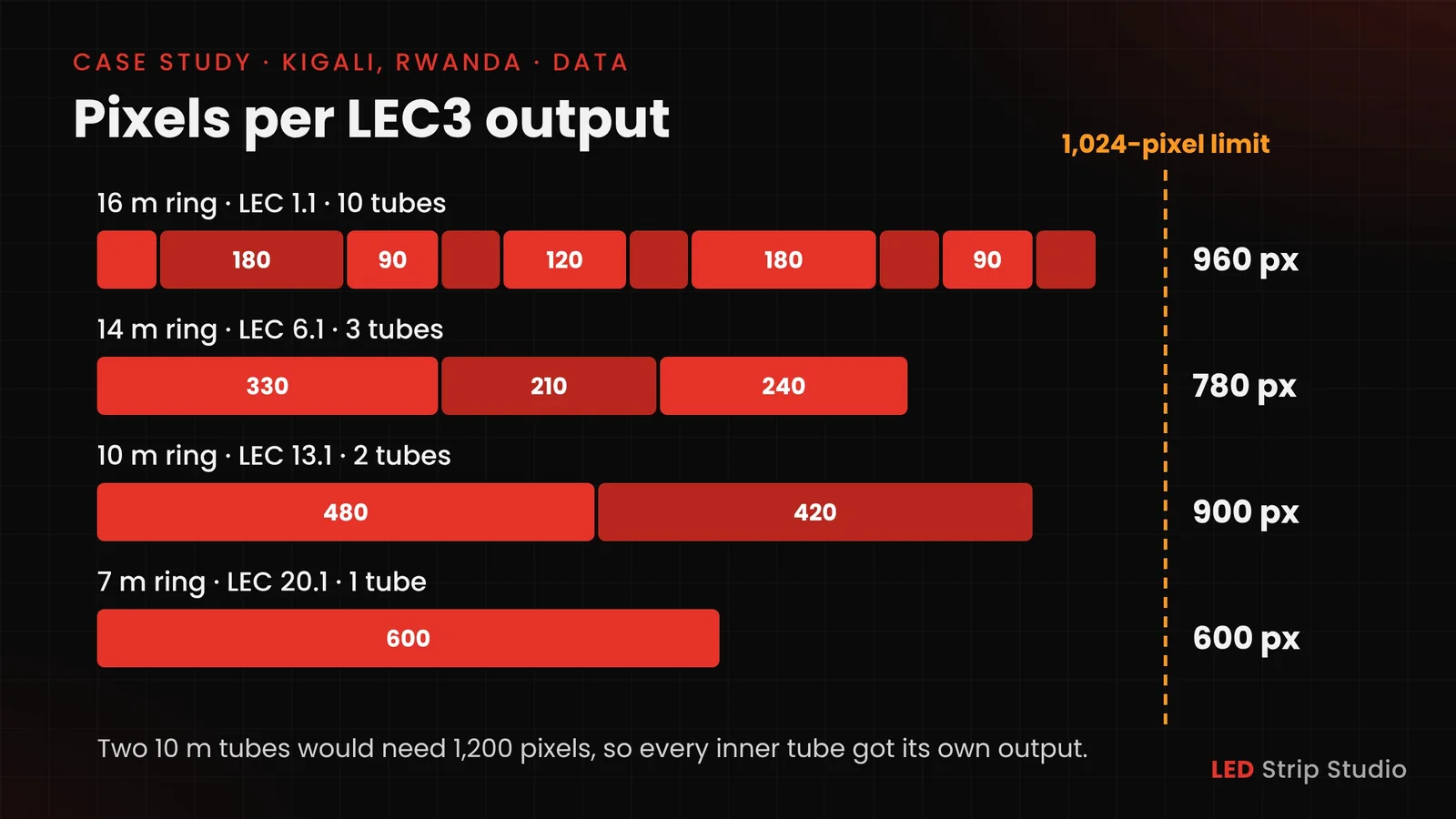
| 16 m | 1–3 m | 6 | Mean Well RSP-200-12 | up to 10 | 1,020 |
| 14 m | 3.5–5.5 m | 3 | Mean Well RSP-200-12 | 2–4 | 1,020 |
| 10 m | 7–8 m | 2 | Mean Well RSP-200-12 | 2 | 930 |
| 7 m | 8.5–10 m | 1–2 | Mean Well RSP-320-12 | 1 | 600 |
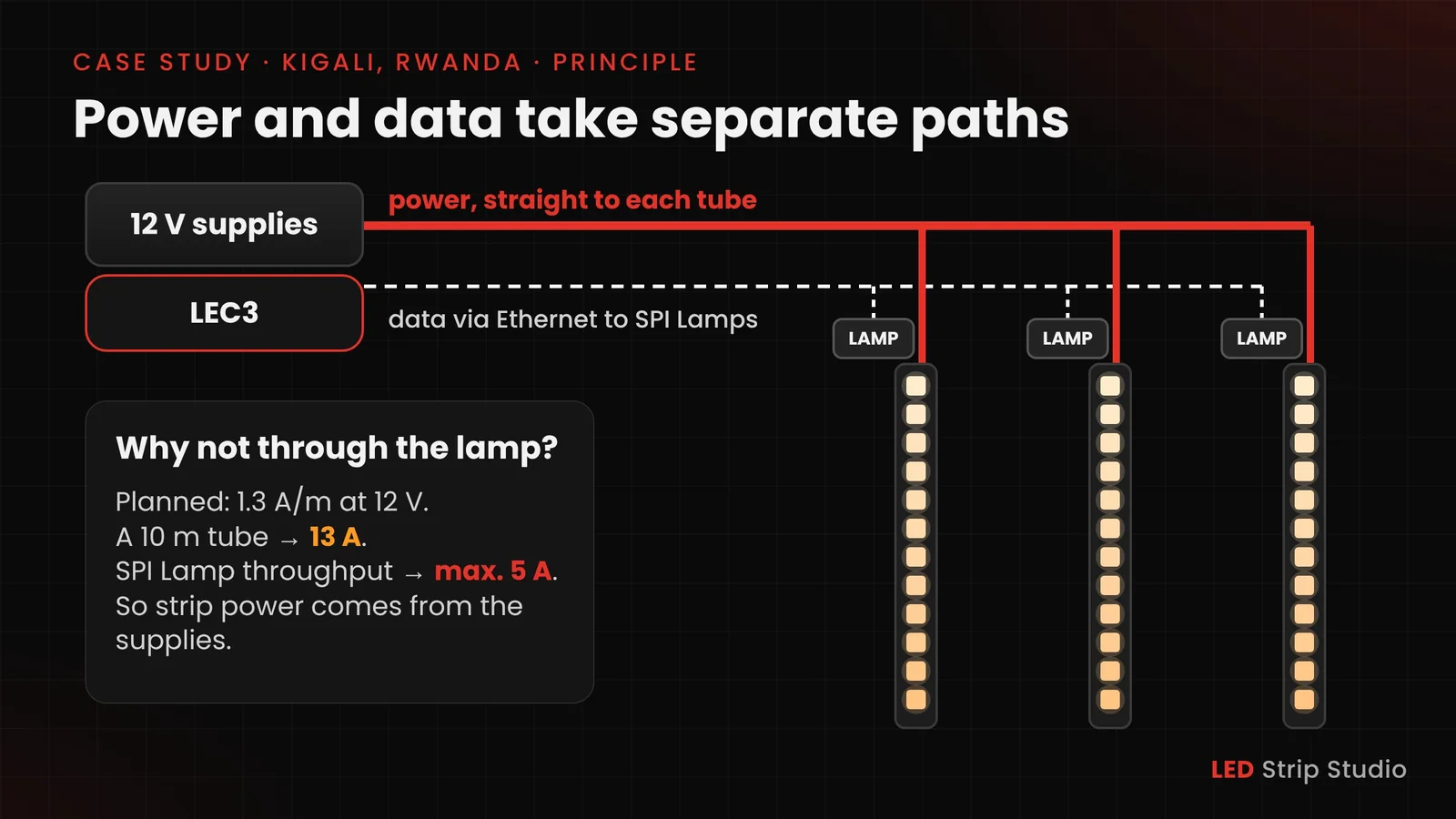
Grouping by position keeps every supply cable short. Strip power goes straight from the supply to the tube and never through a controller or an SPI Lamp. A 10 m tube can draw 13 A, while an SPI Lamp passes at most 5 A.
How Much Headroom Did the Supplies Have?
Less than we’d normally plan. The RSP-200-12 is rated at 16.7 A and the RSP-320-12 at 26.7 A. At full white, the average load per supply would be 14.7 A on the 16 m ring and 16.7 A on the 14 m ring. On the 10 m ring it would be 19.4 A, above the rating, and on the 7 m ring 23.6 A.
That was a deliberate, one-off decision. The tree was planned to run at reduced brightness, so the real load stayed below the full-white numbers, and the supplies were sized for it. For a single event with a fixed program, that worked.
It isn’t how we’d build a permanent installation, though. There we keep the 25 % headroom from our guide on how to calculate LED strip power supply requirements, because content and brightness settings change over the years.
How Was the Data Distributed?
The 38 LEC3 units feed chains of SPI Lamp 2 units over Ethernet, 290 lamps in total. Each lamp turns the differential signal back into SPI right at the top of the tubes. No plain data wire has to run along the rig from one tube to the next.
Chains were planned around the 1,024-pixel limit of one output, which applies to WS2815 on the TM1809 800 kHz chip type. Outer tubes are short, so up to ten share an output, while every inner tube gets one to itself. No output carries more than 1,020 pixels, and every chain stays well within the 32 lamps an SPI Lamp 2 chain allows.
The controllers were networked and synchronized, so the whole structure plays one animation. Content travels as Art-Net over Ethernet, which means effects can be adjusted remotely, without anyone climbing up to the tree.
How Do You Set the Pixel Count on an SPI Lamp?
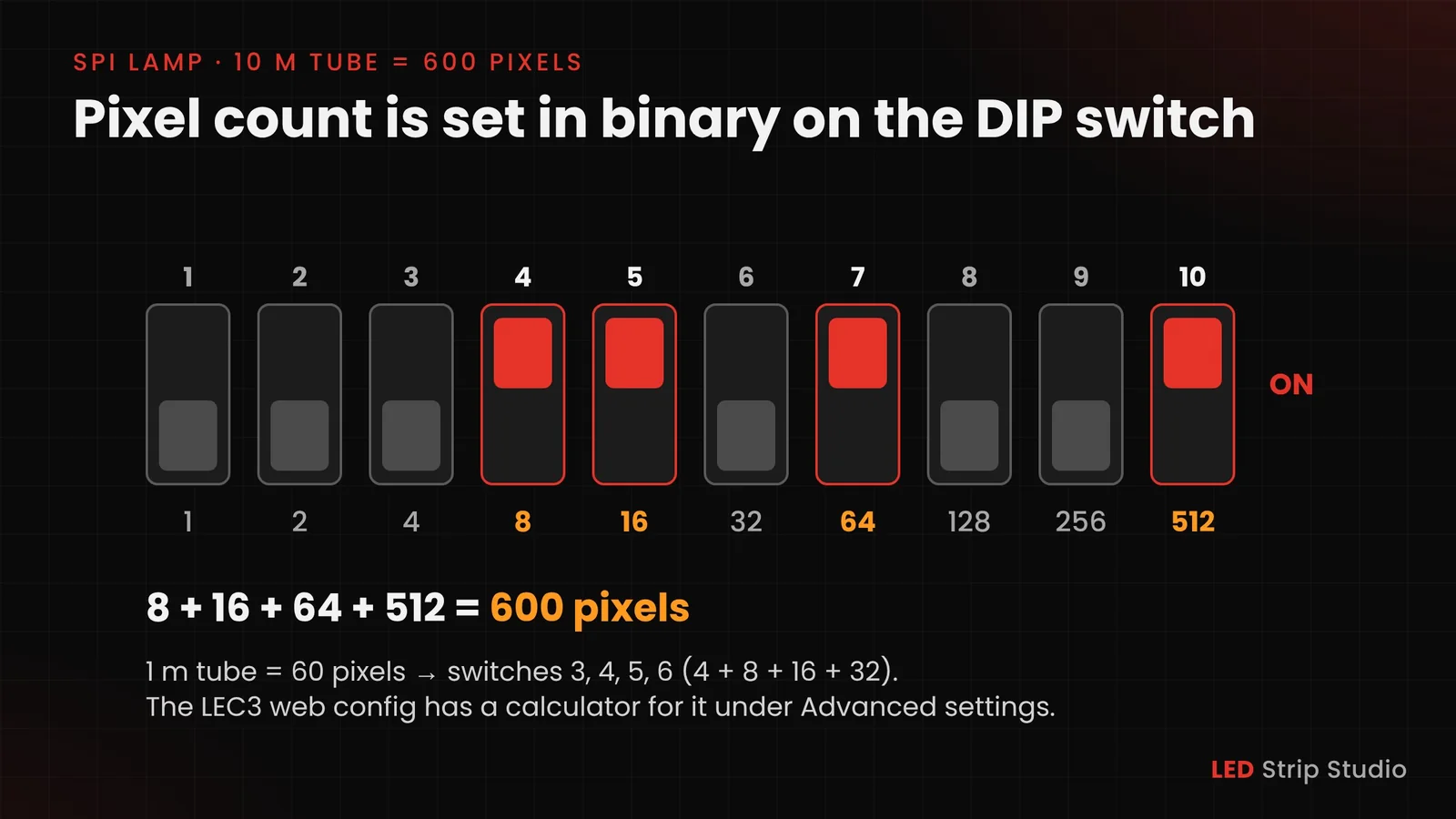
Each SPI Lamp has to know how many pixels hang below it, and you set that number in binary on its DIP switch. A 10 m tube has 600 pixels, so switches 4, 5, 7 and 10 go on: 8 + 16 + 64 + 512 = 600. The spreadsheet listed the pattern for every tube length, so nobody had to convert numbers by hand.
Don’t want to count in binary? The LEC3 web config has a DIP switch calculator under Advanced settings, and our SPI Lamp guide covers the rest of the setup. Why Ethernet works where a plain data wire doesn’t is explained in our guide to sending an SPI signal over long distance.
Why Did We Build the Whole Tree in Our Warehouse First?
Before anything shipped to Rwanda, we assembled the complete tree in our warehouse. The structure was built and every strip installed, and all controllers and the Ethernet network were configured. Every animation was programmed and tested, and the tree shipped only once each element was verified working.
A mock-up of this size costs warehouse space and time. In return, the work on site comes down to rigging and connecting rather than troubleshooting. With a fixed event date and an arena full of people, that matters.
Which Mistakes Does a Build Like This Make Easy?
Large temporary pixel structures tend to fail in the same few ways. These are the ones the plan was built to avoid:
- Planning tubes in your head. Without one row per tube, positions, supplies and outputs drift apart on site.
- Grouping supplies by wattage only. Supplies placed by position keep cables short and voltage drop low.
- Routing strip power through data hardware. Controllers and SPI Lamps have their own current limits, so feed the tubes from the supplies.
- Filling outputs past the pixel limit. Long tubes need an output of their own; short ones can share.
- Sizing for reduced brightness without locking it. If supplies are sized below full white, cap the brightness in the software so nobody pushes full white by accident.
- Testing for the first time on site. A full warehouse mock-up turns site days into rigging days.
Planning a large pixel structure, permanent or for one night? Book a free consultation with our team, or see more builds in our project portfolio.
Frequently Asked Questions
How many pixels did the LED tree in Kigali have?
90,420 pixels on 1,507 m of 12 V WS2815 strip at 60 pixels per meter. They were spread over 341 tubes between 1 and 10 m long.
How many power supplies did the LED tree need?
106 Mean Well supplies: 81 × RSP-200-12 on the three outer rings and 25 × RSP-320-12 on the inner ring. Each one fed up to six neighboring tubes.
Why did each inner tube get its own controller output?
A 10 m tube has 600 pixels, so two of them would need 1,200, above the 1,024-pixel limit of one LEC3 output. Shorter tubes on the outer rings share outputs.
Why weren't the tubes powered through the SPI Lamps?
A 10 m tube can draw 13 A at full output, while an SPI Lamp passes at most 5 A. The tubes were therefore fed straight from their supplies.
Summary
A giant pixel LED tree for a commemoration event at BK Arena, Kigali: 341 WS2815 tubes on four rings, 1–10 m long, 1,507 m in total. Its 90,420 pixels were driven by 38 networked LEC3 controllers and 290 SPI Lamp 2 units over Ethernet. 106 Mean Well supplies were grouped by position, each feeding up to six neighboring tubes, and power never passed through the data hardware. The supplies were sized for reduced brightness, a one-off choice; permanent installations should keep about 25 % headroom. The whole tree was assembled, configured and tested in our warehouse before it shipped.
Sources & references
- LED Strip Studio — install spreadsheet “mapa pokladu” (position, length, current, supply, pixel count, DIP setting and controller output for all 341 tubes)
- Client lighting plan “Rwanda Ceremony”, LED Tubes (front view, ring layout, strip list), BK Arena, Kigali, April 2024
- LED Strip Studio — YouTube: Large Pixel Tree (17 April 2024)
- LED Strip Studio — portfolio: Giant Pixel LED Tree, Rwanda: warehouse mock-up, SPI Lamps, networked LEC controllers, Art-Net over Ethernet
- Mean Well — RSP-200 and RSP-320 series datasheets (RSP-200-12: 12 V, 16.7 A; RSP-320-12: 12 V, 26.7 A)
- LED Strip Studio — SPI Lamp 2: DIP switch pixel count in binary, 5 A throughput, up to 32 lamps and 1,024 RGB pixels per chain
- LED Strip Studio — LEC3: 4 outputs per unit, 1,024 pixels per output for the TM1809 800 kHz chip type
- Worldsemi — WS2815 datasheet (12 V, backup data line)