Technology
How Do Dimmable Festoon Lights Work for Weddings and Terraces?

Festoon lights with Edison-style bulbs have become the classic look of weddings, restaurant terraces and summer festivals. Most of them still run on a plain switch or a simple dimmer: one shade of white, one brightness, all evening. This article shows how dimmable festoon lights with warm and cool white can follow the whole evening, from sunset to the last dance. They are controlled by the same DMX dimmer we build for Christmas lights.
It is written for event technicians, equipment rental companies, wedding venue operators and restaurant owners who want festoon lights to work as lighting design, not just decoration.
 Source: LED Strip Studio
What Are Dual-Polarity Festoon Lights?
Dual-polarity festoon lights are two-wire light lines in which reversing the DC polarity switches between two separate groups of LEDs. Our Edison Dual White Bulb is built this way. It holds three warm white and three cool white filaments: one polarity lights the warm filaments, the reverse polarity lights the cool ones.
A standard LED dimmer outputs only one polarity, so it would light just one of the two sets. The XMAS DIMMER has a full H-bridge on each of its eight outputs. It drives both polarities and dims each on its own DMX channel. One festoon line therefore gets two independent settings: warm white brightness and cool white brightness.
Why should a Christmas dimmer control wedding lights? Because anti-parallel Christmas strings work on exactly the same dual-polarity principle. There the two polarity groups are the odd and even LED sections; in the Edison CCT bulb they are warm and cool white. The XMAS DIMMER manual lists both uses side by side.
For a decoration company, that is a business argument. Dimmers that sit in stock from November to January can light weddings in June and terraces in August. The Christmas side of the product is covered in our article on running commercial Christmas lights as a DMX light show.
Which Parameters Drive a Festoon Line Design?
Every design comes down to a few numbers from the datasheets: the bulb’s 33 V operating voltage, its 38 mA per polarity, and the XMAS DIMMER limits of four bulbs per output and 24 bulbs per dimmer. Everything else follows from them.
| Parameter | Edison CCT bulb | XMAS DIMMER |
|---|---|---|
| Operating voltage | 33 V DC, 2 polarities | 12–36 V DC input; output voltage = input voltage |
| Current | 38 mA warm + 38 mA cool | Max. 0.5 A per output, resettable fuse 0.7 A |
| Power | 1.25 W warm + 1.25 W cool | Self consumption 3 W |
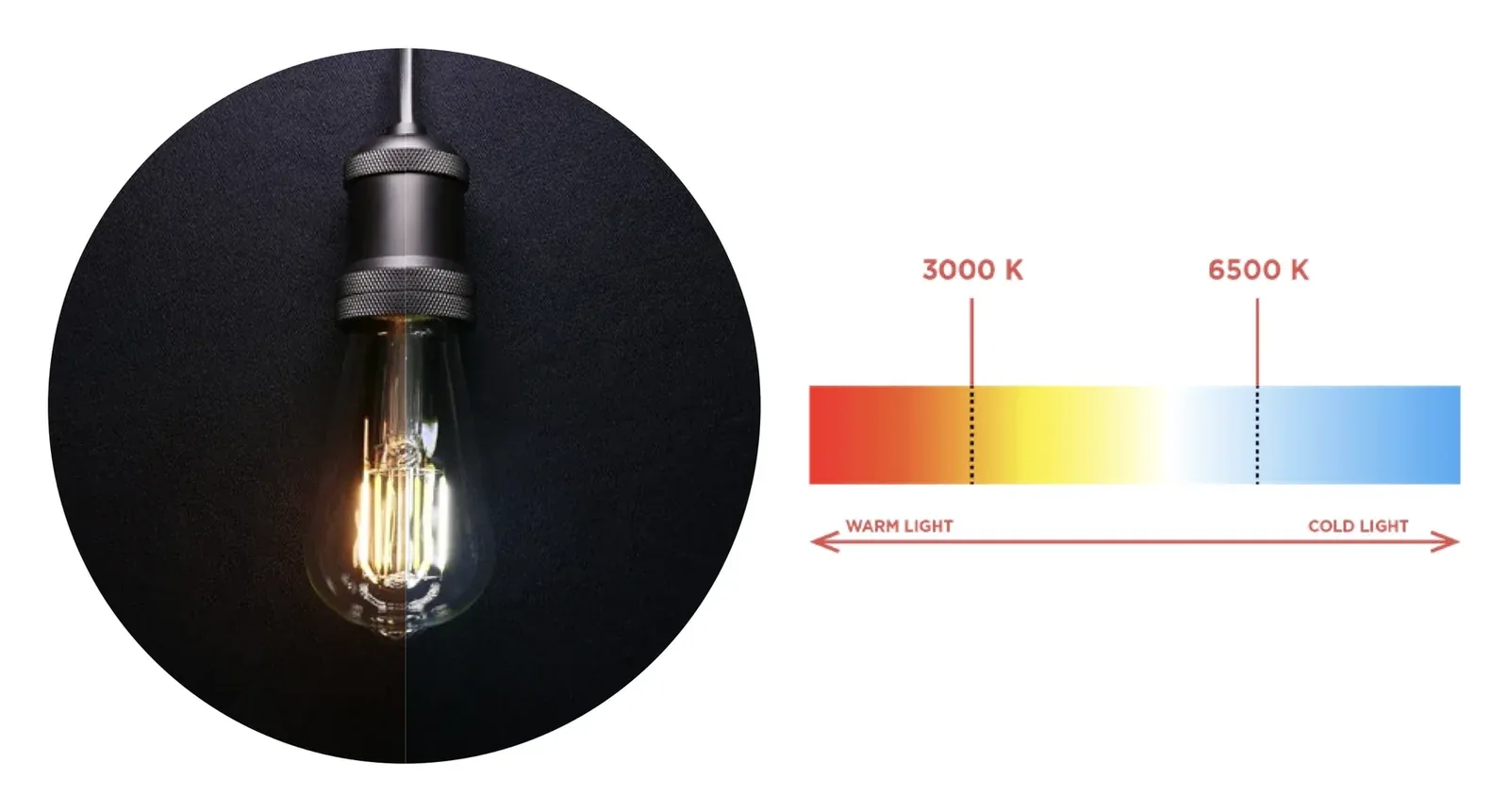
| Light | 3,000 K / 6,500 K typ., CRI > 82 | 8-bit dimming, PWM approx. 1,000 Hz |
| Base / shape | E27, glass ST64, 64 × 140 mm | PCB, 8 outputs, 16 DMX channels |
| Bulbs per dimmer | — | 1 per output recommended, max. 4 per output, max. 24 in total |
| Operating conditions | −10 °C to +45 °C, 5–80 % RH non-condensing | −10 °C to +45 °C, 5–80 % RH non-condensing, IP00 |
The bulb datasheet gives about 150 lm/W. That is roughly 190 lm per set of filaments — a warm decorative level, not task lighting.
 Source: LED Strip Studio
How Many Edison CCT Bulbs Can One Output Carry?
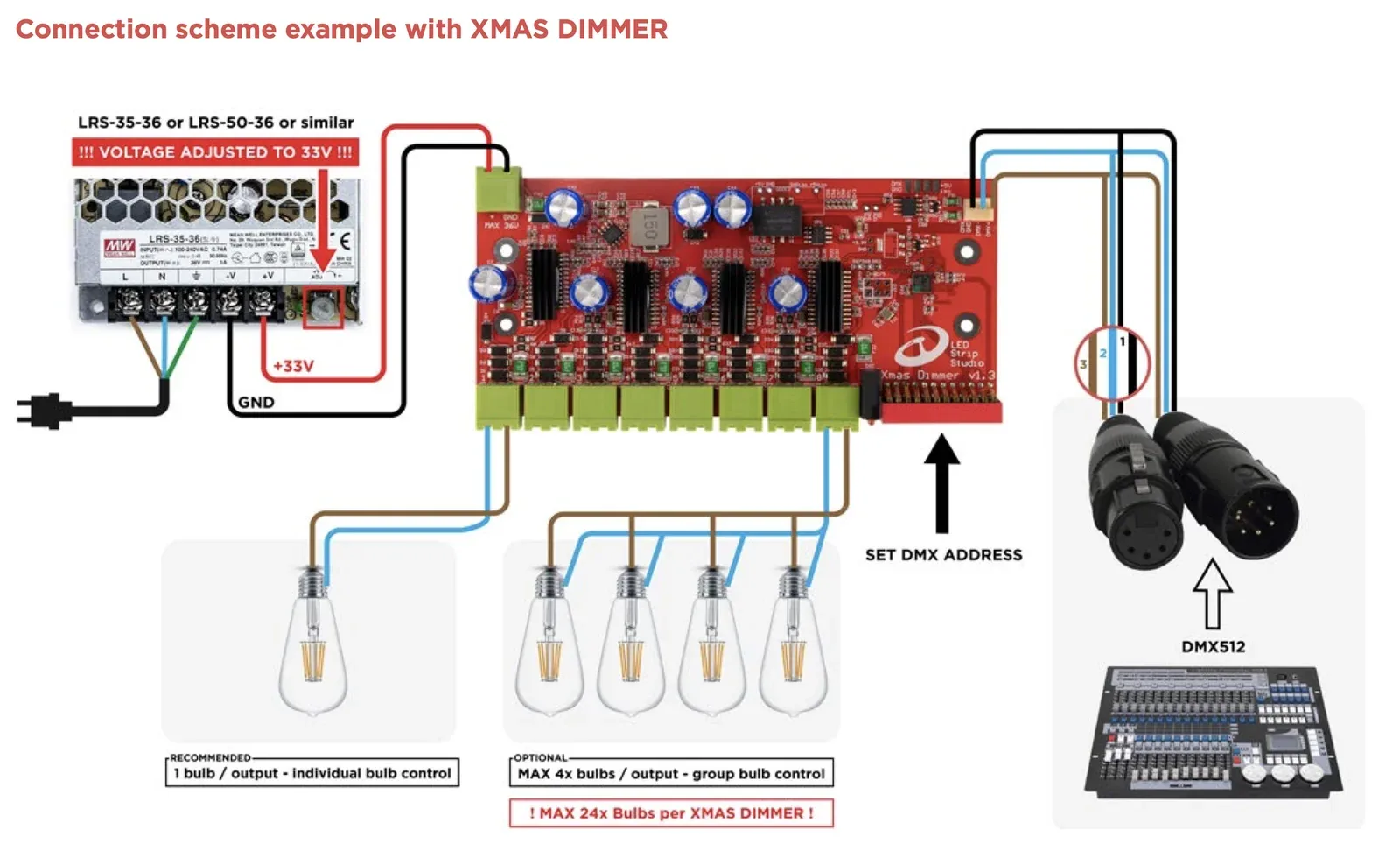
On current alone, 0.5 A would allow 13 bulbs, because 13 × 38 mA is 494 mA. The XMAS DIMMER documentation sets a lower limit: one bulb per output is recommended for individual control, up to four bulbs can share an output as a group, and one dimmer should carry no more than 24 bulbs. Follow those limits, not the fuse.
Only one polarity conducts at any moment, so mixing warm and cool does not double the current. At the full 24 bulbs, the line draws about 0.9 A at 33 V, roughly 30 W plus 3 W for the dimmer. The wiring example in the bulb datasheet uses a Mean Well LRS-35-36 or LRS-50-36 supply with its output adjusted to 33 V.
How Do You Mix Warm and Cool White on One Line?
Each output uses two consecutive DMX channels. Output 1 is on channels 1 and 2: channel 1 dims the positive polarity, channel 2 the negative one. The datasheet puts warm white on the positive centre contact of the E27 base, but test the line once and label it, because the wiring decides which channel ends up warm.
Raising both channels blends the two sets of filaments into an in-between white. Warm white alone, around 3,000 K, suits dinner. Adding cool gives a fresher tone as guests arrive at dusk. The dimmer splits every PWM period into two halves, one per polarity, so even with both channels at 255 each set of filaments is lit for half the time. Mixing shares the time between warm and cool rather than adding their brightness.
 Source: LED Strip Studio
Example: XMAS DIMMER at a Wedding
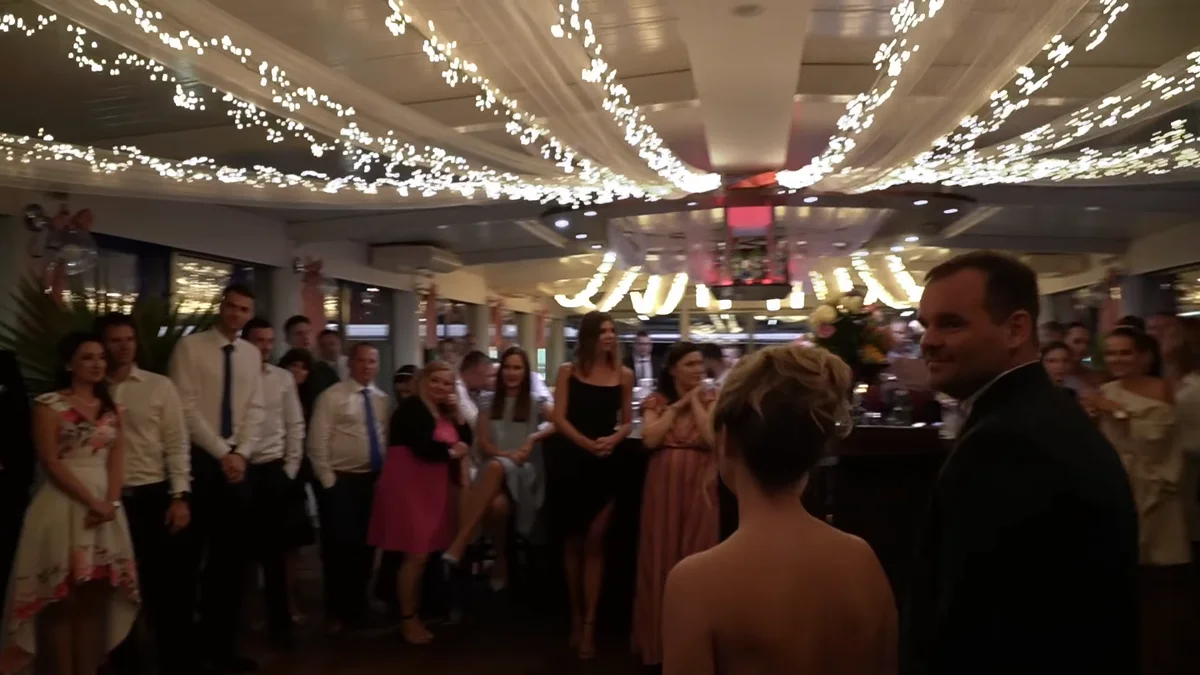
Our video “Xmas Dimmer on a Wedding” shows the dimmer doing a job we never promoted it for: string lights across the ceiling of a wedding venue, dimmed over DMX while the guests dine and dance. The idea is simple: the same board that runs a Christmas market can carry the mood of a wedding reception.
 Watch “Xmas Dimmer on a Wedding” on Facebook · Source: LED Strip Studio
The same dual-polarity principle also works at a much larger scale. At the Day&Night club in Bratislava we covered the ceiling with more than 350 Edison bulbs, controlled over DMX by 40 dual-polarity dimmers. The owner wanted to run the scenes from a simple MIDI keyboard, so scene selection, brightness and animation speed sit on the pads and knobs of an Akai MIDI controller.
What Does a Wedding Evening Split Into Scenes Look Like?
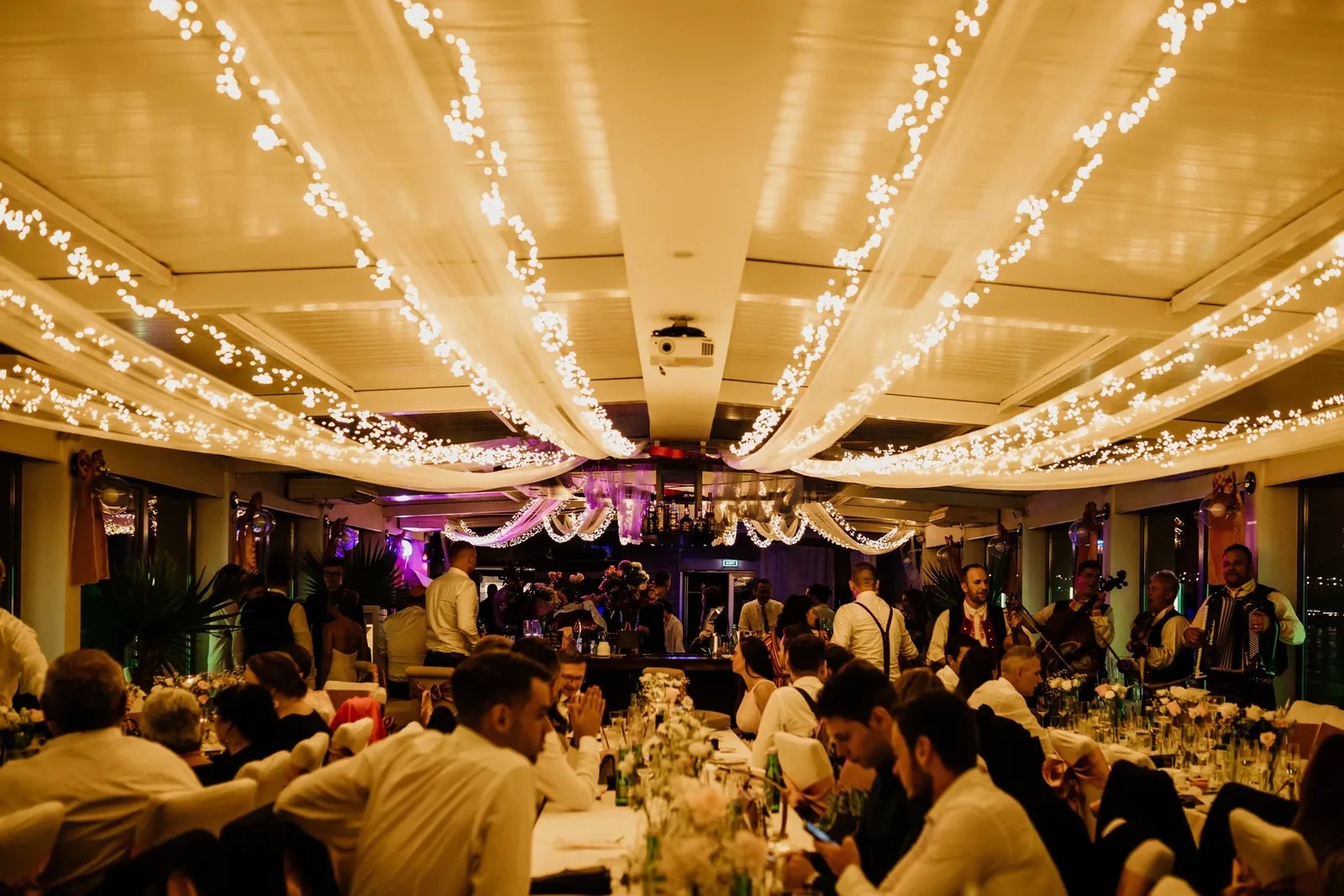
The value of CCT control shows over time, not in a single photo. This is a typical plan we recommend to venues — a recommendation, not a measured standard:
 Source: LED Strip Studio
- Arrival at dusk: warm with a touch of cool at medium level, so the lights stand out against the remaining daylight.
- Dinner: warm white only, around 50–60 %, flattering faces and food.
- First dance: the lines dim to a slow, warm “breathing” or lead gradually towards the dance floor.
- Party: chase effects across the lines, synced with music from LED Strip Studio software.
- Late night: warm, low and static — a clear signal that the evening is winding down.
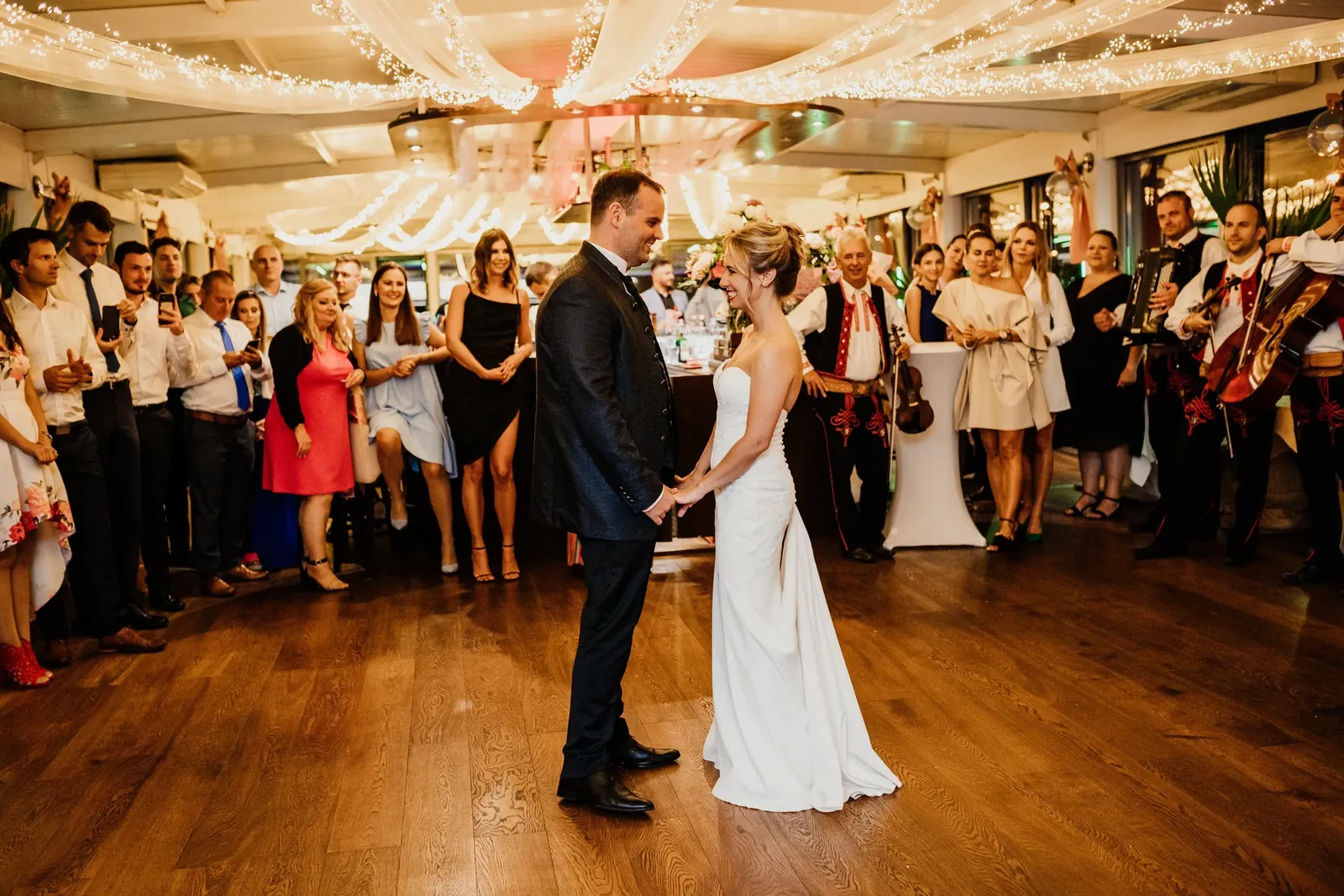 Source: LED Strip Studio
Which Controller Suits Weddings, Terraces and Festivals?
The choice depends on two questions: do you control whole lines or individual bulbs, and do you want to build your own enclosure? The table compares the two LED Strip Studio options that drive Edison CCT bulbs.
| Criterion | XMAS DIMMER | Powered Bulb Dimmer Dual Polarity (MEGA SET) |
|---|---|---|
| Control input | DMX512 | Differential 800 kHz SPI (WS2811 family) |
| Unit of control | 8 lines, 1–4 bulbs each, max. 24 bulbs | 64 bulbs individually |
| Power | External 33 V DC supply | Built in: 85–264 V AC input, 33 V outputs |
| Housing | None, bare PCB (IP00) | Aluminium enclosure, IP30 |
| Best for | Integrators with their own cabinets, line-by-line scenes | Terraces and venues with effects on every bulb |
The Edison CCT Bulb MEGA SET combines 64 bulbs with one Powered Bulb Dimmer Dual Polarity for installations where every bulb should move on its own. It takes its signal from a pixel controller with an SPI output, such as LEC3.
How Do You Connect a Festoon Line to the XMAS DIMMER?
- Use a two-wire festoon cable with E27 sockets and fit it with Edison CCT bulbs only.
- Keep to one bulb per output for individual control, or up to four per output as a group — no more than 24 bulbs per dimmer.
- Connect the line’s two wires to pins A and B of one output.
- Power the dimmer from a 33 V DC supply sized for all connected bulbs.
- Set the DMX start address with the DIP switch in steps of 16, for example 1, 17, 33.
- Programme the scenes and test the whole setup before the day of the event.
Installation must be carried out by a competent person or a qualified electrician, in line with local regulations. For broader DMX basics, see how to control LED strips over DMX.
Which Mistakes Ruin Dimmable Festoon Lights?
Failures at summer events come from site conditions and handover, not from the electronics. These points are worth checking before the first booking.
- Treating the bulbs as outdoor-rated. The datasheet gives no IP rating and specifies non-condensing humidity. An uncovered garden wedding with night dew needs a rain plan and a covered alternative.
- Leaving the dimmer board exposed. The bare XMAS DIMMER is IP00; put it in a dry box or a technical room.
- Mixing with 230 V festoon lines. A 33 V line looks like a mains festoon. Label every cable so nobody plugs it into a socket or screws a mains bulb into it.
- Wrong supply voltage. The dimmer accepts 12–36 V, but the bulbs are specified for 33 V.
- Overloading the outputs. More than four bulbs on an output, or more than 24 on one dimmer, is outside the documented limits.
- No plan for who runs the lights. Weddings rarely have a lighting operator. Programme the scenes in advance and hand over a simple way to recall them.
- Surprising the videographer. The dimmer is flicker-free on most cameras, but a polarity-switching output always pulses. Ask for a test shot at the frame rate they will use.
Planning festoon lights for a wedding venue, a terrace or a rental company? Book a free consultation and we will size the dimmers, supplies and lines for your venue.
Sources & references
- LED Strip Studio / Showtacle Ltd. — XMAS DIMMER User Manual and datasheet (2023): specification, DMX channel list, DIP addressing, compatibility with Edison CCT bulbs
- LED Strip Studio — Edison CCT LED Bulb datasheet
- LED Strip Studio — Powered Bulb Dimmer Dual Polarity datasheet
- LED Strip Studio on Facebook — video “Xmas Dimmer on a Wedding”
Summary
Dimmable festoon lights with Edison CCT bulbs give every line separate control of warm (3,000 K) and cool (6,500 K) white. The XMAS DIMMER drives both polarities, so the same unit runs a Christmas market in winter and a wedding in summer. Plan one bulb per output for individual control, at most four per output as a group, and no more than 24 bulbs per dimmer on a 33 V DC supply. For effects on every single bulb, the Edison CCT Bulb MEGA SET pairs 64 bulbs with a Powered Bulb Dimmer Dual Polarity. Keep the electronics dry, label the 33 V cables and programme the scenes before the event.