Long Cables. Protected Ports.
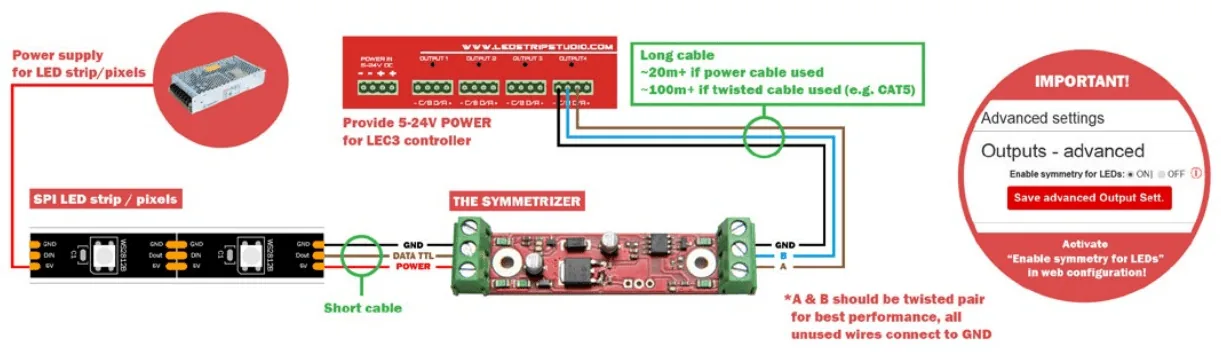
A long data cable collects static discharge and voltage spikes on its way across a site. The Symmetrizer protects both its TTL and differential ports, and its power input, against ESD and overvoltage.
Protection
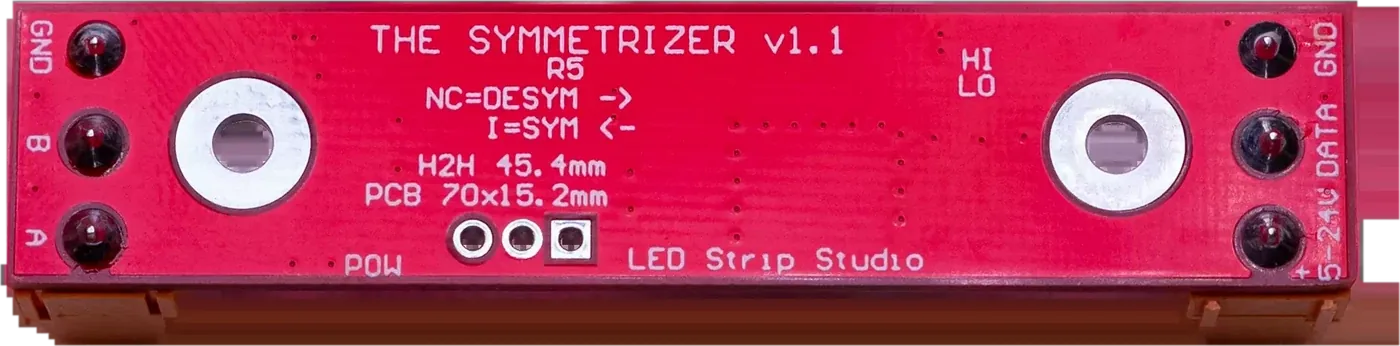
Both ports and the power input
Long cables run past power lines, motors and other equipment, and they are handled and plugged on site. Both the TTL port and the differential port of The Symmetrizer are protected, together with the power input, so a static discharge or a voltage spike on the line is far less likely to damage the board or the pixels behind it.
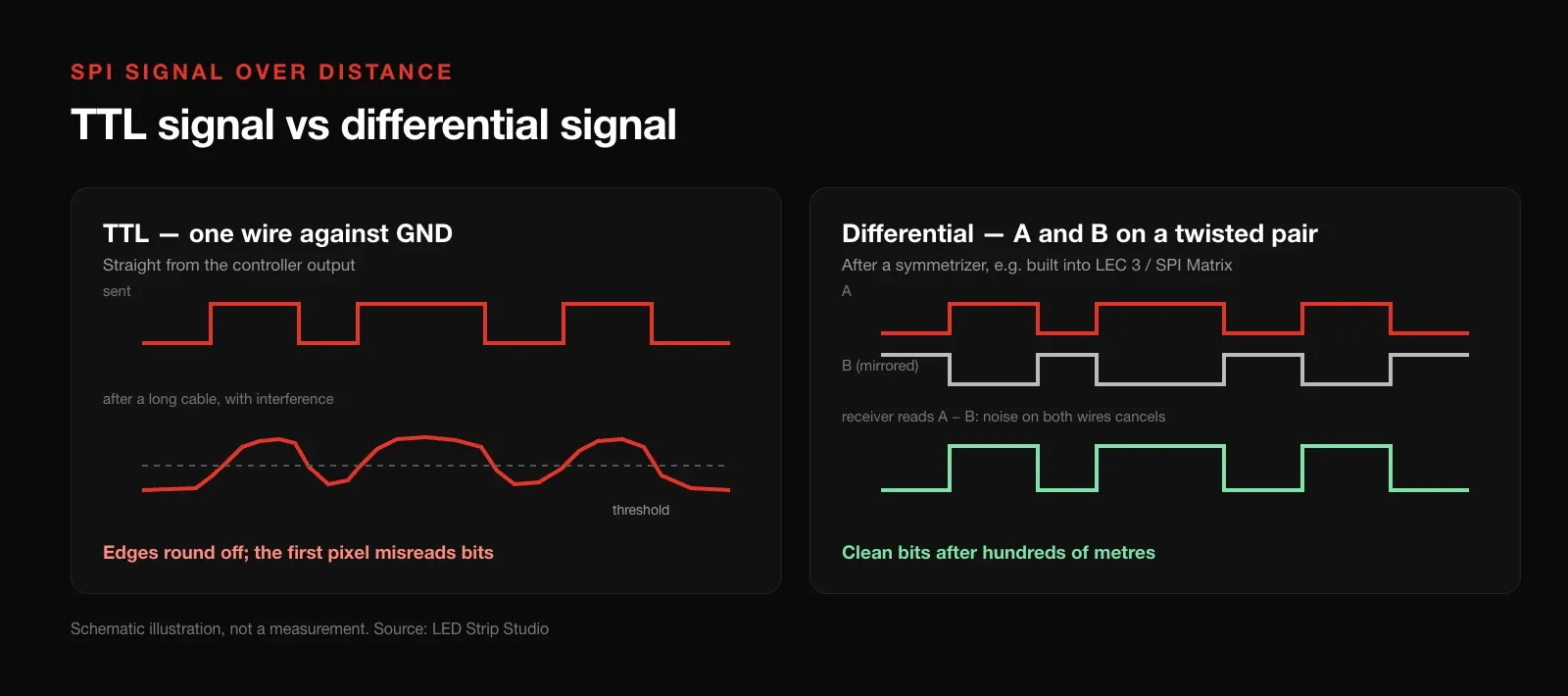
The differential signal itself adds robustness: noise that hits both wires of the pair equally cancels out at the receiver.
- TTL port protected
- Differential port protected
- Overvoltage and ESD protection on the data lines and power
- Differential A/B signal rejects common noise
Real Sites
Protection works best with good wiring
The board operates from −30 °C to 65 °C and is stored from −30 °C to 85 °C, at 5–80 % relative humidity without condensation. It is not rated as waterproof, so mount it in a dry junction box or enclosure.
Protection does not replace clean cabling. Use shielded Cat5e or Cat6 cable, run A and B on one twisted pair and connect the unused wires to GND.
- Operating temperature −30 °C to 65 °C
- 5–80 % relative humidity, non-condensing
- Mount in a dry junction box or enclosure
- Shielded Cat5e/Cat6, unused wires to GND
FAQ
Protection questions
Both the TTL port and the differential port, including the power input, are protected against ESD and overvoltage.
It operates from −30 °C to 65 °C but is not waterproof and needs non-condensing conditions, so mount it in a dry junction box or enclosure. Full answer in Outdoor and Harsh-Environment Hardware.
Shielded Cat5e or Cat6, with A and B on one twisted pair and the unused wires connected to GND. More in Long-Distance SPI Signal.
Planning a Demanding Installation?
Tell us about the site and cable routes and we'll help you plan a robust signal chain.
Book a Free Consultation →