Controller in the Rack. LEDs Far Away.
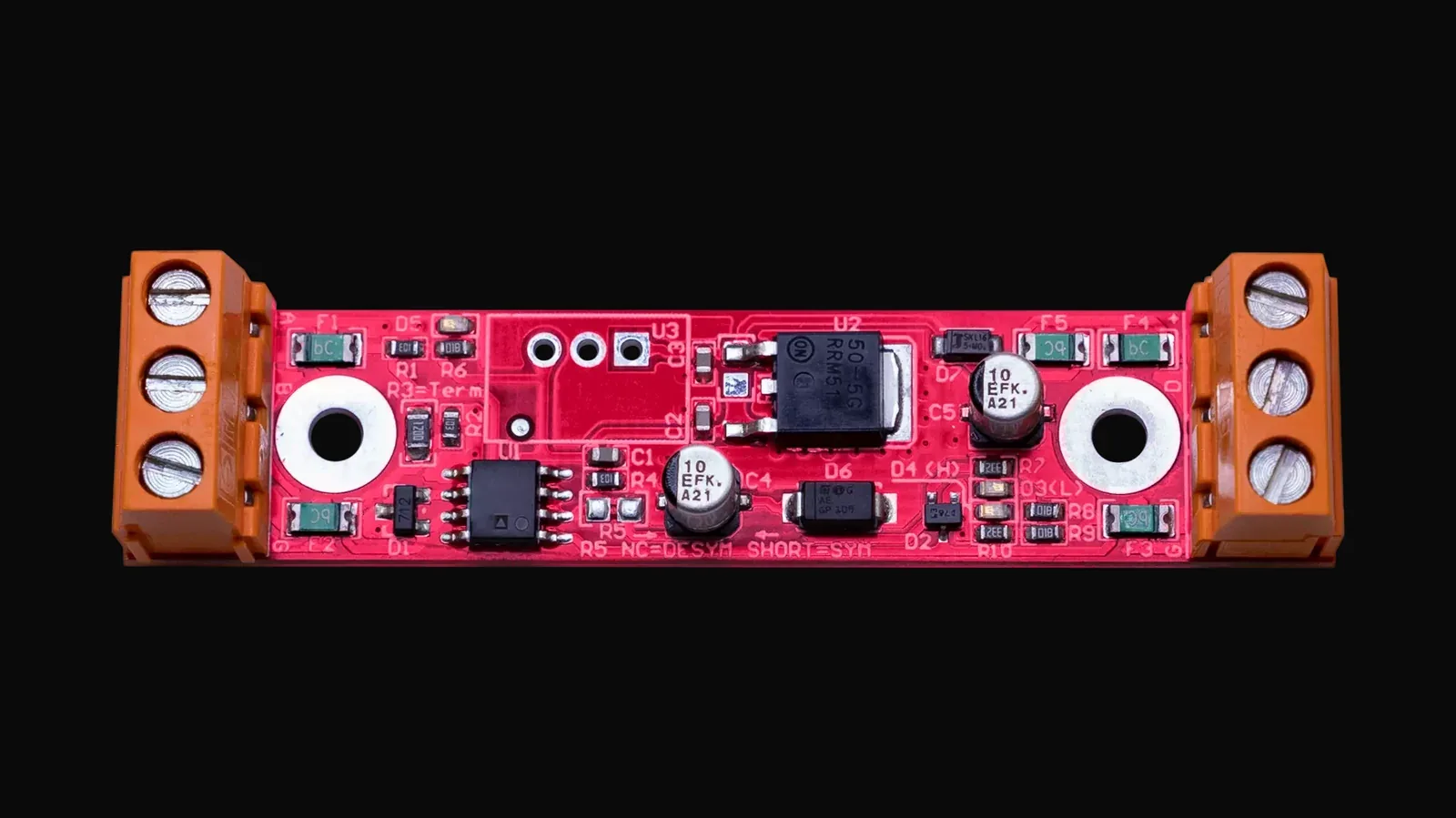
Plain SPI pixel data is reliable for about a metre. LEC3 and SPI Matrix have The Symmetrizer built in: switch it on and the outputs send a differential signal over twisted-pair cable, tested for more than 500 metres, with a receiver at the strip end.
The Problem
Why SPI data fails over distance
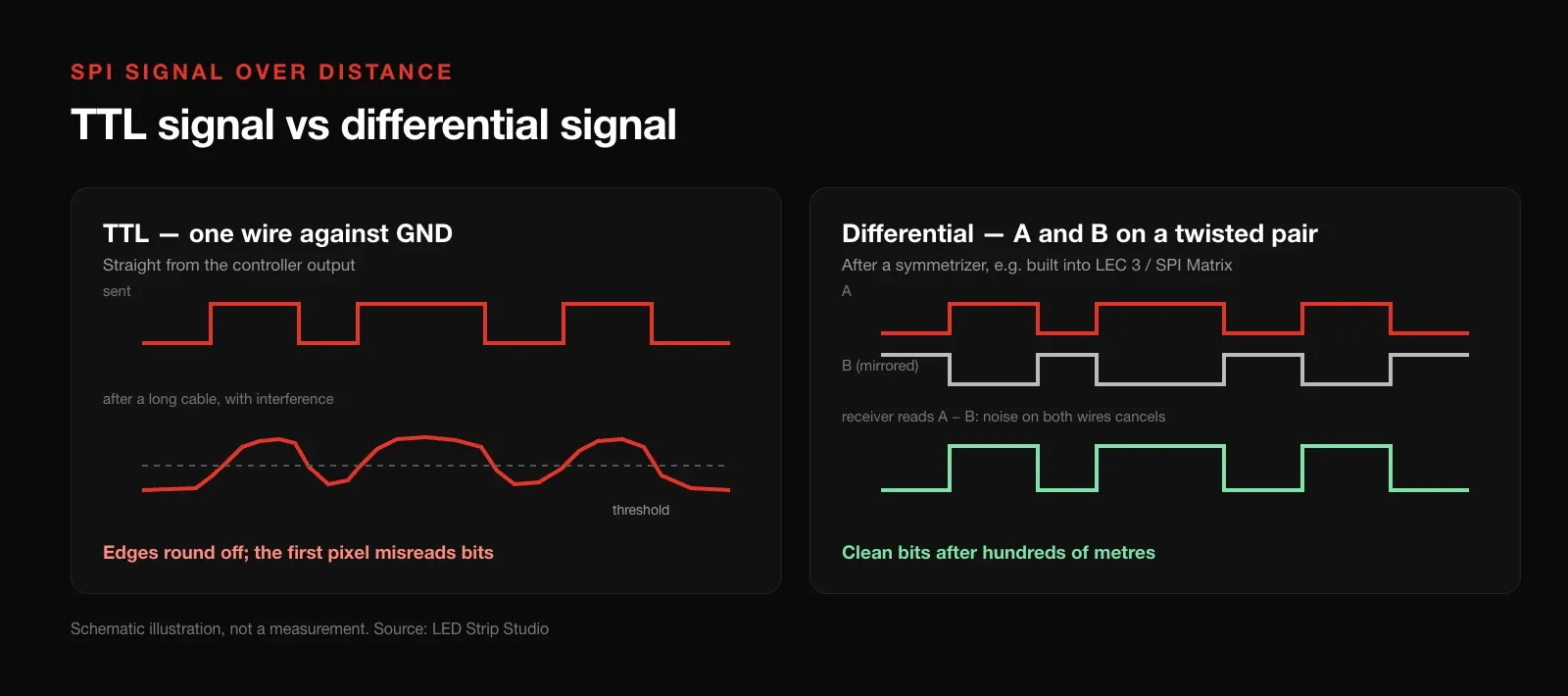
Pixel data leaves the controller as a single-ended TTL signal: one data line measured against ground. On a long cable it picks up interference from power lines and neighbouring data lines, and the edges of the signal smear. The result is flicker, random colour pops or strips that don't light at all.
A differential signal sends the same data on two wires, A and B, in opposite polarity. The receiver only looks at the difference, so noise that hits both wires cancels out. The details are in how to send an SPI signal over long distance.
- Flicker and random colour pops on long TTL runs
- Interference from power cables, motors and air conditioning
- Crosstalk between neighbouring data lines
- Solved by a differential A/B signal on twisted pair
Built In
The transmitter is already in the controller
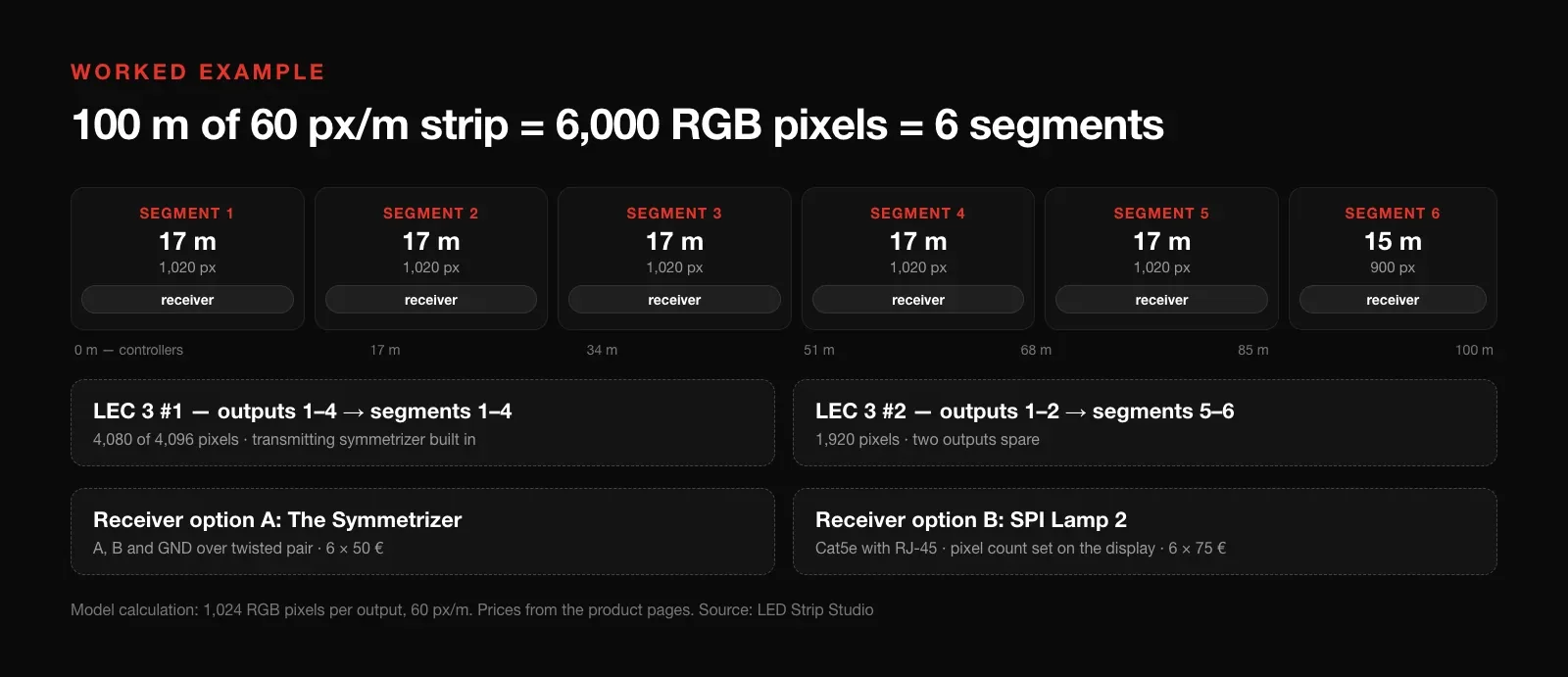
A standalone Symmetrizer converts TTL to differential and back. In LEC3 and SPI Matrix the transmitting side is built in, so the only extra hardware is a receiver at the strip end: a Symmetrizer or an SPI Lamp 2.
Turn it on with Enable symmetry for LEDs in the web configuration, run one twisted pair for A and B, and connect the unused wires to GND.
- Enable symmetry for LEDs in the web configuration
- Receiver needed only at the strip end
- About 20 m+ with ordinary power cable
- About 100 m+ per run with twisted pair such as Cat5e
- More than 500 m in total with The Symmetrizer
FAQ
Long-distance SPI questions
With symmetry enabled and a receiver at the strip end, the differential signal has been tested over more than 500 metres. Plan about 100 m or more per run on twisted pair such as Cat5e, or roughly 20 m with ordinary power cable. Full answer in Maximum LED Signal Transmission Distance.
Only at the strip end. The transmitting symmetrizer is built into LEC3 and SPI Matrix; switch it on with Enable symmetry for LEDs in the web configuration. More in Symmetrizer: Differential to TTL.
We recommend under 1 m from the controller to the first pixel. A TTL Signal Buffer typically extends a gap to 5–10 m.
Twisted pair such as Cat5e. Use one pair for A and B and connect the unused wires to GND. For a wiring example, see Long-Distance SPI Control in the Wiki. More in Choosing Cables for an LED Project.
Planning a Long Cable Run?
Book a free consultation and we'll help you plan the cabling and receivers for your installation.
Book a Free Consultation →