SPI is the signal that tells each LED what color to show. It works well over short distances, but over a long cable, it can get weak and noisy. Then pixels may flicker, freeze, or show the wrong colors. This guide explains the limits and the simple ways to go further.
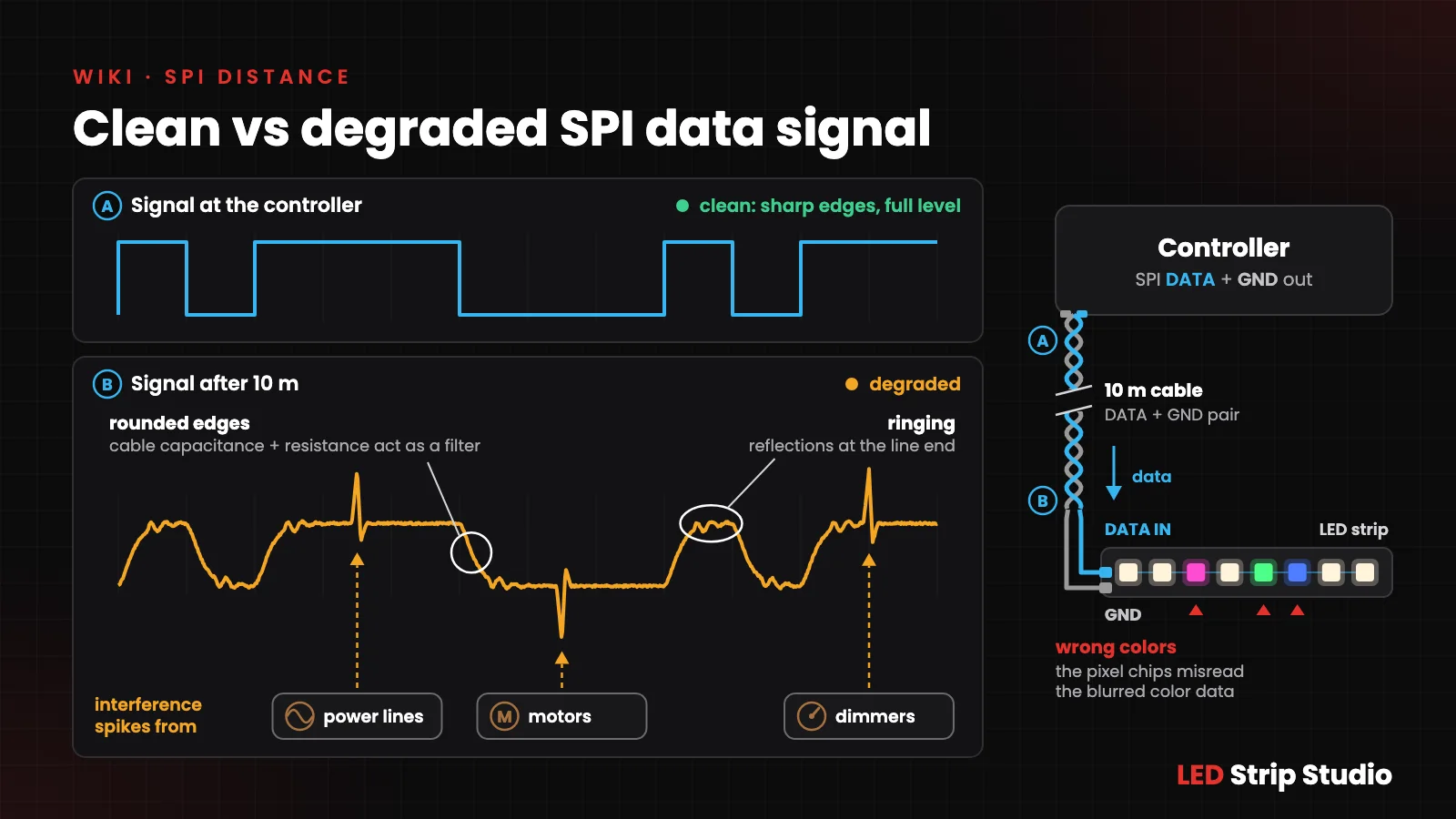
How far can an SPI signal run?
Keep it as short as you can. As a rough guide:
- Up to 1 meter: Works reliably.
- Around 5 meters: Often works, but check your setup.
- Around 10 meters: You will likely see noise and flicker, depending on the surrounding environment.
For the most reliable results, keep direct wires from the controller to the first pixel under 3 meters. Anything longer needs help from extra hardware.
How do I extend an SPI signal over a long distance?
For longer runs, use an extender. Here are the main options:
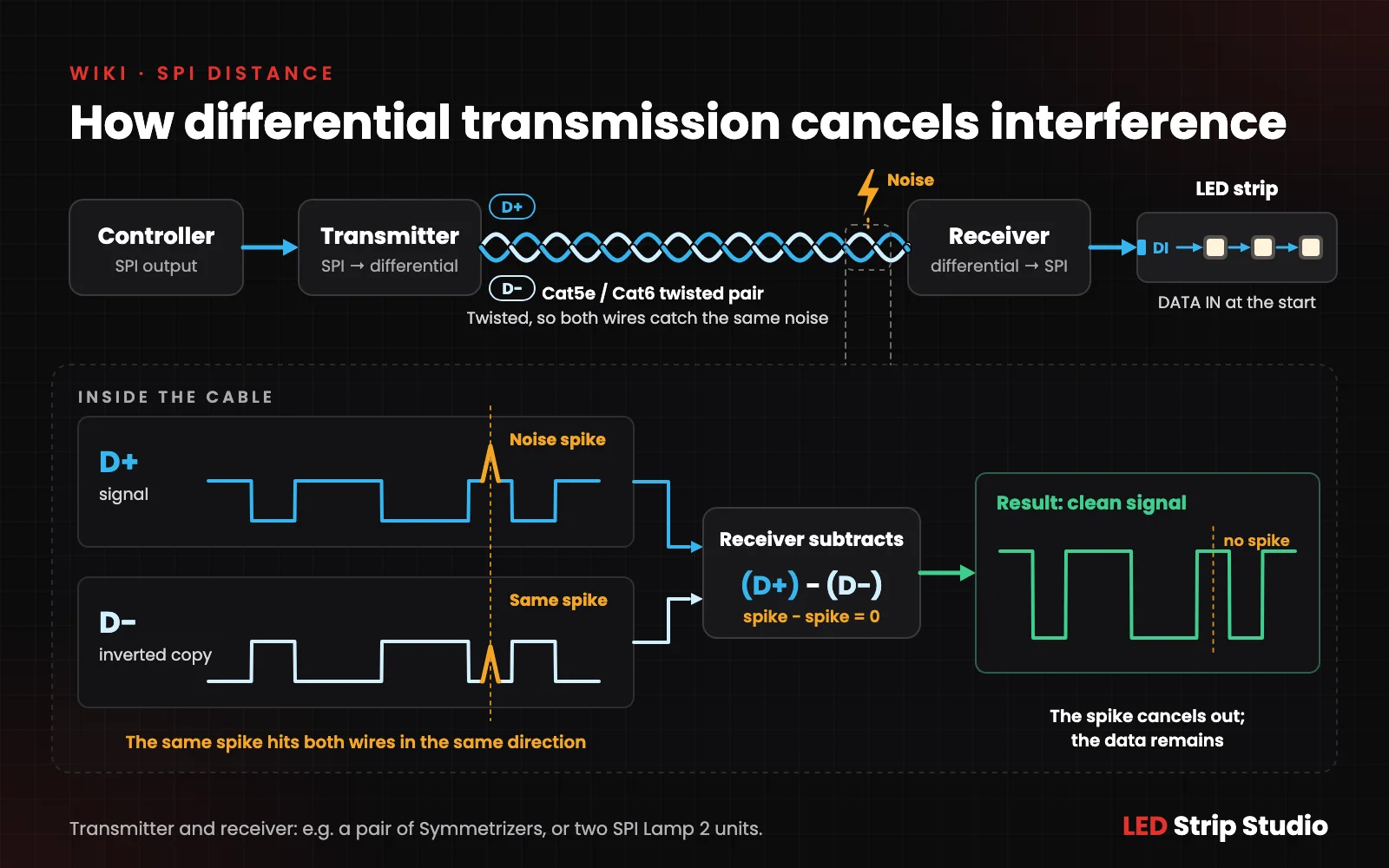
- Differential extenders (best for very long runs). These turn the signal into a stronger, noise-resistant form that travels over twisted-pair or Ethernet cable. Our Symmetrizer can carry data up to about 300 meters. The SPI Lamp 2 can split and extend signals over about 100 meters.
- Signal buffers (good for medium runs). A buffer boosts the signal. It is a simple, budget-friendly choice for distances of about 10 meters. See the next section.
- Better cable (a free improvement). Use shielded twisted-pair cable, such as Cat5e or Cat6. Put the data wire and a ground wire together as a twisted pair. The ground wire helps block noise.
When should I use a TTL signal buffer for SPI?
Use a TTL signal buffer when your run is between about 5 and 15 meters. It sits inline, between two sections of cable, and does three things:
- It reshapes the signal so the sharp on-and-off pulses are clean again.
- It boosts the signal back to full strength for the next section.
Our TTL signal buffer is a good fit for this job. For runs over about 10 meters, or where you need the most reliable result, a differential extender is the better choice.
Note that a TTL buffer cannot fix a signal that is already degraded. For example, with a 10-meter cable, simply placing a TTL buffer halfway along the run (at 5 meters) is not always sufficient. Even after just five meters, the signal may be affected by noise or suffer from attenuated rising and falling edges; in such cases, the buffer would need to be placed closer to the signal source.
Why does my LED strip flicker with 10 meters of SPI cable?
At 10 meters, the signal has usually faded and picked up noise from its surroundings. Long cables act like antennas for nearby power lines, motors, and dimmers. When the pixel chips receive a blurred signal, they misread the color data. The result is random flashes, frozen pixels, or sections that go dark.
Ways to fix it:
- Shorten the cable if you can.
- Keep it away from mains power cables about 15-30cm.
- Add a signal buffer or extender for longer runs.
- Use shielded twisted-pair cable. The twisted-pair cable should be used for every SPI connection.
- Check your ground. Make sure the controller, power supplies, and strips share one ground connection.
- Lower the clock speed on clocked strips such as APA102 or SK9822. Slower clocks are more forgiving over distance.
Can I use a dummy pixel to boost an SPI signal?
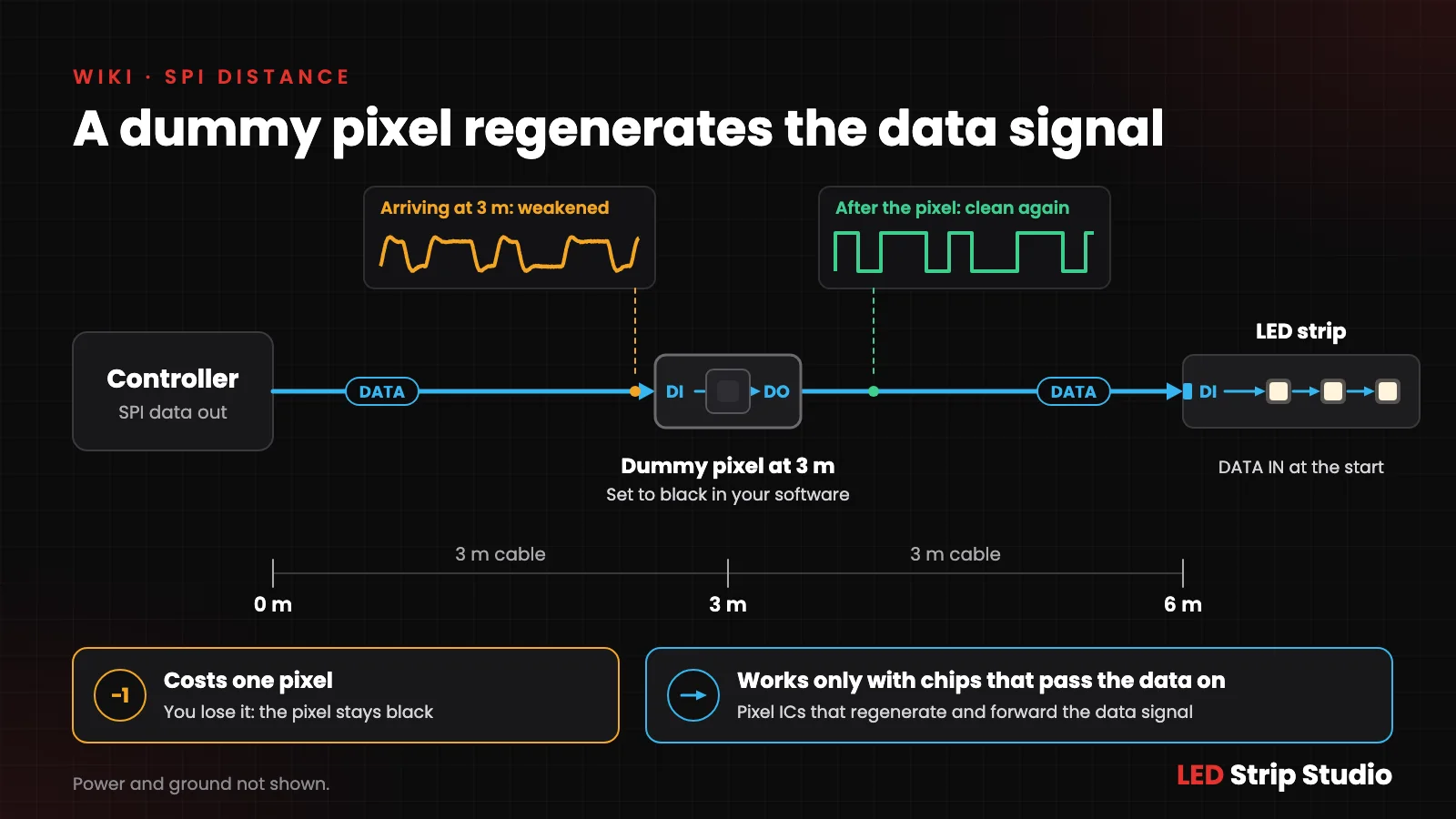
Yes, this is a quick, low-cost trick. Every pixel chip reads the incoming signal, cleans it up, and passes it on. So you can place one extra pixel in the middle of a long gap, for example, at the 3-meter mark of a 6-meter run. Set that pixel to black in your software, and it will quietly boost the signal for the rest of the run.
The trade-off is that you lose one pixel. For a permanent or professional setup, a buffer or extender is usually the better choice.
Our Recommendation: Keep SPI Signal Runs Short
There is one simple rule we always follow: keep SPI signal distances as short as possible.
Instead of pushing the signal to its limits, we prefer adding extra Symmetrizer or SPI Lamp 2 devices to the installation. This helps keep signal transmission reliable and reduces the risk of problems during operation.
There is always a trade-off. Spending a little more on hardware upfront can save you a lot of time, troubleshooting, and headaches later. When it comes to professional LED installations, reliability is worth the extra investment.
SPI Signal Distance: Quick Recommendation Guide
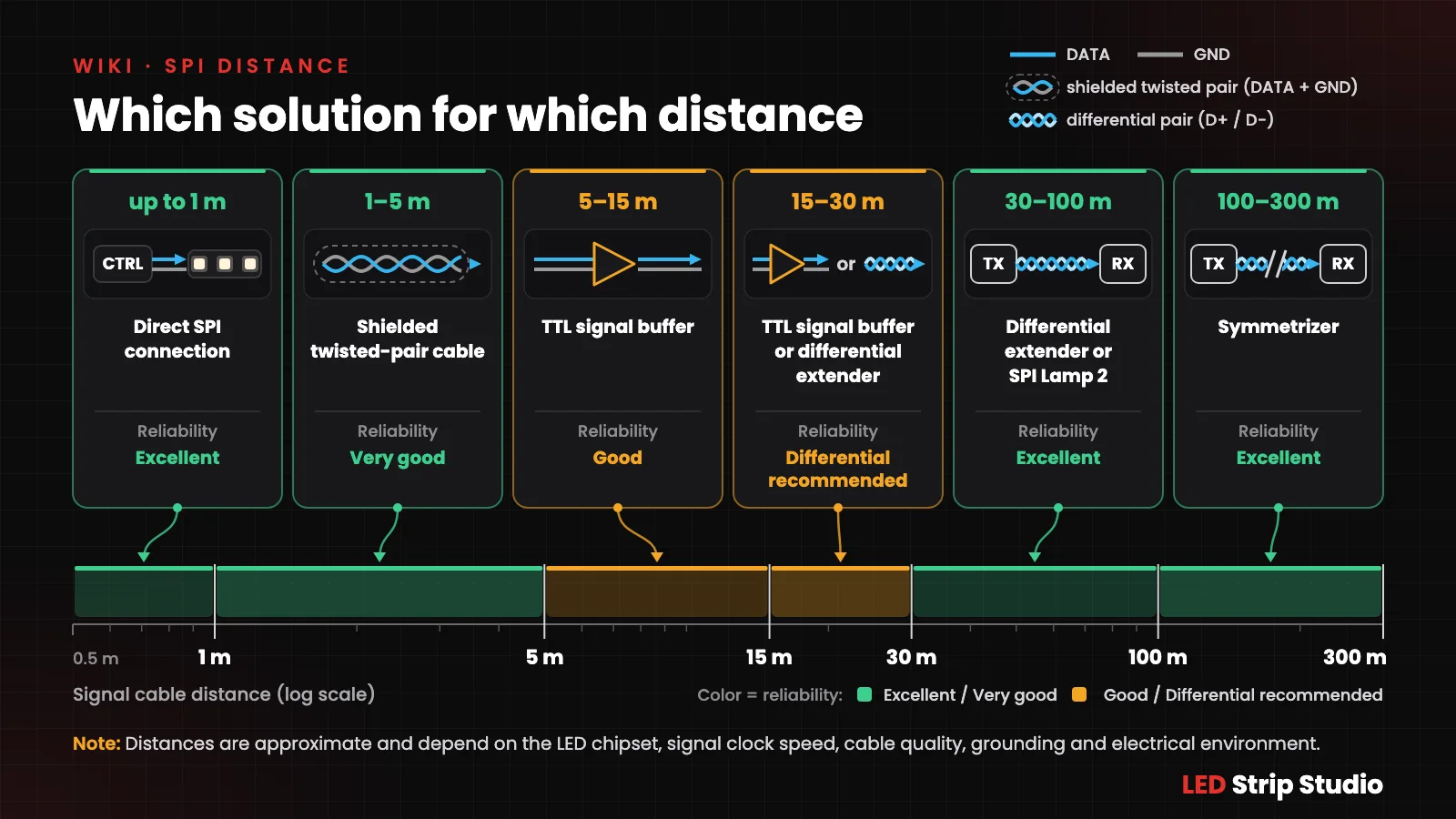
| Distance | Recommended solution | Reliability |
|---|---|---|
| Up to 1 meter | Direct SPI connection | Excellent |
| 1–5 meters | Shielded twisted-pair cable | Very good |
| 5–15 meters | TTL signal buffer | Good |
| 15–30 meters | TTL signal buffer or differential extender | Differential recommended |
| 30–100 meters | Differential extender or SPI Lamp 2 | Excellent |
| 100–300 meters | Symmetrizer | Excellent |
Important: These distances are approximate and depend on the LED chipset, signal clock speed, cable quality, grounding, and electrical environment. For professional installations, we recommend differential signal transmission for longer distances rather than relying on direct TTL connections.
Frequently Asked Questions
What is the maximum distance between an LED controller and the first pixel?
For the most reliable results, keep direct wires from the controller to the first pixel under 3 meters. Up to 1 meter works reliably, around 5 meters often works, and around 10 meters usually brings noise and flicker. Anything longer needs a signal buffer or extender.
Should I use a TTL signal buffer or a differential extender?
Use a TTL signal buffer for runs of about 5 to 15 meters, placed close enough to the source that the signal it receives is still clean. From about 15 to 30 meters a differential extender is recommended, from 30 to 100 meters use a differential extender or SPI Lamp 2, and from 100 to 300 meters the Symmetrizer.
How far can the Symmetrizer and SPI Lamp 2 carry an SPI signal?
The Symmetrizer can carry data up to about 300 meters. The SPI Lamp 2 can split and extend signals over about 100 meters. Both send the signal in differential form over twisted-pair or Ethernet cable.
Can a TTL buffer fix a signal that is already degraded?
No. A TTL buffer cannot fix a signal that is already degraded. With a 10-meter cable, placing the buffer halfway along the run is not always sufficient, because after five meters the signal may already be noisy or have slow rising and falling edges. Place the buffer closer to the signal source.
Which cable is best for a long SPI data run?
Shielded twisted-pair cable such as Cat5e or Cat6. Put the data wire and a ground wire together in one twisted pair, because the ground wire helps block noise.
How far should SPI data cables be from mains power cables?
Keep the data cable about 15 to 30 centimeters away from mains power cables. Long data cables pick up noise from nearby power lines, motors and dimmers.
Does a dummy pixel change my animation?
Only by one pixel, and it works only with pixel ICs that regenerate and forward the data signal. Set the dummy pixel to black in your software so it stays dark and only regenerates the signal for the rest of the run. For permanent or professional setups a buffer or extender is usually the better choice.
Summary
Keep SPI data runs as short as possible: up to 1 meter works reliably, around 5 meters often works, and around 10 meters you will likely see noise and flicker. For the most reliable results keep direct wires from the controller to the first pixel under 3 meters. For about 5 to 15 meters add a TTL signal buffer inline, placed close enough to the source that the signal is still clean; from 15 to 30 meters a differential extender is recommended; SPI Lamp 2 covers about 100 meters and the Symmetrizer about 300 meters over twisted-pair or Ethernet cable. Use shielded twisted-pair cable for every SPI connection, keep it about 15 to 30 cm away from mains cables and share one ground between controller, power supplies and strips.