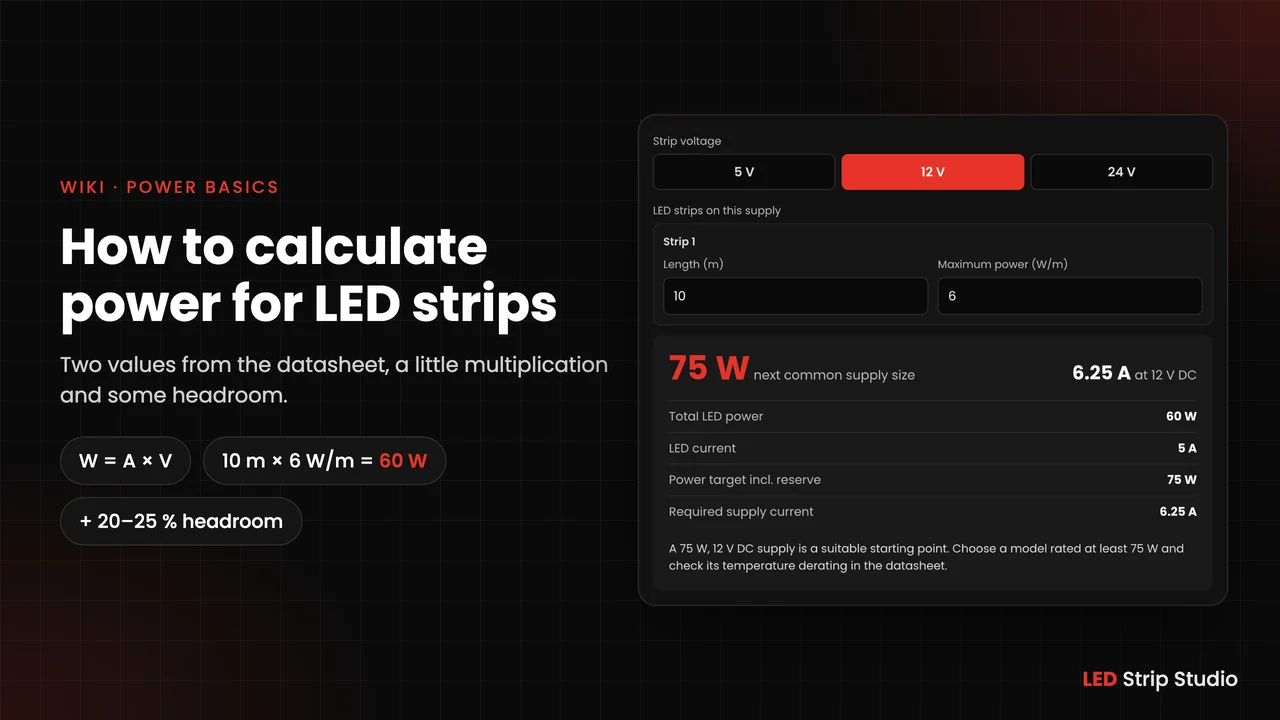
Calculating power for an LED installation is simpler than it looks. You need two values from the strip’s datasheet, a little multiplication, and a power supply with some headroom.
What do I need from an LED strip datasheet?
LED strip datasheets contain a lot of information about light quality, but for power you only need two values:
- Required voltage (typically 5V, 12V or 24V)
- Required power per meter of strip, measured in watts (W) or sometimes amperes (A)
With these two values you can work out how much power your installation needs and how many power supplies you’ll require.
How do I convert LED strip amps to watts?
Power supplies are often rated in watts, but strip datasheets sometimes list current in amperes. The formula is simple: W = A × V.
For example, if one meter of strip needs 0.5A and runs at 12V, multiply 0.5A by 12V to get 6W per meter. That’s the number you need for your calculation.
How many watts per meter does a 12V LED strip use?
For a 12V strip, multiply the current per meter by 12. A strip that draws 0.5A per meter uses 6W per meter. If your datasheet already lists watts per meter, you can skip this step.
How do I calculate power for an LED strip?
Here is a full example:
- Length of strip: 10 m
- Current per meter: 0.5A
- Voltage: 12V
Step 1: Watts per meter. 0.5A × 12V = 6W per meter
Step 2: Total power. 10 m × 6W = 60W
A 60W load means a 100W power supply is a sensible choice.
How much power do 10 meters of LED strip need?
Multiply the length of the strip by its watts per meter. For 10 meters at 6W per meter, you need 10 × 6 = 60W.
It’s always a good idea to leave some extra capacity, usually around 20%. In this case, you would need a power supply rated for at least 72W.
Since 70W power supplies are not very common, I would simply go with a 100W power supply. It’s better to have some extra capacity than to run your power supply at its maximum load.
How to use the pixel power calculator?
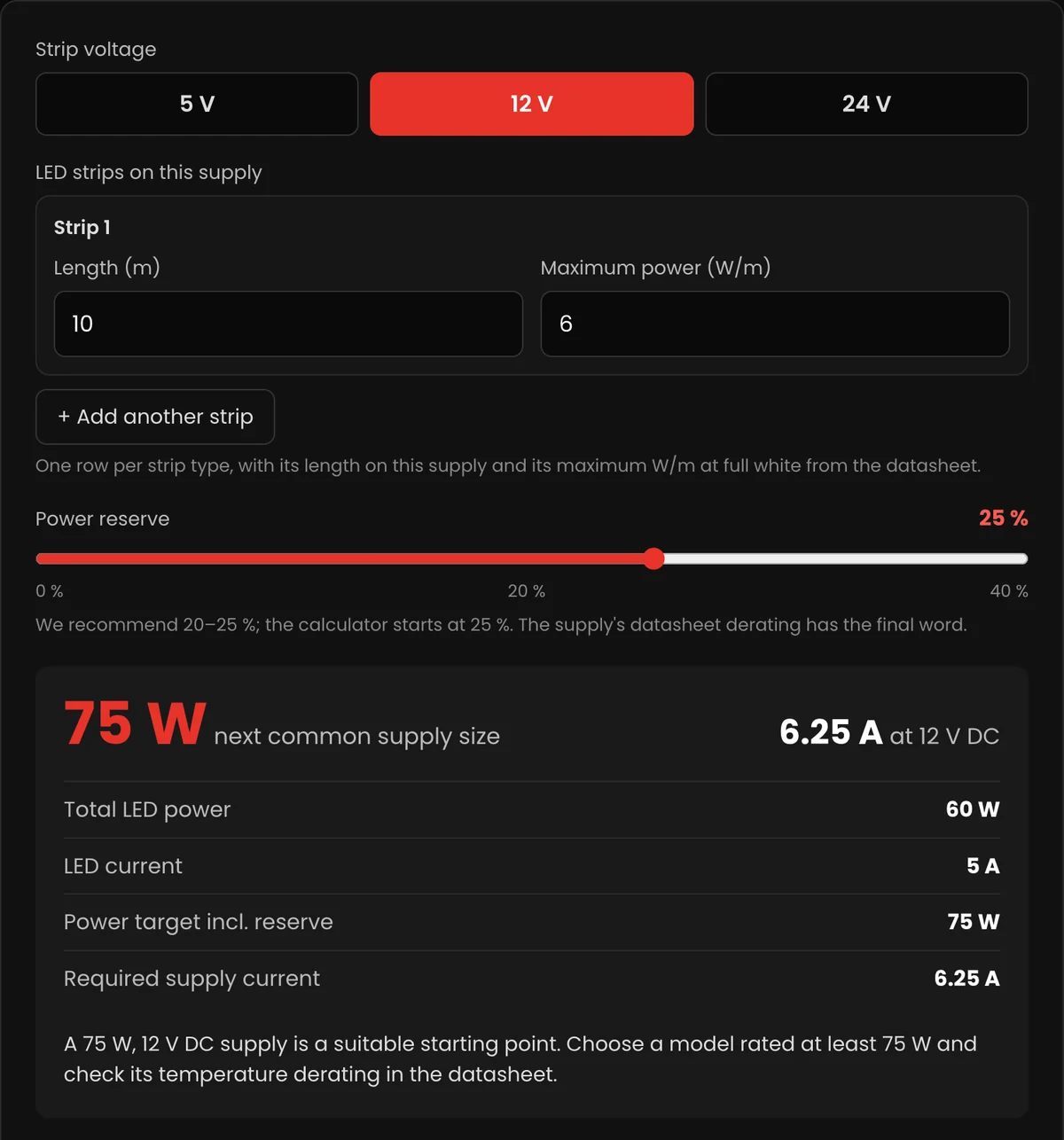
If you’d rather not do the arithmetic by hand, use our calculator:
- Enter the total number of meters of strip.
- Select the voltage (5V, 12V or 24V).
- Enter the power per meter in watts. For the example above, that’s 6W (0.5A × 12V).
The calculator then shows the total power required. It also recommends a power supply somewhat larger than that total, to allow for voltage drop in the cables.
What power supply do I need for WS2815 LED strip?
WS2815 strips are addressable, 12V strips. To size a power supply, look up the power per meter in the WS2815 datasheet, then multiply it by your strip length, following the same steps as above:
- Watts per meter from the datasheet: 8.64 W/m
- Total length: 10 m
- Total power: 8.64 × 10 = 86.4 W
For the full calculation, including recommended headroom, use the WS2815 power consumption calculator.
Which power supply for 24V LED strip?
The method is identical for 24V strips. Example: a 24V strip drawing 0.25A per meter uses 0.25A × 24V = 6W per meter. For 10 meters, that’s 60W, the same total as the 12V example, but with half the current flowing through the cables. Higher voltage often means thinner wiring over long runs.
Does this work for multiple LED segments?
Yes. Calculate the watts for each segment separately, then add them together. If you run three segments of 10 meters at 6W per meter, the total is 3 × 60W = 180W, so you need a power supply rated for at least that much, with headroom.
Frequently Asked Questions
How do I convert watts back to amps?
Divide the watts by the voltage: A = W / V. A 60 W load at 12 V draws 5 A, so the supply must deliver at least 5 A, plus headroom.
Should I use the typical or the maximum power from the datasheet?
The maximum, at full white and full brightness. Most content uses less, but the power supply has to cope with the moment a scene does run at full white.
Does a 24 V strip use less power than a 12 V strip?
Not necessarily. Two strips with the same W/m use the same power; the 24 V strip just draws half the current. 60 W is 5 A at 12 V but only 2.5 A at 24 V.
Is a power supply bigger than calculated a problem?
No. The strip only draws the power it needs, so a 100 W supply on a 60 W load is fine. Just keep the voltage the same as the strip's and fuse every branch for its own cable.
How much LED load can a 100 W supply carry?
With 20 % headroom, up to about 83 W of strips (100 W / 1.2), as long as they all run at the supply's voltage.
Summary
To calculate LED strip power, take two values from the datasheet: the voltage and the power per meter. If the datasheet lists amps, convert them with W = A × V, then multiply the watts per meter by the strip length. A 10 m, 12 V strip at 0.5 A per meter uses 6 W per meter and 60 W in total. Add about 20 % headroom, which gives 72 W, then pick a common size above that: 75 W, or 100 W for extra margin.