Technology
How Do You Make a Christmas Shop Window Stand Out With Addressable LEDs?
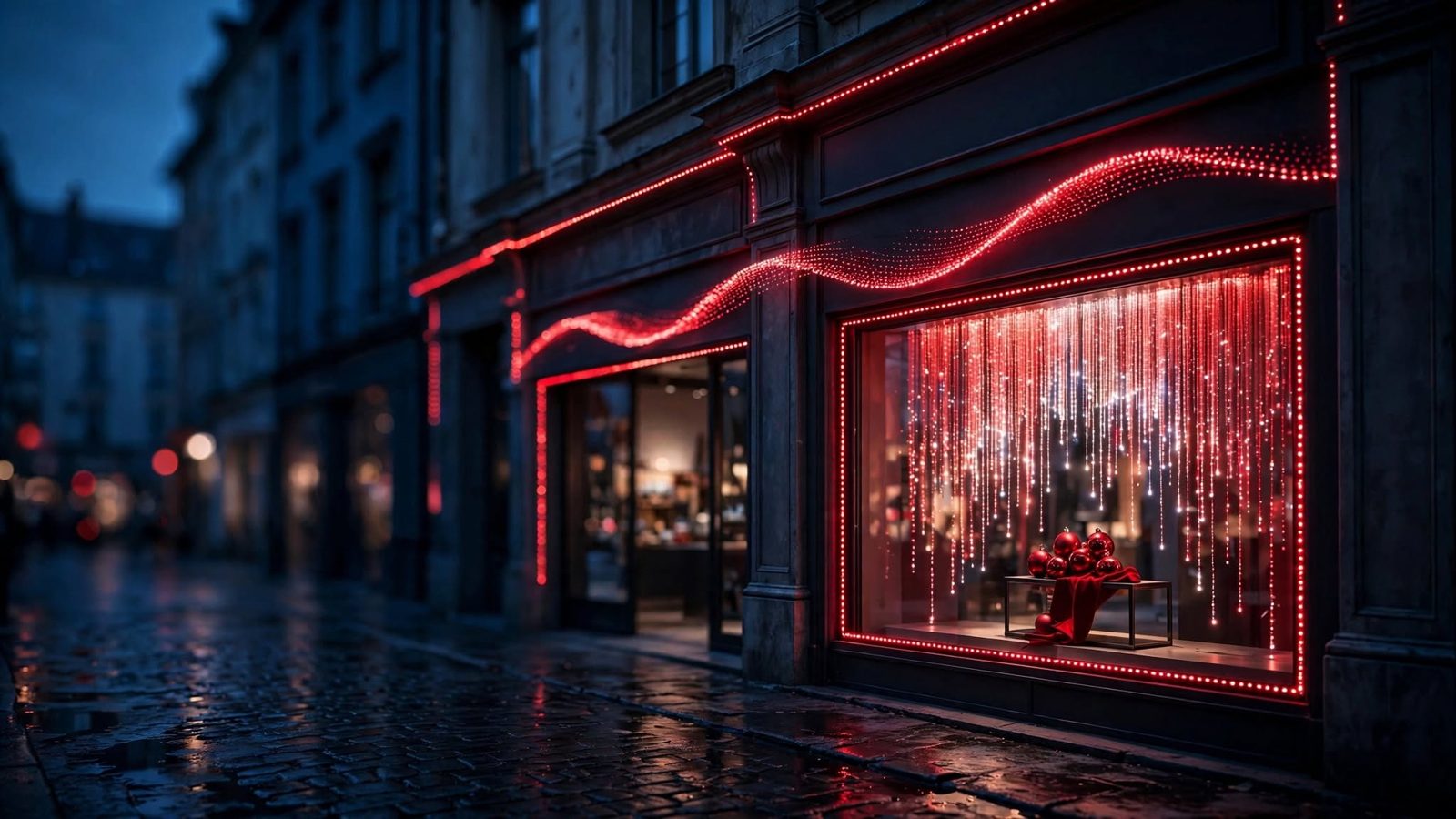
A Christmas window is judged from across the street, in a few seconds, by people who were not planning to stop. Static warm-white strings look festive, but every shop on the street has them.
- Plan from the street: measure every run, pick a pixel density, and turn it into a pixel count.
- Keep the electronics indoors: controllers and power supplies stay inside, only cables and strips go out.
- Choose by size: Reactivo 2 for one window, SPI Matrix or LEC3 for a window plus facade.
- Run it without a PC: design once, play from the SD card.
- Reuse it all year: new content for every season, the same wiring.
Why Use Pixel LED on a Window or Facade?
Addressable pixel LED lets the same outline move: snow falling down the glass, a logo drawn in light, a slow wave of brand colour across the whole facade.
The difference is control. Every pixel is a point you can address, so one installation can run a calm warm scene in the afternoon, a busier show after dark, and switch itself off at closing time.
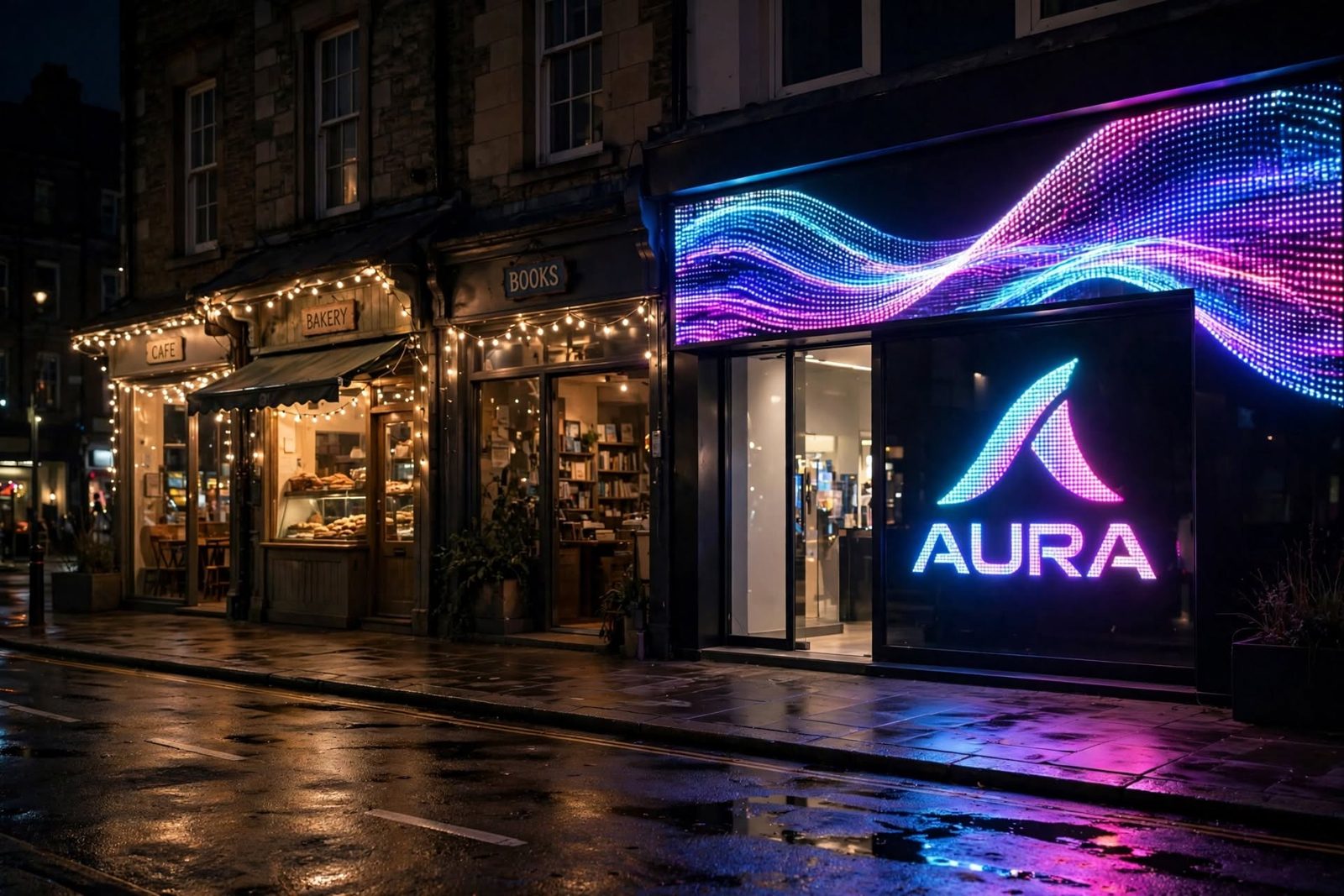 Warm-white strings on every shop, and one facade that moves. Illustration, not a photograph of a specific project.
How Do You Plan the Installation Before You Buy?
Start from the street, not the catalogue. Stand where shoppers will stand and decide what they should see: an outline of the window, a curtain of light behind the glass, lines along the facade edges, or a logo. Then turn the idea into a pixel count. That number decides the controller, the power supplies and the cable plan.
- Measure every run. Window perimeter, facade edges, cornices, the height of a tree or a column.
- Pick a density for the viewing distance. Seen from across the street, 30 pixels per metre already reads as smooth motion. Behind glass at arm’s length, 60 per metre looks more refined.
- Multiply and add a margin. A 6 × 3 m window outlined at 60 pixels per metre is 18 m × 60 = 1,080 pixels. That is just over one controller output, which handles up to 1,024 RGB pixels.
- Group the runs by where cables can go. Each output should start close to its first pixel.
- Fix the dates. Most shops want the lights on in the last week of November. Work back from that: content, test install, final mounting.
Should You Choose RGB or RGBW Strips?
RGBW strips give a cleaner warm white, but they cut the count per output from 1,024 to 768 pixels. For a window that spends most of the season in warm white, that trade is usually worth it.
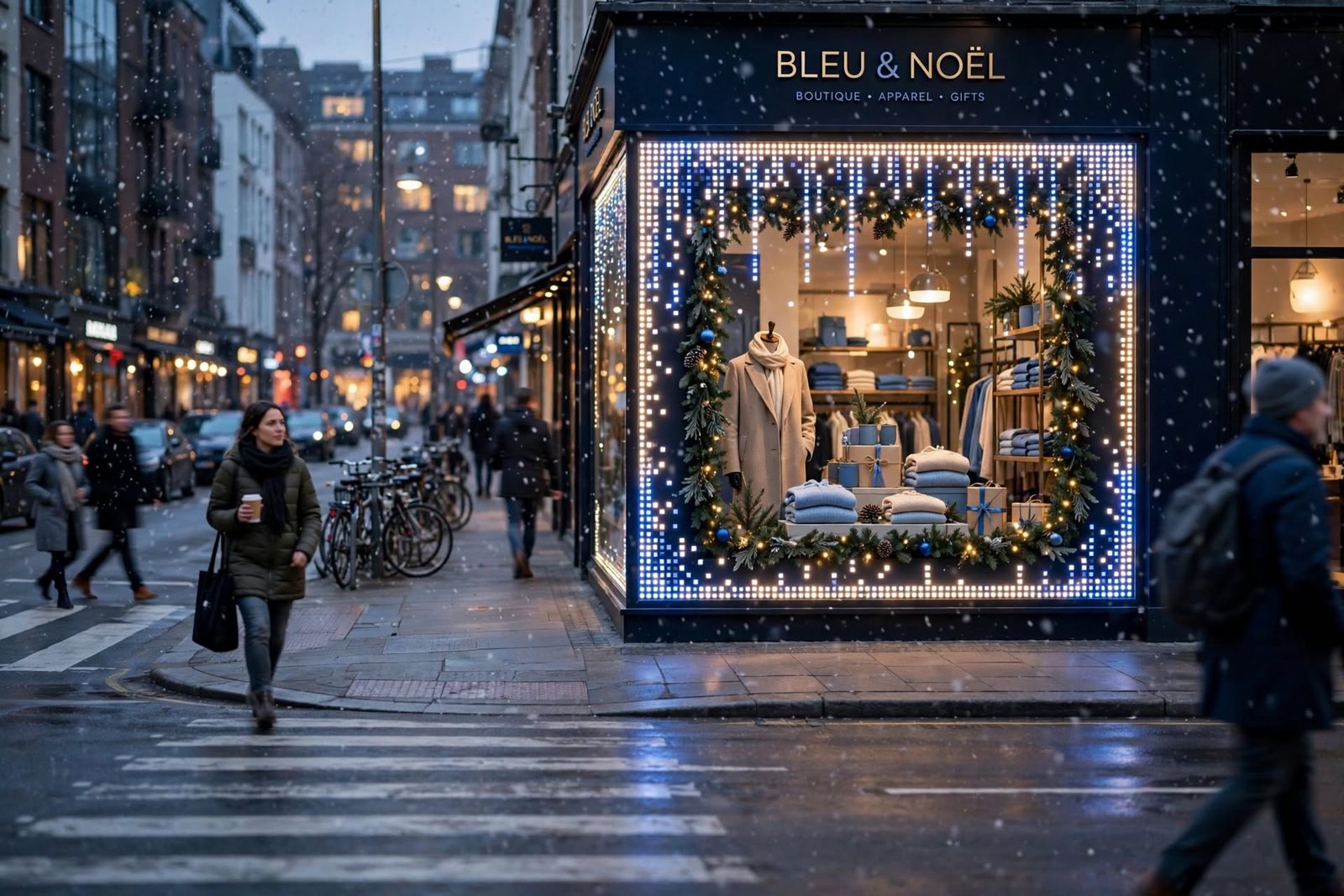 A window outline at a higher density reads as a moving frame from across the street. Illustration, not a photograph of a specific project.
What Changes When the LEDs Go Outside?
The pixels go outside; the electronics stay in.
Where Do the Controller and Power Supply Go?
Keep controllers and power supplies indoors. Our controllers ship in indoor-rated enclosures. Put them in the shop, a back office or a weatherproof cabinet, and run only cables and outdoor-rated (IP65 or higher) strips outside. Seal every cut end and leave drip loops so water runs away from joints.
How Do You Bring the Data Out to the Facade?
Pixel data degrades after about 3 m of plain cable. The Symmetrizer carries it over ordinary twisted-pair cable, about 100 m and more per hop on Cat5e. One pair costs €100 excl. VAT and saves a site visit in December.
How Do You Keep the Far End Bright?
Long runs dim and shift colour towards the far end. Inject power at both ends and in between, and size supplies with headroom. 12 V and 24 V strips carry power further than 5 V ones.
Which Controller Fits a Window or a Facade?
| Controller | Best for | What it gives you |
|---|---|---|
| Reactivo 2 | One shop window, up to 1,024 RGB pixels | Wi-Fi or Ethernet, LSS Remote app, playlists and scheduling, inputs for buttons and sensors. €230 excl. VAT with accessories. |
| SPI Matrix | A window plus facade, or several windows | Four outputs, up to 4,096 RGB pixels, Art-Net, sACN or standalone from SD |
| LEC3 | Large permanent facades | Four outputs, up to 4,096 RGB pixels, with a lifetime software licence |
| Xmas Dimmer | Your existing warm-white strings | Puts up to eight of them on DMX, so they follow the same show. €260 excl. VAT. |
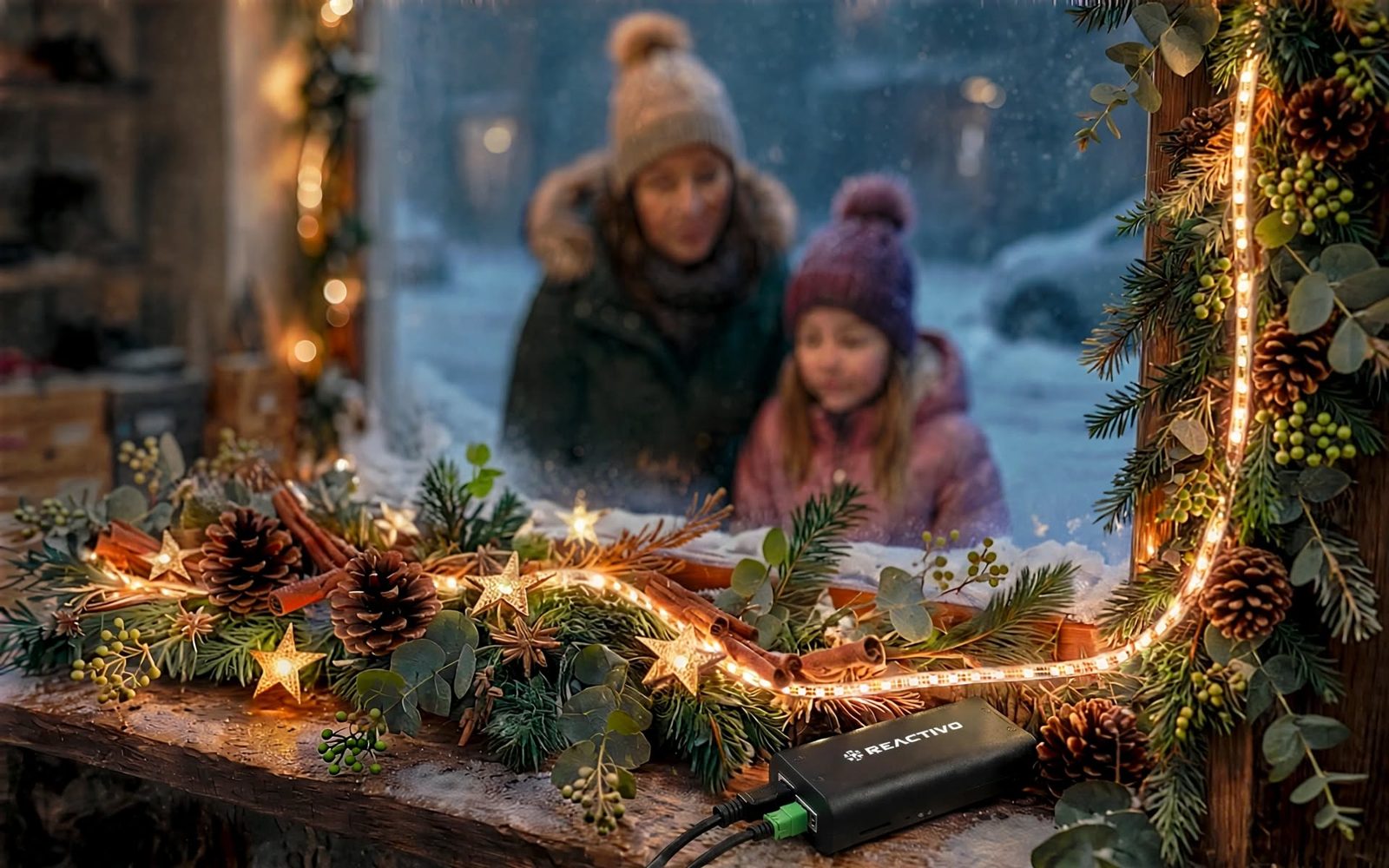 One Reactivo 2 behind the glass runs the whole window. Illustration, not a photograph of a specific project.
One controller for one shop window: Wi-Fi, app control and SD card playback
How Do You Run the Season Without a PC on Site?
Design once on a laptop, then let the controller play from its SD card.
- Map the window and facade in LED Strip Studio 4.
- Build three or four scenes, not thirty: calm warm white by day, a livelier show after dark, a highlight for late openings, a slow fade-out at closing.
- Export them to the SD card. One card holds up to 255 effects.
- Decide who switches what: the LSS Remote app, a button by the till, or a DMX cue. Reactivo 2 can also start the evening show at dusk with a light sensor.
- Sync split installations: one controller as Master, the rest as Slaves.
- Unplug the laptop and test a full power cycle before handover.
What Happens to the System After Christmas?
It keeps working. The controllers, strips and mapping are not Christmas decorations; they are a lighting system you own all year.
- New content, same wiring. Open the archived LED Strip Studio 4 project, create a new effect and export it to the SD card. Nothing on the facade has to be touched.
- Every season and campaign. January sales, Valentine’s Day, Easter, summer, Black Friday or a product launch in your brand colours.
- Events and evenings. Late openings, store parties or a show that reacts to music.
- Warm-white strings too. Xmas Dimmer also dims festoon lights and Edison bulbs for terraces, restaurants and weddings.
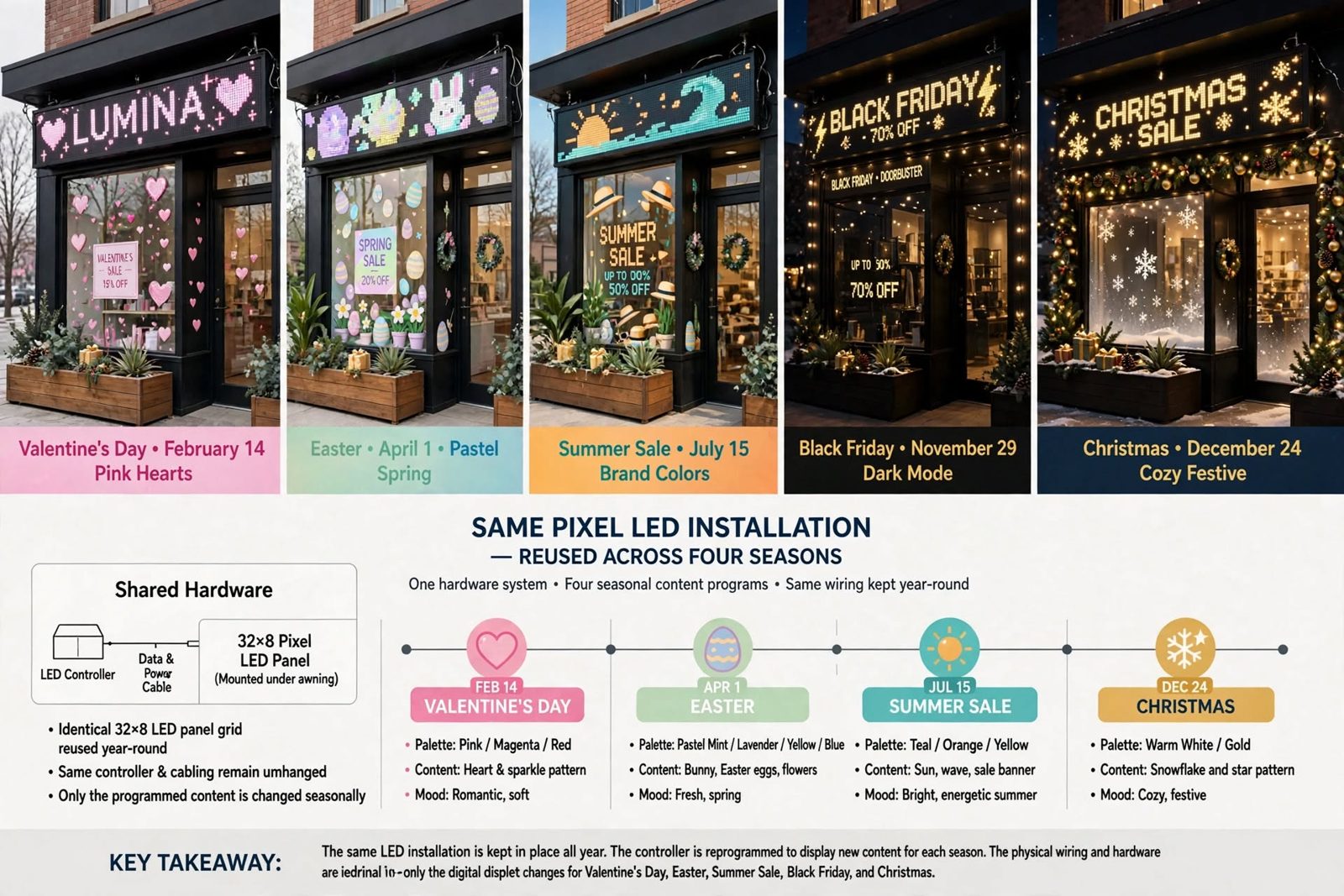 One installation, five seasons: only the content on the SD card changes. Illustration, not a photograph of a specific project.
You buy the hardware once, and every new season costs only an afternoon of content work.
Which Mistakes Cost You the Season?
- A controller mounted on the outside wall.
- A long plain data cable to the first pixel.
- Power fed from one end only.
- Too many scenes nobody knows how to choose from.
- A PC left on site to start the show.
- Ordering in December.
Planning a Christmas window or facade? Book a free consultation and we will size the pixels, power and cabling with you before you order. If you would rather hand over the whole job, LSS Lab designs and builds it turnkey.
Summary
Plan a pixel LED shop window from the street: measure every run, pick 30 or 60 pixels per metre, and turn it into a pixel count. Keep controllers and power supplies indoors, carry the data out with a Symmetrizer and feed power along every run. Reactivo 2 fits one window, SPI Matrix or LEC3 a window plus facade, and Xmas Dimmer adds your existing warm-white strings. Design once in LED Strip Studio 4, play from the SD card, and reuse the same installation for every season after Christmas.