


Description
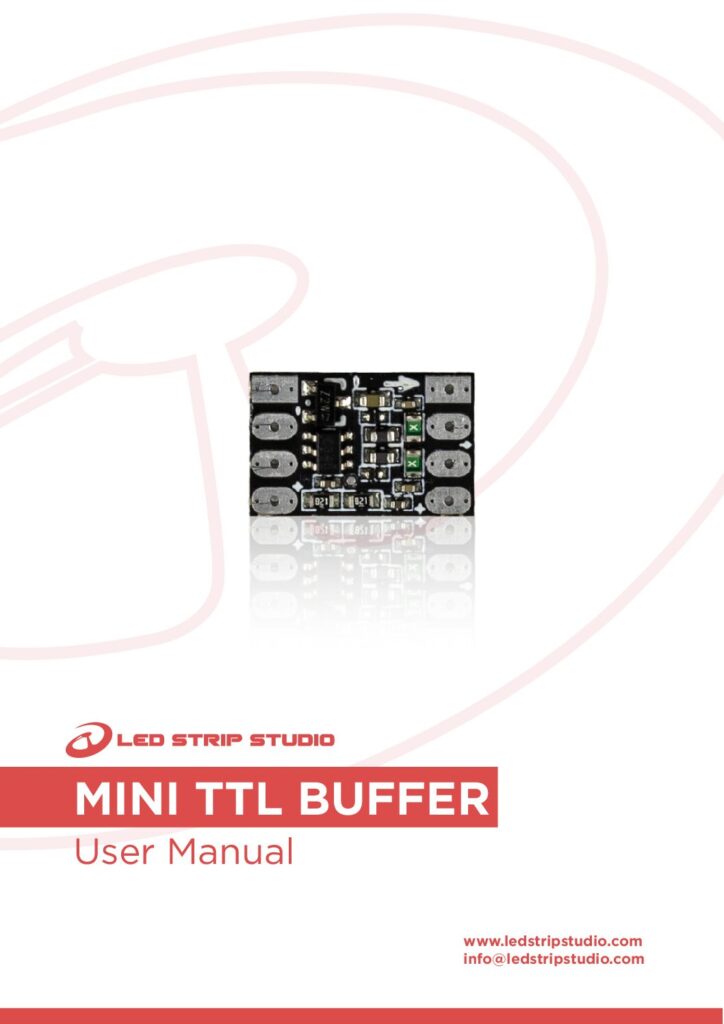
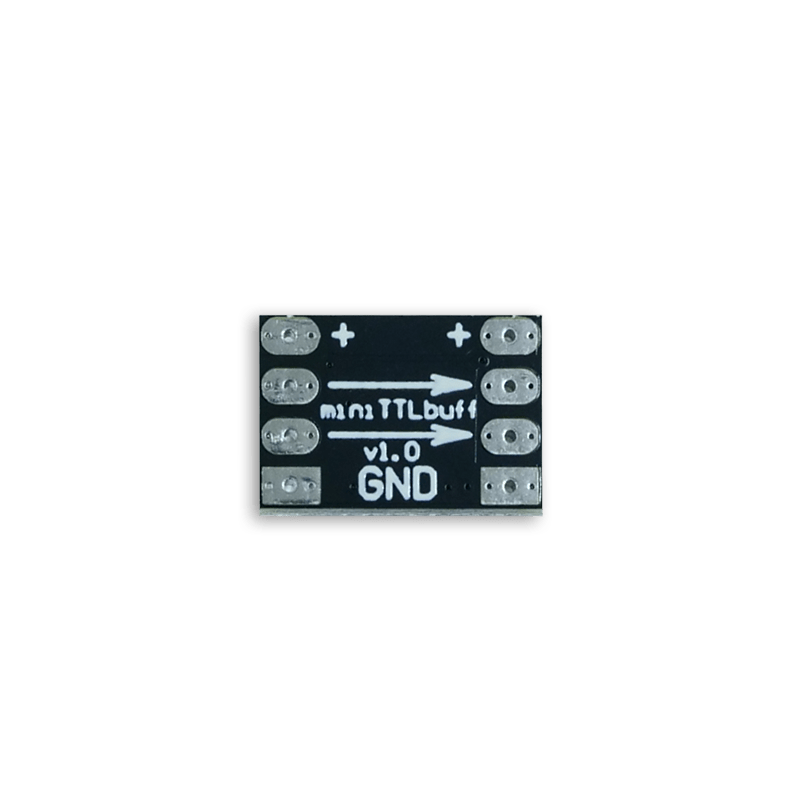
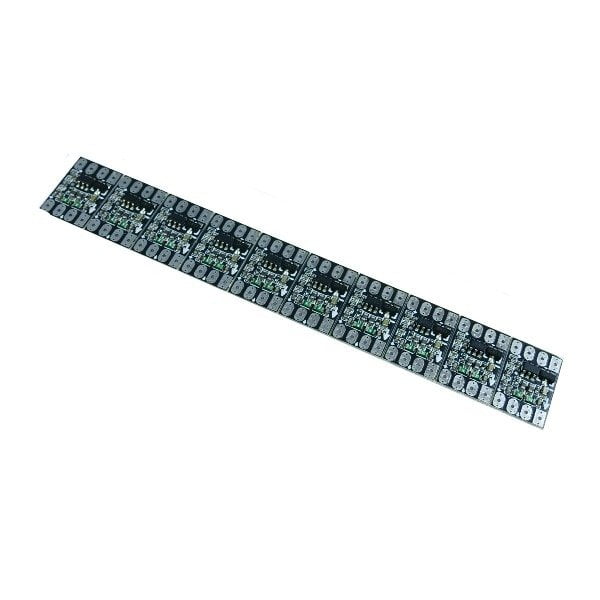
The Mini TTL Signal Buffer regenerates the data signal on its way to your 12V digital addressable LED strips, so the cable between the controller and the next pixel can be longer. Two uni-directional channels on a board of just 10 × 15 × 2.5 mm, with solder pads instead of connectors. Price is per pack of 10 units.
What does the Mini TTL Signal Buffer do?
A TTL data line does not travel well. Every extra metre of cable adds capacitance, the pulse edges grow slower and rounder, and at some point the first pixel reads noise instead of a frame. Flickering, wrong colours and a strip that only behaves when you touch the cable all start here.
The buffer takes that tired signal in and sends a clean, full-level copy out. Drop one in at the far end of a long run, or chain several along a very long one, and the pixels see the same crisp signal the controller sent.
Two independent channels on one tiny board
Each side carries two data lines, DATA1 and DATA2. One module therefore handles two separate strip runs leaving the same point, instead of asking you to fit two devices where there is barely room for one.
One direction only
Data enters on the IN side and leaves on the OUT side, so wire it that way round. The module is a repeater sitting in the line between controller and pixels — it does not split a signal and it does not convert between protocols.
How small is the mini TTL signal buffer?
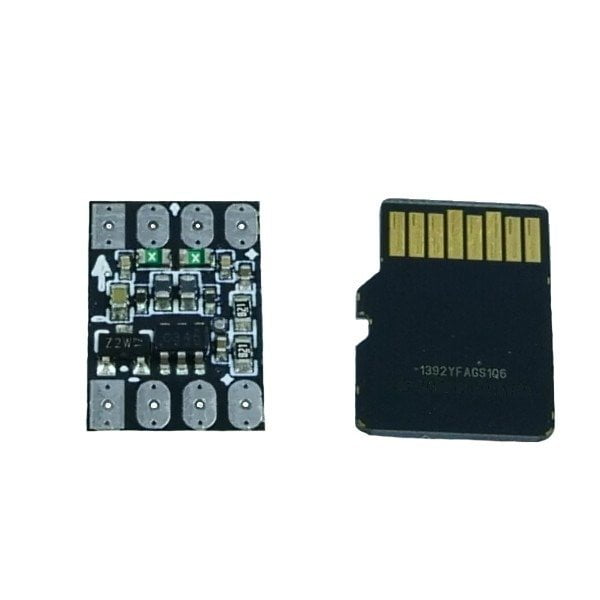
10 × 15 × 2.5 mm and about one gram. That is small enough to disappear inside an aluminium profile, a strip joint, a diffuser channel or the back of a fixture, which is the whole point of the mini version: you can put the buffer exactly where the signal needs help, not where a housing happens to fit.
Soldered in, not plugged in
Both sides use solder pads of 1.8 × 3 mm on a 2.5 mm pitch — the same spacing as most addressable strip pads, so it joins the run the same way a strip-to-strip joint does. There is no terminal block and no plug, which is what keeps the board this small and the joint this flat. Plan for a soldering iron on site.
Which voltage does the mini TTL signal buffer run on?
12 V DC, matching 12V pixel systems directly. The module itself draws 0.03 A and 0.36 W, so it adds nothing meaningful to your power budget.
Power travels with the data
Each side carries GND, DATA1, DATA2 and +12V together, so a single four-wire cable feeds the next section of the installation. The board passes up to 2 A through, and that figure is your limit — for a longer or brighter section, inject power locally at the strip and let the buffer handle the data.
What keeps the signal clean?
The module accepts TTL-like levels with a low range of 0 to 1 V and a high range of 3.5 to 5 V, and drives a tighter 0 to 0.7 V low with the same 3.5 to 5 V high. Maximum frequency is 800 kHz, which covers the usual 800 kHz addressable protocols.
An output filter that limits the slew rate
The output stage deliberately softens its edges instead of switching as hard as it can. Gentler edges mean less ringing and less radiated noise on a long cable — useful in trusses and profiles where data and power run side by side.
No input or output protection on this version
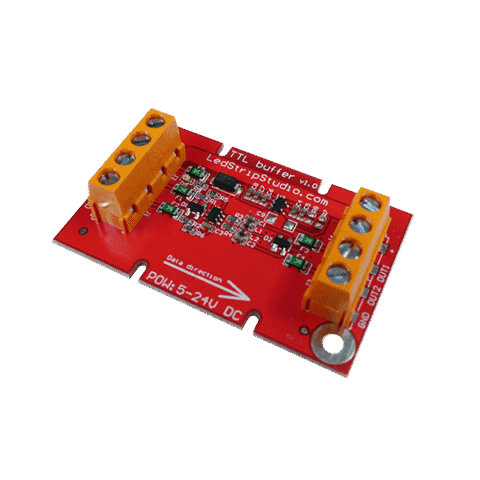
The mini board leaves the protection circuits out to stay this small. Get the polarity right, keep it on 12 V, and do not use it as a firewall between a controller and a suspect line. Where a run is exposed to surges or field wiring mistakes, use the full-size TTL Signal Buffer instead: it has protection on both sides, screw terminals, 5 to 24 V DC and 5 A pass-through.
Where does the mini TTL signal buffer belong?
Anywhere the distance beats the signal and there is no room for a box: LED profiles along a facade or a ceiling line, stage and club fixtures, LED screens built from many short segments, and any layout where the controller lives far from the pixels. It pairs with LEC 3, SPI LED Controller and REACTIVO 2, and complements THE SYMMETRIZER, which converts to a differential pair for the really long hauls. Ten pieces per pack covers every problem spot in the job with a few left in the spares box. Ask our support team if you are not sure how many your run needs.